Auto logout in seconds.
Continue Logout

Healthcare procurement is under increasing strain as financial pressure collides with growing operational demands. To understand how leaders are responding, Advisory Board surveyed 102 health system supply chain and executive leaders for our 2026 state of healthcare procurement survey. The findings show procurement becoming a more strategic role, with decisions shaped by reliability, scale, and long‑term viability — beyond short‑term cost considerations.
Top procurement challenges and objectives
Rising costs rank as the top challenge procurement leaders expect in 2026, driven by ongoing tariff uncertainty, margin pressure, and the risk of funding cuts. In response, leaders are moving beyond blunt cost-cutting toward more deliberate strategies that protect operational performance while maintaining financial discipline. They’re focusing on reliable products, greater standardization, stronger supply chain resilience, and better inventory management to reduce waste and variability.
Key insights shaping healthcare procurement in 2026
Insight 1: Health systems balance margin pressures with imperatives to maintain quality for patients and staff
Despite ongoing margin pressure, procurement leaders continue treating quality as nonnegotiable. As organizations make tough purchasing decisions, leaders are setting clear guardrails to protect patient outcomes and staff experience. More than half of respondents (52%) rank ensuring product quality among their top supply chain objectives, underscoring that financial discipline cannot come at the expense of reliability or performance.
60%
Of leaders cite “rising costs” as one of their top three supply chain challenges
Insight 2: Standardizing purchasing processes is just as important as standardizing vendors and SKUs
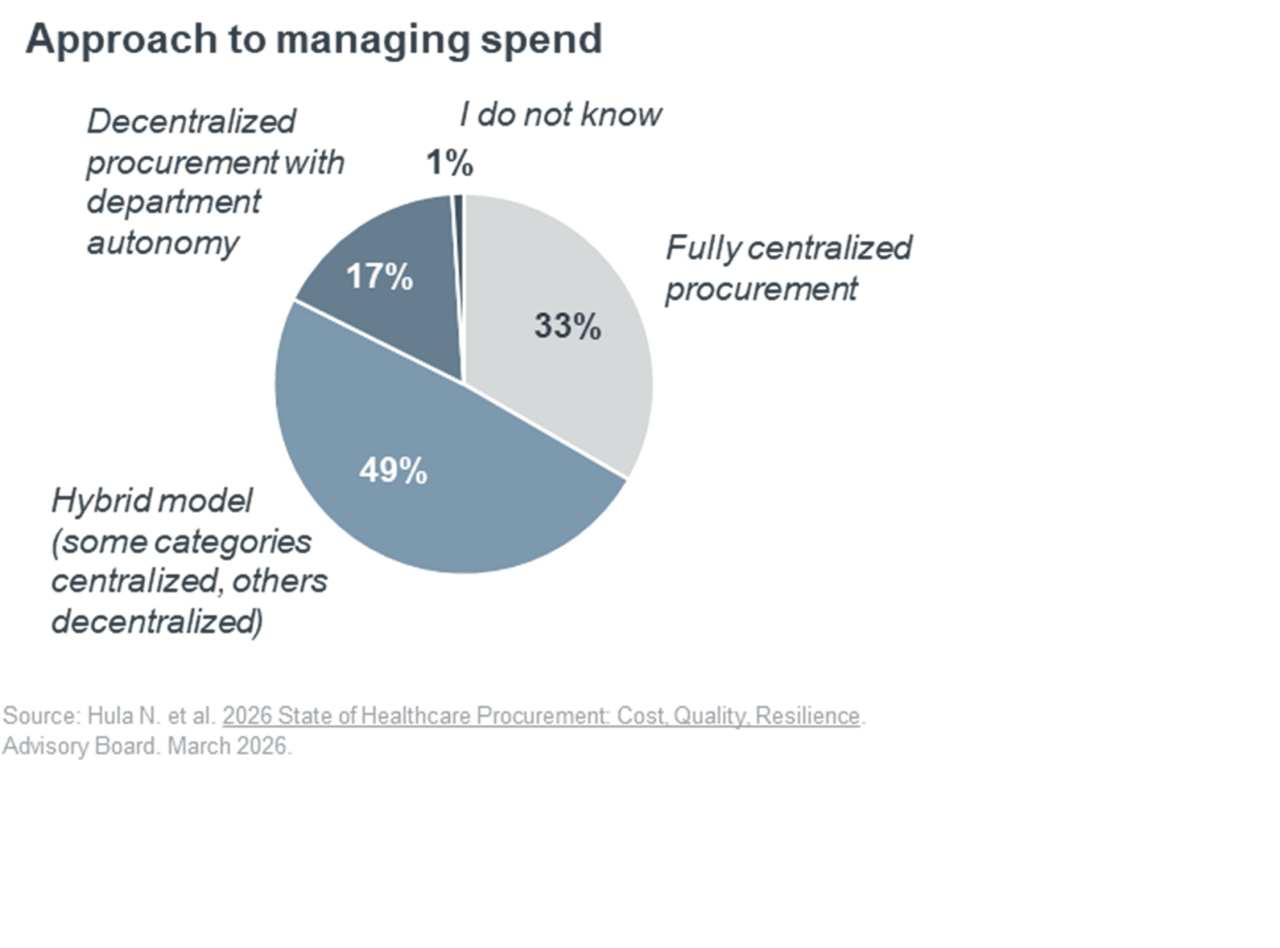
Health systems have captured many early gains from vendor and SKU consolidation, but leaders now see process standardization as the next opportunity for impact. Even highly disciplined organizations report variation purchasing across sites, departments, and categories, limiting savings and visibility. In fact, 62% of respondents cite controlling rogue spend as a top challenge, reinforcing that consistent purchasing workflows matter just as much as much as which vendors or products are under contract.
Insight 3: Resilience efforts focus primarily on internal optimization
Rather than relying solely on supplier diversification, health systems are strengthening supply chain resilience by tightening internal operations. Leaders are investing in better forecasting, analytics, and inventory discipline, with 36% prioritizing supply chain reliability when selecting partners. These internally focused efforts help organizations improve preparedness and continuity without materially increasing costs.
39%
Of leaders cite inventory optimization as a top supply chain objective in 2026
Insight 4: Environmental sustainability must be paired with financial sustainability
Environmental sustainability remains a priority for procurement leaders, but only when it supports financial performance. As margin pressure intensifies, organizations are moving away from stand‑alone sustainability initiatives and toward efforts that reduce waste, improve efficiency, and lower total cost of ownership. Leaders increasingly view sustainability as most effective when it aligns with core supply chain goals, reinforcing that environmental progress must also deliver operational and financial value.
21%
Of leaders view sustainability as a top supply chain objective in 2026, compared to 31% in 2025
Insight 5: Early AI adoption in procurement focuses on low-risk use cases
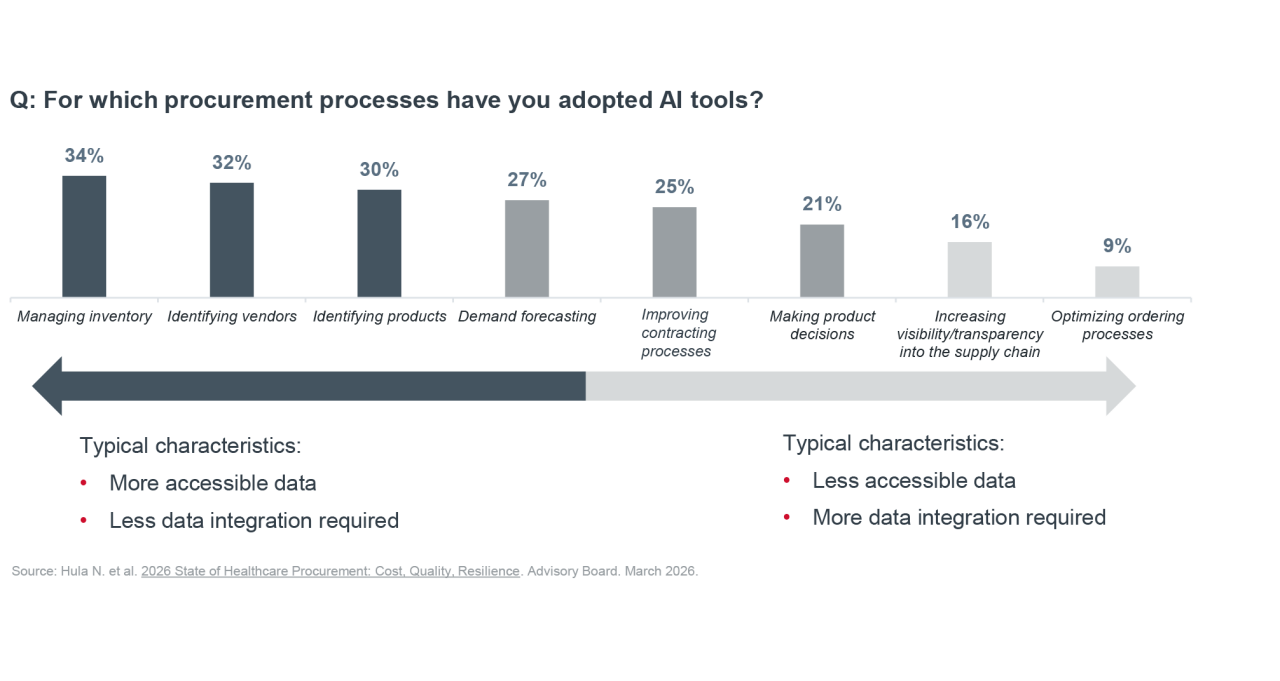
Health systems are approaching AI adoption in procurement cautiously, focusing first on low‑risk, high‑value use case over broad transformation. Early applications include inventory management and product or vendor identification that rely on accessible data and limit operational risk. This measured approach allows organizations to build confidence, strengthen data foundations, and demonstrate value before expanding AI’s role in more complex purchasing decisions.

As healthcare supply chain leaders face rising costs and margin pressure, they need more than products—they need a partner that drives measurable value. Staples Business helps organizations standardize purchasing and processes, improve visibility, and reduce total cost of ownership with reliable fulfillment, accurate order management, and next-day delivery to over 98% of the U.S.
As a complete non-clinical solutions partner, we provide furniture, EVS, breakroom, print, marketing, and tech, enabling vendor consolidation and simpler indirect spend management. Through data-driven insights and demand management strategies, we help forecast usage, reduce variation, optimize inventory, and prevent overstocking. SKU rationalization and sustainable packaging solutions further help control costs and strengthen supply chain resilience, so health systems can stay focused on delivering exceptional patient care. Learn more here.
This report is sponsored by Staples, an Advisory Board member organization. Representatives of Staples helped select the topics and issues addressed. Advisory Board experts wrote the report, maintained final editorial approval, and conducted the underlying research independently and objectively. Advisory Board does not endorse any company, organization, product or brand mentioned herein.
To learn more, view our editorial guidelines.

This report is sponsored by Staples. Advisory Board experts conducted the underlying research independently and objectively.

Emily Schmidt
Senior writer and editor, Sponsorship
Posted on April 06, 2026
Updated on April 06, 2026

Don't miss out on the latest Advisory Board insights
Create your free account to access 1 resource, including the latest research and webinars.
Want access without creating an account?
You have 1 free members-only resource remaining this month.
1 free members-only resources remaining
1 free members-only resources remaining
You've reached your limit of free insights
Become a member to access all of Advisory Board's resources, events, and experts
Never miss out on the latest innovative health care content tailored to you.
Benefits include:
Unlimited access to research and resources
Member-only access to events and trainings
Expert-led consultation and facilitation
The latest content delivered to your inbox
You've reached your limit of free insights
Become a member to access all of Advisory Board's resources, events, and experts
Never miss out on the latest innovative health care content tailored to you.
Benefits include:
Unlimited access to research and resources
Member-only access to events and trainings
Expert-led consultation and facilitation
The latest content delivered to your inbox
This content is available through your Curated Research partnership with Advisory Board. Click on ‘view this resource’ to read the full piece
Email ask@advisory.com to learn more
Click on ‘Become a Member’ to learn about the benefits of a Full-Access partnership with Advisory Board
Never miss out on the latest innovative health care content tailored to you.
Benefits Include:
Unlimited access to research and resources
Member-only access to events and trainings
Expert-led consultation and facilitation
The latest content delivered to your inbox
This is for members only. Learn more.
Click on ‘Become a Member’ to learn about the benefits of a Full-Access partnership with Advisory Board
Never miss out on the latest innovative health care content tailored to you.
Benefits Include:
Unlimited access to research and resources
Member-only access to events and trainings
Expert-led consultation and facilitation
The latest content delivered to your inbox
