Auto logout in seconds.
Continue Logout

In 2026, we surveyed 102 health system procurement leaders about their challenges and priorities regarding environmental services (EVS), focusing on how they manage spend. Leaders' responses highlight clear opportunities to improve EVS performance without compromising patient care and experience.
EVS faces budget constraints amidst rising costs
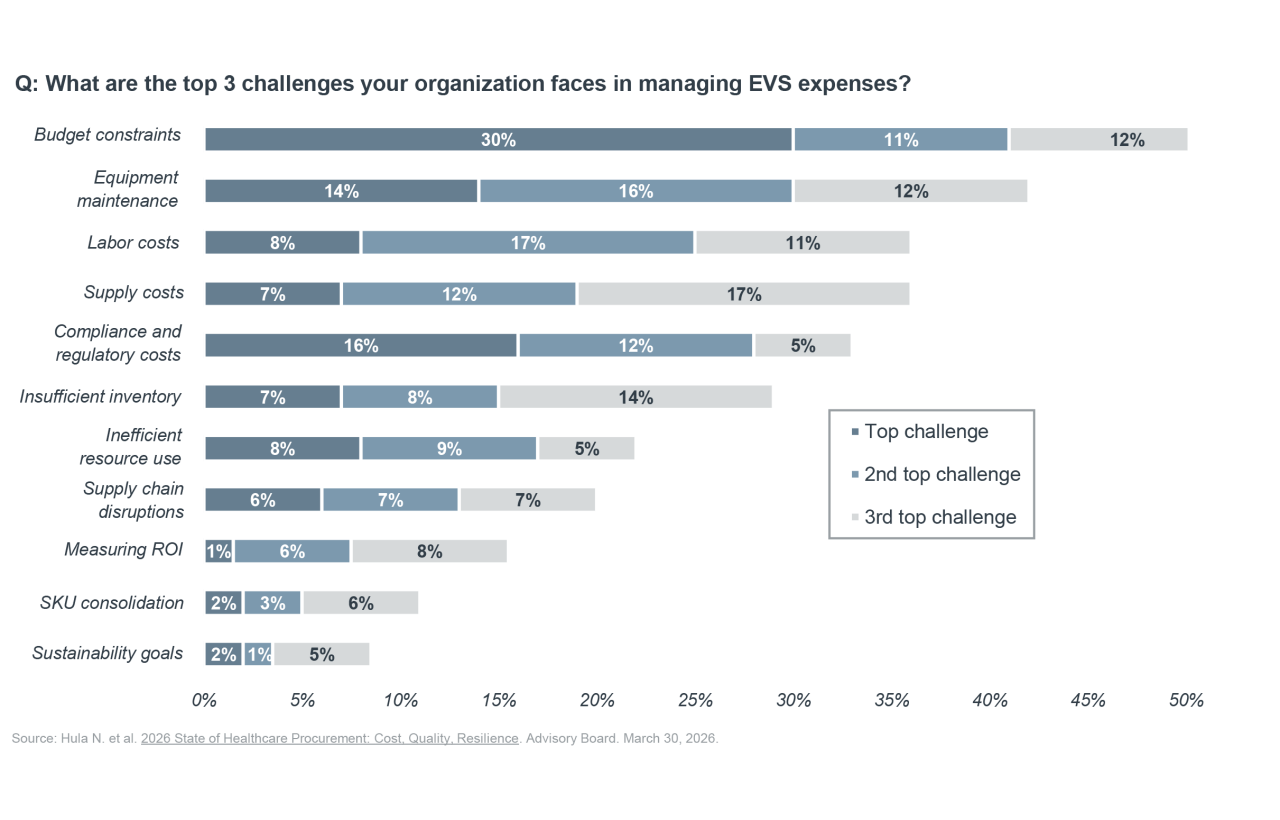
Health systems face intense budget pressure driven by tariff uncertainty, sustained margin pressure, and the risk of funding cuts. As leaders scrutinize spend across all expense categories, EVS has become a clear pain point. Fifty-three percent of respondents cited budget constraints as a top three EVS challenge, making it the most common concern in this category.
Continuously rising costs intensify this pressure. Procurement leaders report higher prices for EVS supplies, labor cost inflation, and expanding compliance requirements that increase the cost of maintaining safe and effective cleaning operations. Many health systems also rely on EVS equipment that has exceeded its anticipated lifespan. Aging equipment drives higher repair and maintenance needs, further straining tight budgets and limiting leaders’ ability to redirect resources to higher‑value priorities.
Organizations have opportunities to improve EVS while managing budgets
Health systems must ensure EVS spend aligns with their increasingly tight budget. At the same time, our survey results show that leaders’ goals for savings don’t revolve around blunt cost‑cutting measures. They recognize that such actions undermine safety as well as patient and staff satisfaction – potentially damaging their reputation and revenue.
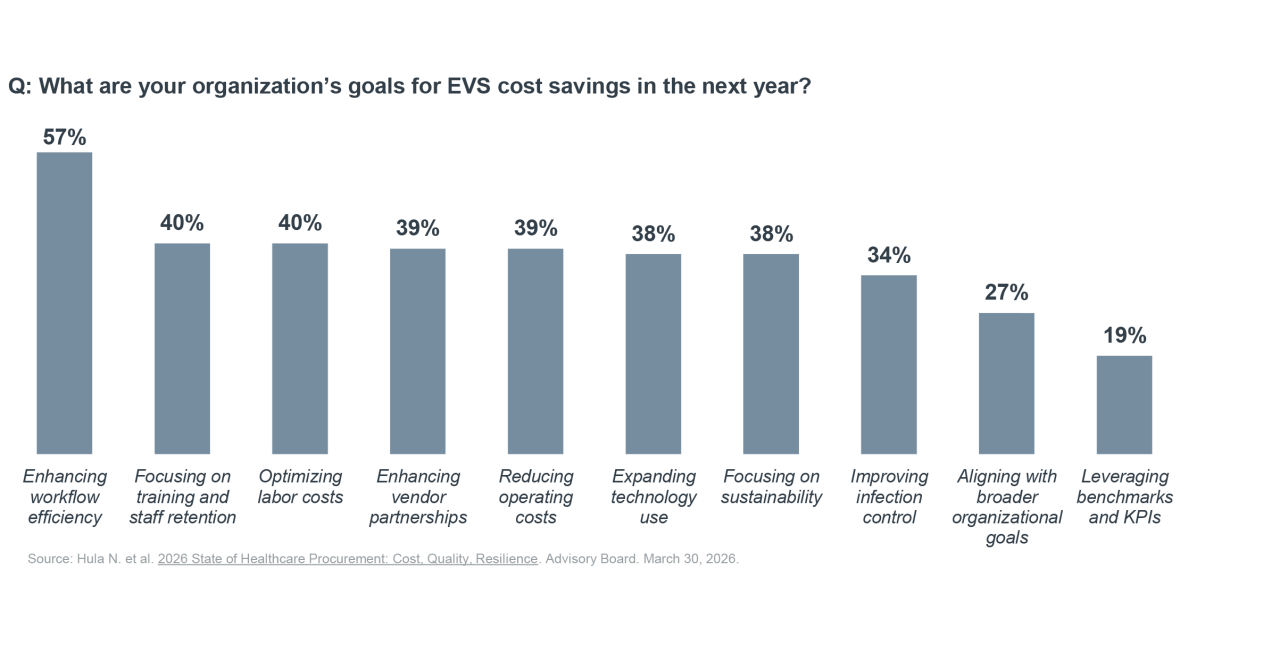
Instead, health systems’ goals for cost reduction emphasize four key efficiency gains. These goals help enhance workflows, standardize purchasing, leverage technology, and improve environmental sustainability to ultimately achieve cost savings.
1. Make EVS staff more effective while improving outcomes at a lower cost
The most common EVS goal survey respondents cited was enhancing workflows. Health systems can pursue this goal by standardizing cleaning protocols and tracking KPIs such discharge room turnaround times, operating room (OR) turnover speed, Hospital Consumer Assessment of Healthcare Providers and Systems (HCAHPS) cleanliness scores, patient satisfaction metrics, and equipment downtime. These measures help leaders identify recurring problem areas and prioritize improvement efforts.
57%
Of respondents cited enhancing workflow efficiency as a goal for EVS cost savings and efficiency improvement
Health systems can also invest in staff training to both improve performance and reduce costly personnel turnover. By encouraging and sponsoring certifications such as certified healthcare environmental services technician (CHEST) or certified surgical cleaning technician (CSCT), organizations strengthen staff capabilities while signaling a commitment to career advancement. These investments can improve retention by helping staff view EVS roles as part of a longer‑term career path. Including EVS staff in performance improvement initiatives and leadership or decision‑making committees further supports engagement and helps retain high‑performing employees.
40%
Of respondents cited focusing on training and staff retention as a goal for EVS cost savings and efficiency improvement
2. Standardize EVS vendors across the system to achieve consistency and purchasing scale
Historically, health systems have focused standardization efforts on high‑cost physician preference items, drugs, and commodity medical supplies. Many leaders now recognize EVS as an opportunity to apply similar strategies, particularly in ambulatory settings, where newly acquired clinics and facilities often retain their own EVS vendors.
By consolidating EVS contracts and vendors, health systems reduce variation, improve consistency across care sites, and unlock purchasing scale. This also helps reduce stockouts, minimize emergency ordering, simplify staff training, and create a more consistent patient experience regardless of care setting. Staff who work across multiple facilities can operate more efficiently when products, protocols, and supplier support are standardized systemwide.
3. Invest in technology that prevents costly EVS disruptions
Health systems can turn to technology to prevent costly environmental services disruptions before they escalate. Thirty‑eight percent of respondents say they plan to expand their use of technology to improve EVS performance in the coming year. Leaders increasingly view these tools as a way to ensure equipment uptime, reduce avoidable costs, and support more proactive facility management.
Common investments include EVS equipment with built-in predictive maintenance and monitoring, which helps teams track use and identify performance issues early to avoid unplanned downtime. Others deploy AI-based tools that analyze turnaround times, compliance data, and workflow bottlenecks to flag emerging problem areas. Earlier visibility into EVS hot spots allows leaders to intervene sooner, reduce downtime, prevent missed cleaning events, and maintain service levels without increasing labor spend.
4. Reduce EVS supply waste to support finances and the environment
Many health systems scaled back on standalone environmental sustainability initiatives in 2025. However, leaders continue to prioritize waste reduction as a practical lever for improving financial performance while still advancing environmental goals.
Health systems pursue this strategy by implementing processes that support proper supply use and inventory management platforms that prevent expiration‑driven waste. Leaders also invest in tracking the financial impact of EVS supply waste more closely and share these insights with senior leadership. By quantifying the cost of waste, procurement teams strengthen the case for targeted investments and process changes that improve both financial performance and environmental sustainability.

Suppliers can help health systems achieve their EVS goals
Health systems cannot achieve their environmental services goals on their own. Having the right supplier partner enables leaders to balance cost control with maximizing performance and patient experience.
Our survey data showed that procurement teams increasingly look beyond just price and prioritize vendors whose capabilities align with their EVS priorities. They value vendors that can prove reliability, flexibility, and can offer support services that strengthen EVS operations.

Quality and reliability
While price matters, reliability and service quality continue to drive supplier selection. Half of respondents cited on‑time delivery as a top factor when choosing an EVS supplier, and more than a third cited supply chain reliability. Health systems seek vendors with distribution networks that support consistent day‑to‑day operations and hold up during disruptions.
Flexibility
Flexibility increasingly differentiates EVS suppliers. Vendors spanning multiple EVS categories help systems consolidate contracts, reduce vendor touchpoints, and support standardization efforts. Nearly half of all leaders also value suppliers that customize offerings to meet local needs by adjusting shipment quantities, packaging sites, and delivery schedules. This capability proves especially important as systems grow their number of ambulatory sites, which often have limited storage environments and nontraditional supply receiving hours.
Support services
Health systems value suppliers that provide consultative support. Leaders seek partners that help reduce unnecessary SKUs, train staff to use products effectively, and identify workflow improvements that enhance efficiency, patient experience, and outcomes. These services allow suppliers to contribute directly to EVS performance while strengthening long‑term partnerships.

As healthcare supply chain leaders face rising costs and margin pressure, they need more than products — they need a partner that drives measurable value. Staples Business helps organizations standardize purchasing and processes, improve visibility, and reduce total cost of ownership with reliable fulfillment, accurate order management, and next-day delivery to over 98% of the U.S.
As a complete non-clinical solutions partner, we provide furniture, EVS, breakroom, print, marketing, and tech, enabling vendor consolidation and simpler indirect spend management. Through data-driven insights and demand management strategies, we help forecast usage, reduce variation, optimize inventory, and prevent overstocking. SKU rationalization and sustainable packaging solutions further help control costs and strengthen supply chain resilience, so health systems can stay focused on delivering exceptional patient care. Learn more here.
This expert insight is sponsored by Staples, an Advisory Board member organization. Representatives of Staples helped select the topics and issues addressed. Advisory Board experts wrote the report, maintained final editorial approval, and conducted the underlying research independently and objectively. Advisory Board does not endorse any company, organization, product or brand mentioned herein.
To learn more, view our editorial guidelines.

This expert insight is sponsored by Staples. Advisory Board experts conducted the underlying research independently and objectively.

Emily Schmidt
Senior writer and editor, Sponsorship
Posted on May 08, 2026

Don't miss out on the latest Advisory Board insights
Create your free account to access 1 resource, including the latest research and webinars.
Want access without creating an account?
You have 1 free members-only resource remaining this month.
1 free members-only resources remaining
1 free members-only resources remaining
You've reached your limit of free insights
Become a member to access all of Advisory Board's resources, events, and experts
Never miss out on the latest innovative health care content tailored to you.
Benefits include:
Unlimited access to research and resources
Member-only access to events and trainings
Expert-led consultation and facilitation
The latest content delivered to your inbox
You've reached your limit of free insights
Become a member to access all of Advisory Board's resources, events, and experts
Never miss out on the latest innovative health care content tailored to you.
Benefits include:
Unlimited access to research and resources
Member-only access to events and trainings
Expert-led consultation and facilitation
The latest content delivered to your inbox
This content is available through your Curated Research partnership with Advisory Board. Click on ‘view this resource’ to read the full piece
Email ask@advisory.com to learn more
Click on ‘Become a Member’ to learn about the benefits of a Full-Access partnership with Advisory Board
Never miss out on the latest innovative health care content tailored to you.
Benefits Include:
Unlimited access to research and resources
Member-only access to events and trainings
Expert-led consultation and facilitation
The latest content delivered to your inbox
This is for members only. Learn more.
Click on ‘Become a Member’ to learn about the benefits of a Full-Access partnership with Advisory Board
Never miss out on the latest innovative health care content tailored to you.
Benefits Include:
Unlimited access to research and resources
Member-only access to events and trainings
Expert-led consultation and facilitation
The latest content delivered to your inbox