Auto logout in seconds.
Continue Logout

Health system laboratories are increasingly being recognized for their role in driving both clinical value and financial performance. Advisory Board’s survey of 50 health system lab leaders reveals four ways health systems are driving lab growth. Learn how leaders are managing external pressures and making proactive investments to deliver high-quality, financially sustainable services to a wider market share.
Executive summary
Laboratories play a central role in clinical decision-making, yet many health systems have questioned their role in recent years. To deliver high-quality, financially sustainable services, labs must navigate rising demand, workforce shortages, increasing payer scrutiny, and rapid innovation. As these pressures intensify, health system executives must decide whether to invest in expanding their lab capabilities or partner with an external provider for lab services.
To better understand how health system leaders are prioritizing lab services and growth, Advisory Board surveyed 50 hospital and health system executives responsible for laboratory operations.
The survey reveals that health system labs plan to invest to strengthen laboratory services over the next five years. Sixty-four percent of respondents expect to increase lab budgets in the short term, rising to 68% over time. Only 1 out of 50 leaders surveyed expects their lab budget to decrease.
Leaders are directing resources toward multiple areas that relieve operational strain and strengthen long-term performance. They are managing pressures like the workforce shortage and payer scrutiny through investment in automation and a focus on lab test quality and value. Leaders are also taking proactive steps to capture patient demand by adopting new types of tests and expanding outreach lab services.
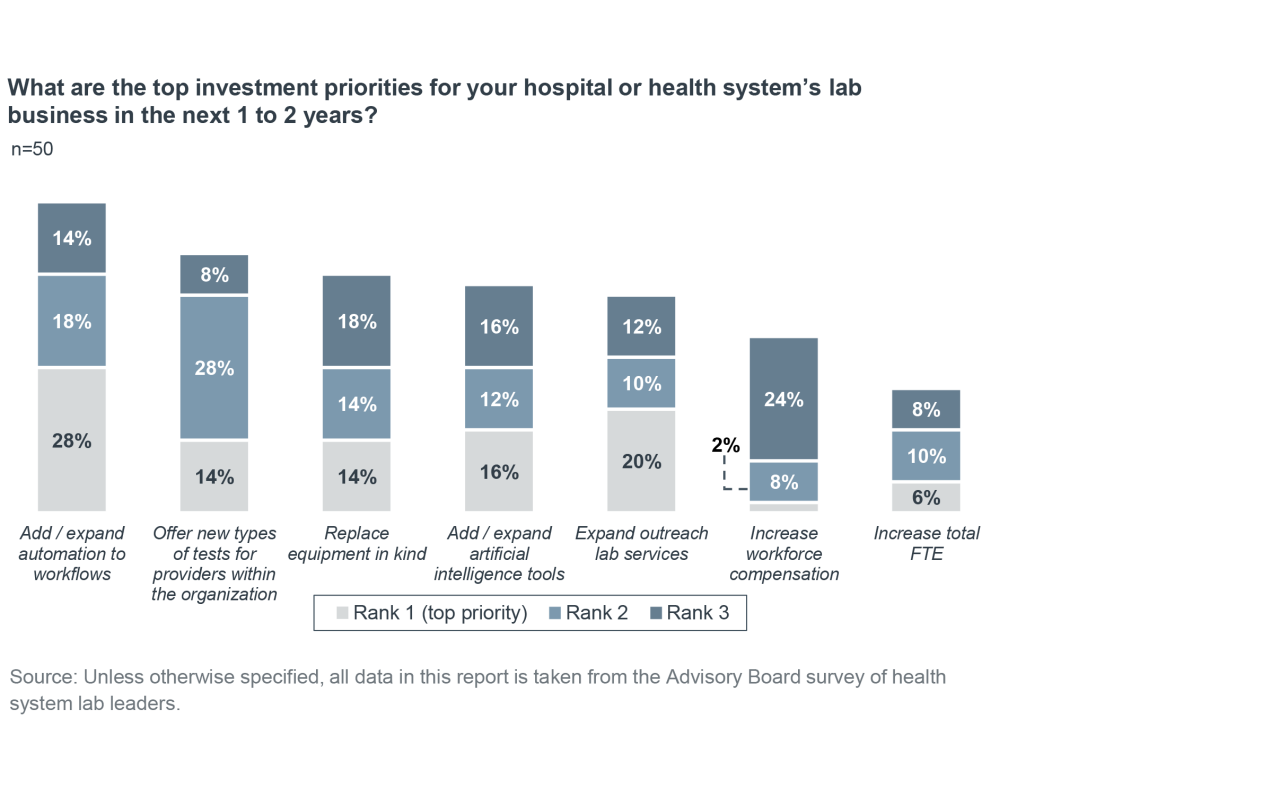
This report examines the survey data and describes the top four ways health systems are prioritizing lab growth. To help leaders act on these findings, experts from Mayo Clinic Laboratories share their perspective on turning these growth priorities into reality.
About the survey
Advisory Board surveyed 50 hospital and health system leaders responsible for lab operations to better understand how health systems are prioritizing lab services. The respondents included:
- 37 directors/senior directors (e.g., directors of operations, directors of ancillary services, laboratory directors, directors of pathology)
- 11 executives (e.g., chief operating officer, VP of operations)
- 2 other lab leaders (chair of pathology and lab department leader)
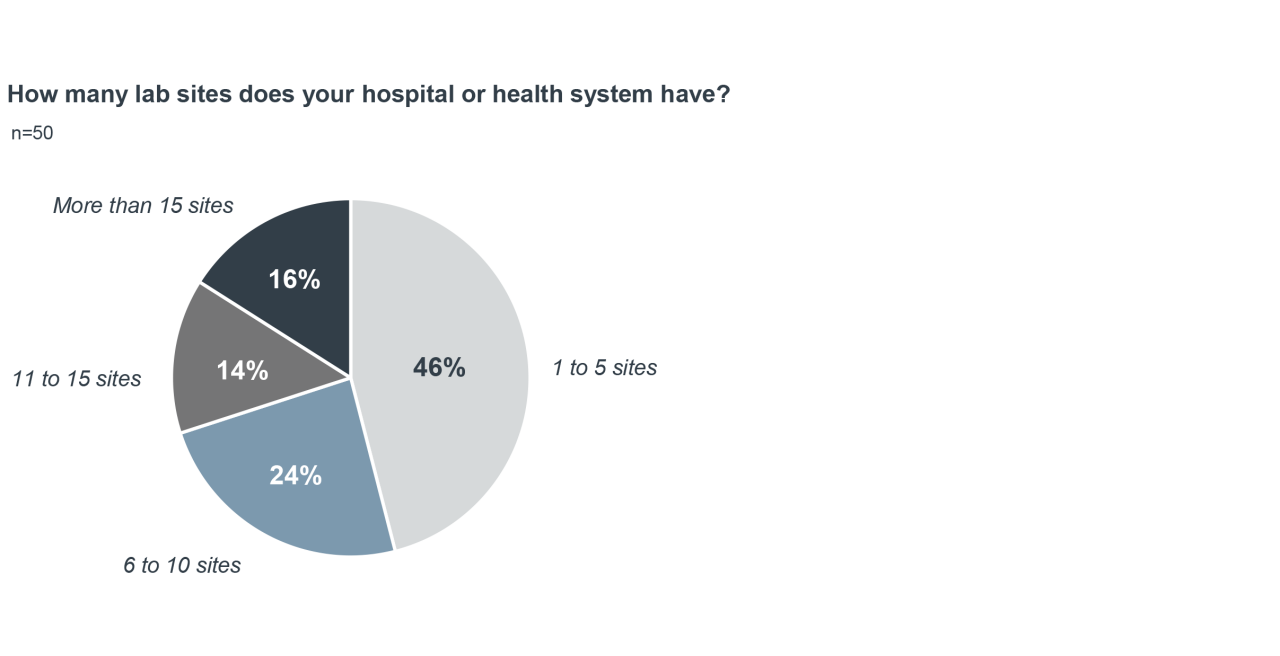
The survey respondents represent hospital and health system labs of various sizes. Most have both inpatient and outpatient lab services, while about half also have an outreach lab service.
94%
Have both inpatient and outpatient labs
48%
Have an outreach lab service
88%
Partner with other regional or national labs
4 ways health systems are pursuing lab growth
Health systems are advancing lab growth through four main tactics. The first two tactics respond directly to business pressures, including payer scrutiny and workforce strain. With the second two tactics, health systems are responding to opportunities to capture new market share, by investing in outreach services and innovative lab tests.
Business pressure
Health system leaders rank payer-driven cost controls as the biggest threat to their lab business. Both commercial and government payers are tightening management of test utilization and spend. Payers are particularly concerned about unnecessary testing, such as when tests are ordered through established workflows or standing protocols that may not reflect patient-specific needs. These patterns can carry financial implications for both payers and providers. For example, in Washington State, unnecessary pre-operative testing for low-risk surgeries contributed to $86 million in spending.1
40%
Of respondents rank commercial or government cost control strategies as their biggest threat to their lab business
Payers also voice concerns over the rapid expansion of specialized testing. Genetic testing volumes and associated spend continue to rise, while the number and variation of available tests outpace existing coding and coverage frameworks.2 As a result, payers worry about overuse of unverified tests. As this scrutiny intensifies, labs face growing pressure to justify both their ordering processes and the clinical value of the tests they provide.
"Payer scrutiny is coming down to tests that cost hundreds of dollars instead of just thousands of dollars."
Diagnostics market access leader
How leaders are responding
Lab leaders are working to understand how payers and lab benefit managers evaluate lab test value and aligning their ordering and coding processes accordingly. Their goal is to make tests easier to defend clinically and ensure reimbursement.
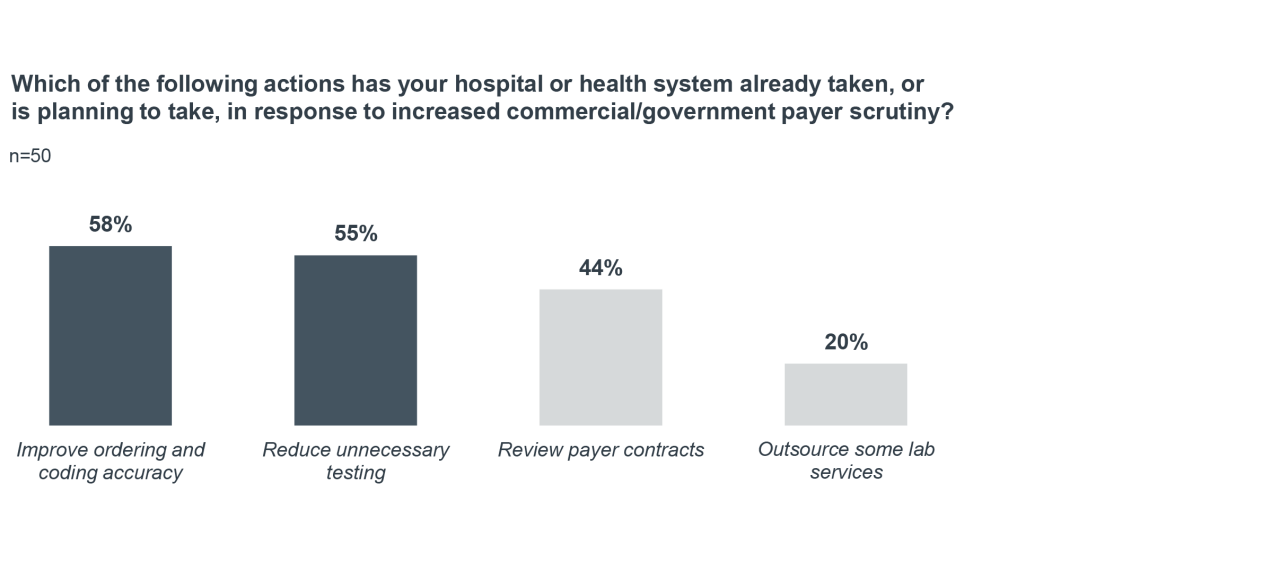
Labs have different approaches to demonstrating value. Henry Ford Health System, for example, used a laboratory formulary to organize tests by clinical category and reported a roughly 50% drop in unnecessary testing after introducing that structure.1
36%
Of respondents consider impact on lab test quality as their top priority when making investments in lab technology
The University of Louisville applied that same approach with an ordering algorithm for autoimmune encephalopathy testing, reducing inpatient use by 10% and saving $5 million over five years.1 Other systems have taken simpler steps, like requiring clinicians to justify each order, which helped the University of Utah lower avoidable lab spending.1
Lab leaders at one cancer institute spent the last few years improving their payer negotiation skills and billing documentation. They worked with each local and national payer individually to understand what data they value most when determining coverage for lab tests. From there, the cancer institute updated their EHR to ensure the right documentation was included in their payment requests. As a result, they’ve increased coverage of their larger panel tests from only two payers covering the tests five years ago to nearly all payers covering them today.
Key barrier
The rapid rate of innovation, especially in molecular and genetic diagnostics, makes it more difficult for labs to demonstrate test quality and value. Each new test adds another decision point around when it should be used and how it will be covered. In genetic testing, the number and variety of tests on the market have grown quickly, while coding and coverage frameworks have not kept pace.1 Lab teams struggle to sort through that mismatch while also building evidence and keeping up with payer expectations.
"Healthcare leaders today operate in a period of near-constant disruption, making it crucial to have the foresight to anticipate trends and respond in disciplined ways that truly improve patient care."
Dr. William Morice II, President and CEO
Mayo Clinic Laboratories
Expert perspective
As test menus expand and coverage requirements evolve, lab leaders face growing pressure to demonstrate not only the clinical value of new tests but also when and how they should be used. That responsibility extends beyond individual organizations and requires engagement in broader discussions about appropriate test utilization and patient care.
Dr. William Morice II, President and CEO of Mayo Clinic Laboratories, emphasizes that leaders can better navigate these challenges by participating in professional communities and contributing to the broader scientific dialogue. “This not only helps you get insights to make decisions for your own organization but also broadens your perspective to ensure that new tests are used thoughtfully throughout healthcare. This approach helps demonstrate the value of the laboratory in patient care to stakeholders within and outside our laboratory community.” |
Business pressure
Leaders identify staffing constraints as the second greatest threat to their lab business. The lab workforce shortage continues to strain lab operations and limit many organizations’ growth. According to the U.S. Bureau of Labor Statistics, approximately 22,600 openings for clinical laboratory technologists and technicians are projected each year, on average, through 2034, largely due to retirements and workforce turnover.3 As of 2022, 46% of open lab roles went unfilled.4
32%
Of respondents rank rising compensation rates and staffing shortage as their biggest lab business threat
Workforce challenges show little sign of easing. Limited awareness of lab careers, constrained education pipelines, and a lack of clear advancement pathways continue to restrict the supply of new talent.5 Simultaneously, high workloads and compensation disparities contribute to high attrition rates.5 Because of these factors, many organizations struggle to maintain current capacity, let alone position their labs for future growth.
How leaders are responding
Lab leaders are responding to workforce shortages with a broad mix of strategies rather than a single fix, though adding automation is top priority. Alongside automation, organizations report increasing compensation, investing in staff training, and more closely tracking productivity and costs as areas they are prioritizing. The relatively even mix across these approaches suggests leaders are trying to stabilize performance from multiple angles, especially as no single strategy has clearly emerged as dominant. Meanwhile, adjusting non-compensation benefits and outsourcing ranks among the lowest-priority responses.
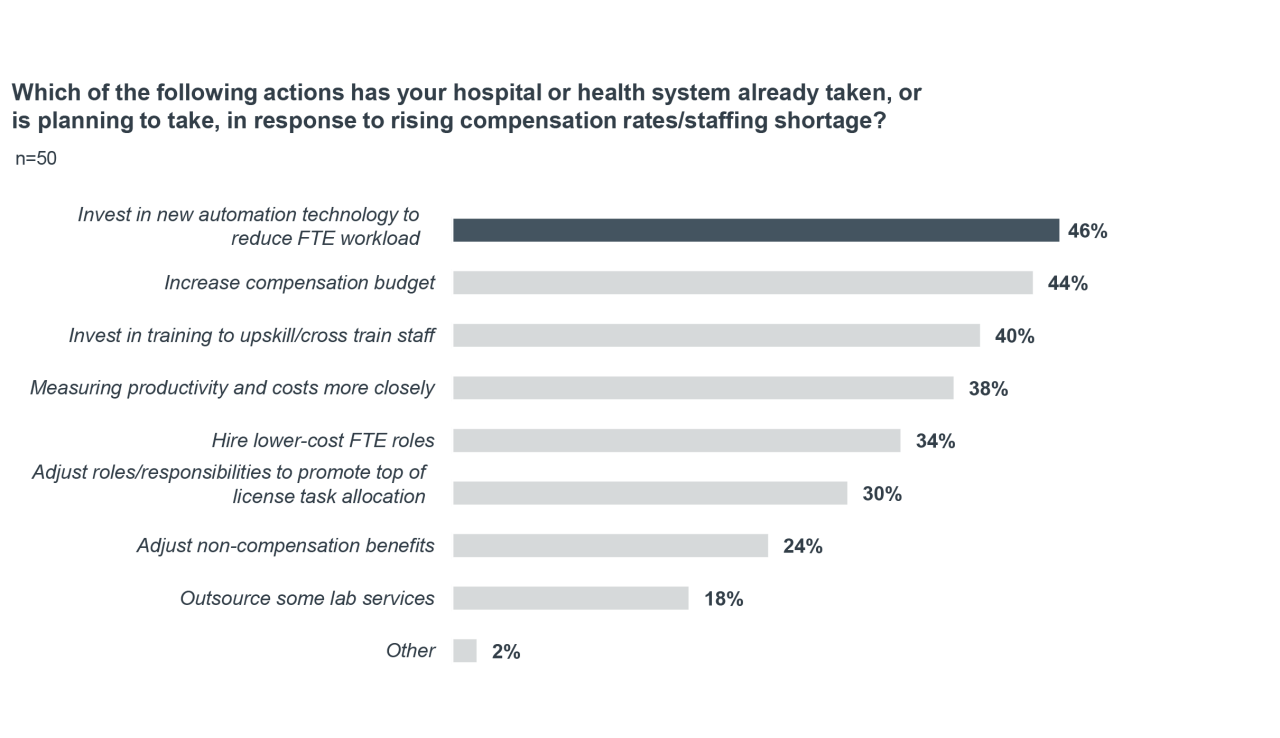
Automation still stands out as the most commonly cited investment, with leaders using it to reduce manual work and improve throughput across the testing process. Rather than focusing on advanced capabilities, most organizations prioritize tools that standardize workflows and ease administrative burden.
Examples of how labs are using automation6
- Intake: Capture data from requisitions and images to auto-populate fields and speed case entry
- Scheduling and workflow management: Track volume in real time and use historical patterns to anticipate demand and adjust staffing
- Report generation: Organize incoming data and support report assembly, reducing manual effort and freeing staff for interpretation
Key barrier
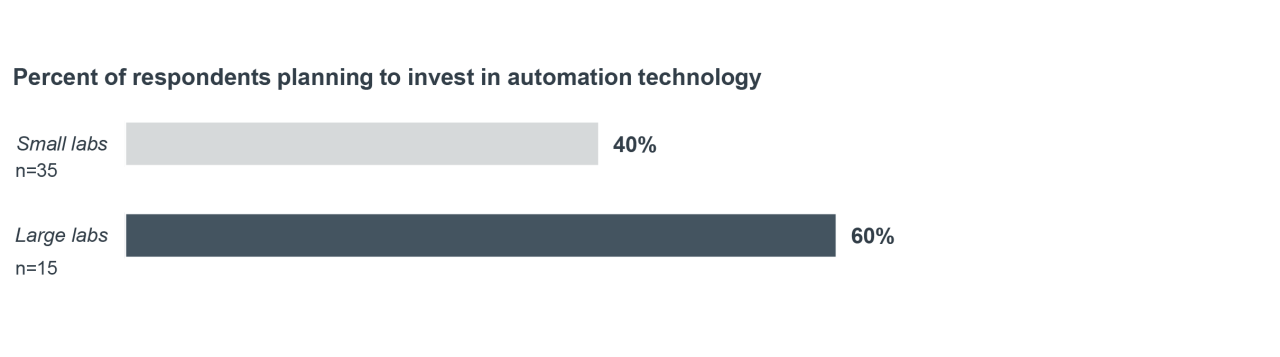
Cost is the primary barrier to adoption of automation technology. The significant capital requirement is likely why larger labs are investing in automation more often than smaller labs. For organizations already operating under tight financial constraints, even high-priority initiatives can stall when near-term costs outweigh perceived returns.
70%
Of respondents rank upfront cost as the largest barrier to adoption of automation technology
In addition to cost, leaders highlight data privacy and security as ongoing risks to investing in automation, particularly as AI tools integrate more deeply into lab workflows. One COO stated, “We are concerned about a potential data breach in the future.”
Expert perspective
As organizations expand their use of automation, leaders emphasize the importance of grounding these investments in clear, operational needs rather than adopting new technologies for their own sake. While tools can streamline workflows and reduce manual burden, their impact depends on how well they align with existing processes and priorities.
Dr. Chris Garcia, Chief Digital Innovation Officer at Mayo Clinic Laboratories, encourages leaders to start with the problem they are trying to solve. “For laboratory leaders evaluating automation or AI, the most important step is to start with the problem, not the technology,” he explains. “You remain the expert in what will truly make a difference for your patients, clinicians, and care teams.”
From there, leaders must assess whether a solution is financially sustainable and ready for real-world implementation. As Garcia notes, when a solution clearly addresses a meaningful challenge, organizations can work with partners to ensure it delivers lasting impact. |
Business opportunity
Demand for lab services is projected to grow steadily, with volumes expected to rise at a 6.5% annual rate through 2033.7 Survey respondents say they are already seeing that growth in practice, describing lab orders as “doubling” and calling labs “one of the fastest-growing service lines by volume.”
20%
Of respondents rank outreach expansion as their top investment priority overall
How leaders are responding
Health systems are betting on outreach labs to make better use of capacity and capture new market share. Outreach labs extend lab services beyond the hospital. They receive and process tests sent from physician offices, urgent care centers, and other non-hospital sites that may or may not be affiliated with the outreach lab organization.
Existing outreach labs are already generating valuable revenue for their organizations, with multiple respondents reporting that their outreach business brings in significant profit.
"We need to increase budget [for outreach lab services] to expand and drive profits to the possible maximum."
Chief operating officer speaking on their outreach lab services
Health system with 6 to 10 labs
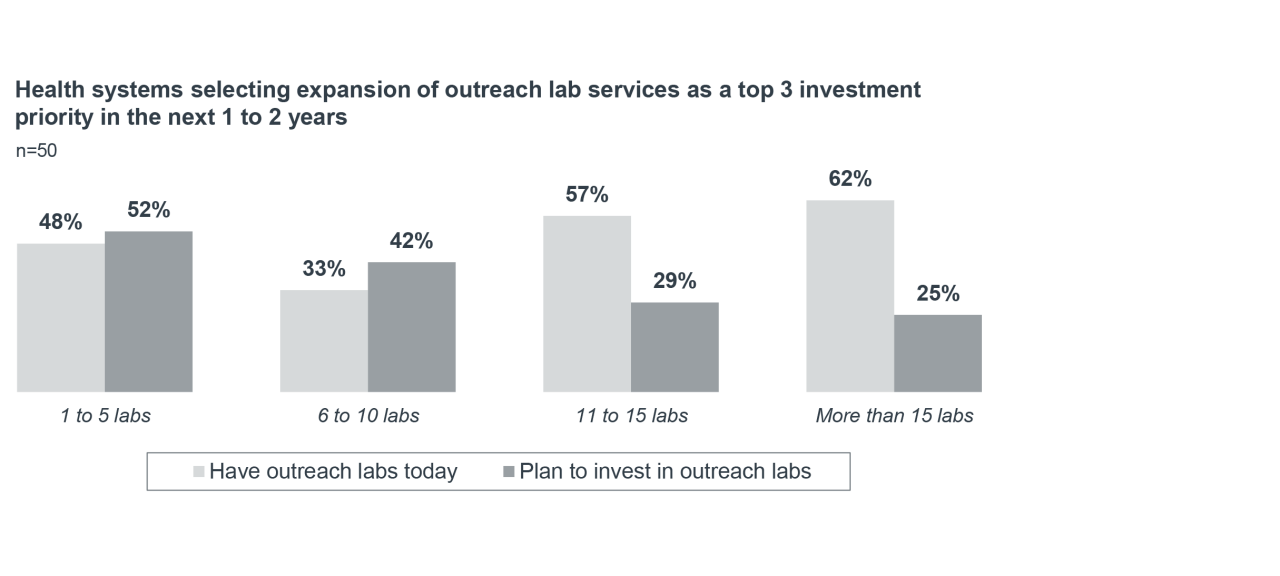
Our survey found that many large labs have already found success with outreach services, while smaller health system labs hope to catch up. Specifically, health systems with fewer than 11 labs were less likely than larger organizations to have outreach labs today, but more likely to invest in them in the future.
Key barrier
Health system executive buy‑in remains a major hurdle to expanding outreach services, as some organizations still view the lab as a cost center rather than a driver of growth. This perception, combined with the fact that laboratory services generate less direct revenue than other service lines despite supporting all of them, makes it difficult for leaders to prioritize lab investments in a tight margin environment.
Outreach also presents a more complex value proposition than many other investments. Its impact extends beyond direct revenue to include better use of existing capacity, stronger provider relationships, and broader contributions to organizational performance. However, these benefits are often less visible and harder to quantify, limiting leaders’ confidence in the return on investment.
Therefore, lab leaders must build a clear, credible business case that connects outreach to both financial performance and systemwide priorities. That process requires alignment across finance, compliance, IT, and marketing, as well as the ability to translate operational improvements into outcomes executives value. Without that level of clarity and alignment, even strong outreach strategies struggle to gain traction.
"When leaders and care teams can see both the clinical and business value, it becomes much easier to align around a shared vision and invest in the long-term success of the outreach strategy."
Dr. William Morice II, President and CEO
Mayo Clinic Laboratories
Expert perspective
Building support for outreach strategies often requires alignment well beyond the lab itself, particularly as leaders seek to demonstrate both clinical and financial impact.
“Gaining buy-in for an outreach laboratory strategy starts with engagement at every level of the organization,” says Dr. Morice. He emphasizes that success depends on both grassroots and leadership engagement, with lab teams staying closely connected to clinicians while clearly communicating value to executive stakeholders. “That means consistently sharing data on performance, outcomes, and financial impact, and telling a cohesive story about how the lab contributes across the entire care continuum.” |
Business opportunity
Demand for new lab tests and technology continues to rise, driven by both clinical need and test innovation. The rise in genetic testing capabilities and new treatment options expands the utility of multi-panel early detection test and companion diagnostics. Point-of-care tests have also become more popular as more clinicians move out of the hospital setting.
50%
Of respondents rank investing in new tests as one of their top three priorities for investment
How leaders are responding
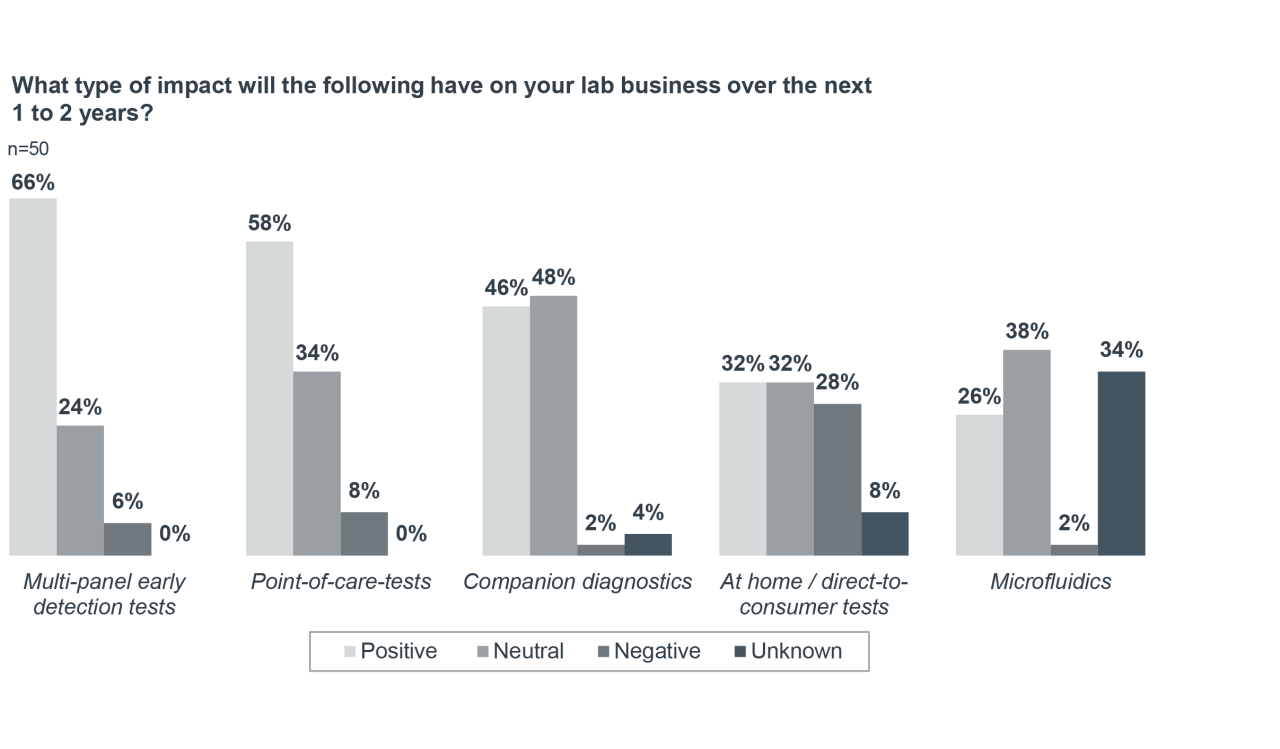
Health systems are expanding the range of tests they offer as new diagnostic technologies take on a larger role in care delivery. Most lab leaders expect multi-panel early detection tests to have a positive impact on their lab business in the next couple of years. These tests rely on genetic and genomic data to identify cancer earlier, often through blood-based diagnostics and expanded gene panels. Single-cancer early detection tests are already standard of care today, which may be giving lab leaders the confidence in the multi-panel options.
Point-of-care testing is ranked second, with more than half of leaders expecting this technology to have a positive impact on their lab services. The growth here is largely driven by the continued shift of care into ambulatory settings.
Companion diagnostics, which help match patients to targeted therapies is third, with a larger portion of leaders expecting a neutral response on their lab business going forward. Companion diagnostics have been on the market longer and have become standard of care for some cancer screening processes. It is possible many labs have already adopted this technology and don’t expect as much advancement in the coming years.
Key barrier
Uncertainty around whether new tests will deliver consistent financial and clinical value remains a major barrier to investment. Coding and reimbursement challenges make it difficult for labs to determine if a new diagnostic will generate reliable returns, even after it is adopted. New tests often reach the market before coding systems fully define how to bill for them, forcing labs to rely on ambiguous or nonspecific codes that can lead to claim denials or delayed payment.8,10 Even when codes exist, reimbursement varies widely across payers, with different coverage policies, documentation requirements, and medical necessity criteria.9
This variability makes it difficult for lab leaders to predict whether a test will ultimately be profitable or sustainable at scale. At the same time, payers expect strong evidence that diagnostics improve outcomes or reduce costs, yet that evidence often lags behind the pace of innovation, especially for newer molecular and genomic tests.8 As a result, many diagnostics sit in a gray area where clinical promise is clear, but financial value remains uncertain.
"Overcoming hurdles in innovation requires a disciplined, science-first approach paired with a relentless focus on the patient."
Dr. Matthew Binnicker, Chief Scientific Officer
Mayo Clinic Laboratories
Expert perspective
As labs expand their innovation portfolios, leaders emphasize the importance of balancing speed with scientific rigor. New tests often show strong clinical promise, but organizations still need the evidence, operational infrastructure, and quality processes required to support adoption at scale.
Dr. Matthew Binnicker, Chief Scientific Officer at Mayo Clinic Laboratories, said that while the pace of innovation can make it tempting to prioritize speed, trust is built by grounding every step in rigorous experimentation, objective data, and a willingness to challenge assumptions.
“By collaborating across teams, pressure-testing our ideas, and identifying ways to work more efficiently without compromising safety or quality, we can move innovation forward responsibly,” he added. |
Resources for health system lab leaders
For more on how health systems are strengthening lab performance and driving growth, explore additional insights and resources from Mayo Clinic Laboratories, including podcasts, articles, and videos on improving efficiency, expanding services, and demonstrating value across the care continuum.
1 Lohr G. 2022 diagnostic laboratory market trends. Advisory Board. December 21, 2022.
2 Kim S. 3 questions health plan leaders are asking about labs. Advisory Board. July 27, 2021.
3 Clinical Laboratory Technologists and Technicians. U.S. Bureau of Labor Statistics. August 28, 2025.
4 Robinson, A. & Rohde, R. Workforce in the Shadow of Healthcare – An Update on the Survival Status of Laboratory Medicine and Public Health. Biomedical Journal of Scientific & Technical Research. February 6, 2024.
5 Zanto, S. et al. Addressing the Clinical Laboratory Workforce Shortage. ASCLS. August 2, 2018.
6 Gilligan J. From intake to interpretation: How AI assists lab teams today. Mayo Clinic Laboratories. March 23, 2026.
7 Diagnostic Testing Market Size to Reach USD 449.78 Billion by 2033. BioSpace. April 16, 2024.
8 Cohen JP, Felix AE. Personalized Medicine's Bottleneck: Diagnostic Test Evidence and Reimbursement. Journal of Personalized Medicine. April 4, 2014.
9 Bradley C. Cost Control and Reimbursement Challenges in Clinical Labs. Lab Manager. November 18, 2025.
10 Coustier N. Reimbursement Déjà Vu: Lessons for AI/ML Medtech Founders from the Molecular Diagnostics Industry. MedTech Intelligence. May 30, 2024.
Mayo Clinic Laboratories provides specialized laboratory testing for serious and complex conditions to advance patient care worldwide. For 55 years, Mayo Clinic Laboratories has helped physicians answer the toughest clinical questions with confidence and empowered hospitals to elevate care within their communities. Through an integrated diagnostics ecosystem powered by Mayo Clinic, the organization offers access to 4,300 tests and pathology services, delivering trusted, timely answers to clinicians and patients. Learn more here.
This report is sponsored by Mayo Clinic Laboratories, an Advisory Board member organization. Representatives of Mayo Clinic Laboratories helped select the topics and issues addressed. Advisory Board experts wrote the report, maintained final editorial approval, and conducted the underlying research independently and objectively. Advisory Board does not endorse any company, organization, product or brand mentioned herein.
To learn more, view our editorial guidelines.

This report is sponsored by Mayo Clinic Laboratories. Advisory Board experts wrote the report, maintained final editorial approval, and conducted the underlying research independently and objectively.

Atticus Raasch
Senior analyst, Custom research services and production assistant, Radio Advisory
Emily Schmidt
Senior writer and editor, Sponsorship
Posted on August 06, 2026

Don't miss out on the latest Advisory Board insights
Create your free account to access 1 resource, including the latest research and webinars.
Want access without creating an account?
You have 1 free members-only resource remaining this month.
1 free members-only resources remaining
1 free members-only resources remaining
You've reached your limit of free insights
Become a member to access all of Advisory Board's resources, events, and experts
Never miss out on the latest innovative health care content tailored to you.
Benefits include:
Unlimited access to research and resources
Member-only access to events and trainings
Expert-led consultation and facilitation
The latest content delivered to your inbox
You've reached your limit of free insights
Become a member to access all of Advisory Board's resources, events, and experts
Never miss out on the latest innovative health care content tailored to you.
Benefits include:
Unlimited access to research and resources
Member-only access to events and trainings
Expert-led consultation and facilitation
The latest content delivered to your inbox
This content is available through your Curated Research partnership with Advisory Board. Click on ‘view this resource’ to read the full piece
Email ask@advisory.com to learn more
Click on ‘Become a Member’ to learn about the benefits of a Full-Access partnership with Advisory Board
Never miss out on the latest innovative health care content tailored to you.
Benefits Include:
Unlimited access to research and resources
Member-only access to events and trainings
Expert-led consultation and facilitation
The latest content delivered to your inbox
This is for members only. Learn more.
Click on ‘Become a Member’ to learn about the benefits of a Full-Access partnership with Advisory Board
Never miss out on the latest innovative health care content tailored to you.
Benefits Include:
Unlimited access to research and resources
Member-only access to events and trainings
Expert-led consultation and facilitation
The latest content delivered to your inbox
