Auto logout in seconds.
Continue Logout

Reliant Medical Group redesigned its vaccine workflow after the closure of its in-house pharmacies created new challenges around access, reimbursement, and care coordination. By implementing a vaccine eRx workflow that embedded clinical, billing, and coverage logic into the electronic health record (EHR), Reliant simplified prescribing decisions, nearly eliminated inappropriate vaccine administrations, decreased administrative burden, and helped ensure patients received vaccines through the appropriate site of care, ultimately closing care gaps.1
The challenge
Low adult vaccination rates leave patients vulnerable to preventable illness and drive avoidable costs across the healthcare system.2,3 As health systems work to close care gaps, clinicians must navigate complex vaccine eligibility, coverage, and reimbursement requirements.
Stocking vaccines in house is usually the most convenient workflow for patients and providers, but it isn't possible for every organization. For example, Reliant Medical Group administers all vaccines on site except those covered under Medicare Part D for patients with Medicare, which cannot be billed in-clinic and require a pharmacy referral. When Reliant's in-house pharmacies closed, clinicians were left navigating those Part D rules themselves — risking missed reimbursement or unexpected patient charges — and worried that verbal referrals alone would rarely translate into completed vaccinations.
The organization
Reliant Medical Group serves 320,000 patients annually through a network of 500 providers across 20 locations in Central and MetroWest Massachusetts, offering comprehensive primary care and expertise in more than 30 specialty areas.4 Reliant and Atrius Health together make up Optum Massachusetts, sharing clinical informatics and EHR leadership across both groups.
The approach
Reliant created an eRx workflow to help reduce patient drop-off, guide clinicians to the appropriate vaccine product, minimize billing errors, and connect patients with their preferred site of care. Reliant saw value in electronic prescriptions because they transformed a verbal recommendation into a concrete action for the patient. This approach led to Reliant sending nearly 6,000 electronic prescriptions across tetanus, diphtheria (Td)/tetanus, diphtheria, pertussis (Tdap), hepatitis B, respiratory syncytial virus (RSV), and shingles vaccines in the last twelve months.
To achieve this, a multidisciplinary team of clinical, pharmacy, billing, and EHR leaders led the redesign. The team used existing EHR functionality to identify patients due for vaccines based on age, vaccination history, and underlying conditions, then built decision support and reimbursement logic directly into the ordering workflow. The system guided clinicians to the right product, inventory source, and site of care, removing the need to manually navigate complex coverage rules. Local champions reinforced adoption, and clinician trust grew as the workflow consistently prevented reimbursement issues and unexpected patient charges.
The result
In the last twelve months, more than 1,500 patients so far have completed a vaccination they could not have received in the clinic. Reliant’s vaccine eRx workflow also reduced vaccine ordering and administration errors to near zero, helping prevent vaccines from being administered outside recommended coverage, reimbursement, and site-of-care requirements. By translating eligibility, coverage, and reimbursement requirements into automated workflow logic, the organization helped clinicians make the right decision at the point of care while avoiding common billing and dispensing errors.
1500+
Patients have completed a vaccination they could not have received in the clinic
4 pillars of effective vaccine eRx workflows
Reliant Medical Group's vaccine eRx workflow was designed to do more than send vaccine prescriptions. The organization developed a set of workflow design principles that helped translate complex vaccine eligibility, coverage, reimbursement, and dispensing requirements into a simpler experience for clinicians and patients. To create this workflow, Reliant leveraged existing EHR capabilities, internal resources, and expertise, avoiding the need for additional team members or technology investments.
The following pillars informed how Reliant designed, implemented, and drove adoption of its eRx workflow.
Successful vaccine eRx depends on an organization's ability to translate complex vaccine eligibility, dispensing, coverage, and reimbursement requirements into EHR logic that clinicians can use at the point of care. Dr. Lloyd Fisher, Chief Medical Information Officer of Optum Massachusetts (Reliant's parent organization), set out to build a more accurate and efficient vaccine workflow.
Although Dr. Fisher brought both clinical and technology expertise to the effort, Reliant recognized that no single stakeholder could supply all the knowledge required. Dr. Fisher partnered with pharmacists, billers, coders, and EHR builders to ensure the workflow reflected the realities of vaccine administration and reimbursement.
Each stakeholder contributed a distinct perspective to the workflow design:


By bringing clinical, pharmacy, billing, and EHR perspectives together from the outset, Reliant aligned clinical recommendations with dispensing requirements, coverage rules, and frontline workflow needs. That collaboration proved critical because clinicians often can't determine how a vaccine should be billed or where a patient should receive it simply by looking at a patient's insurance information.
"I can see a patient's insurance and pharmacy benefit plan, but I need revenue cycle experts to help translate what that means. For example, it isn’t always obvious when a patient has Medicare Part D coverage."
Dr. Lloyd Fisher, Chief Medical Information Officer
Reliant Medical Group
The most effective vaccine eRx workflows support the entire clinical decision-making process, not just prescription transmission. Before Reliant could determine where a patient should receive a vaccine or how it should be billed, the organization first needed a reliable way to identify which patients needed which vaccines.
Rather than purchasing new technology, Reliant started with functionality already available within its EHR. The organization leveraged Health Maintenance, a common feature that tracks preventive care needs, including vaccinations. The tool already accounts for factors such as age, vaccination history, and underlying conditions, allowing Reliant to identify care gaps and determine which vaccines each patient requires.
Once Reliant identified vaccine needs, the team created custom order sets that enabled clinicians to order recommended vaccines quickly and consistently. However, identifying the appropriate vaccine only solved part of the challenge. The workflow still needed to determine which product to use, where the vaccine should be administered, and how it should route based on coverage and reimbursement requirements.
"We look at a patient’s age, vaccination history, conditions, and other factors to determine which vaccines they need. Then we build the logic to say, ‘A patient has XYZ need, here’s the most efficient product that we have to give them.’ With custom order sets, clinicians can order those vaccines with a single click."
Dr. Lloyd Fisher, Chief Medical Information Officer
Reliant Medical Group
Identifying which vaccines a patient needs is only part of the challenge. Reliant also had to determine which product to use, where the patient should receive it, and how to align those decisions with increasingly complex coverage and reimbursement requirements. To accomplish that goal, the organization built insurance and billing logic directly into the EHR so the system could guide clinicians toward decisions that were both clinically and operationally appropriate.
Reliant embedded several forcing mechanisms into the workflow. If a clinician bypassed the recommended order set and attempted to place an ineligible vaccine order, the system issued a hard stop. The workflow also automatically selected the appropriate vaccine inventory source, a critical capability because vaccines may come from state-funded, federally funded, or privately purchased inventories that align with different coverage requirements. In addition, the system directed patients to the appropriate site of care.
Example: RSV Medicare challenges
For vaccines such as RSV, shingles, and measles-mumps-rubella (MMR), Medicare coverage rules can influence where patients receive the vaccine. For example, RSV is typically covered under Part D, which is generally reimbursed when administered within an in-network pharmacy rather than a physician office.5 Reliant’s EHR logic can automatically identify care gaps, coverage, and the right product, ultimately routing patients to the appropriate site of care. That process in the EHR may look like the following for a patient covered by Medicare:
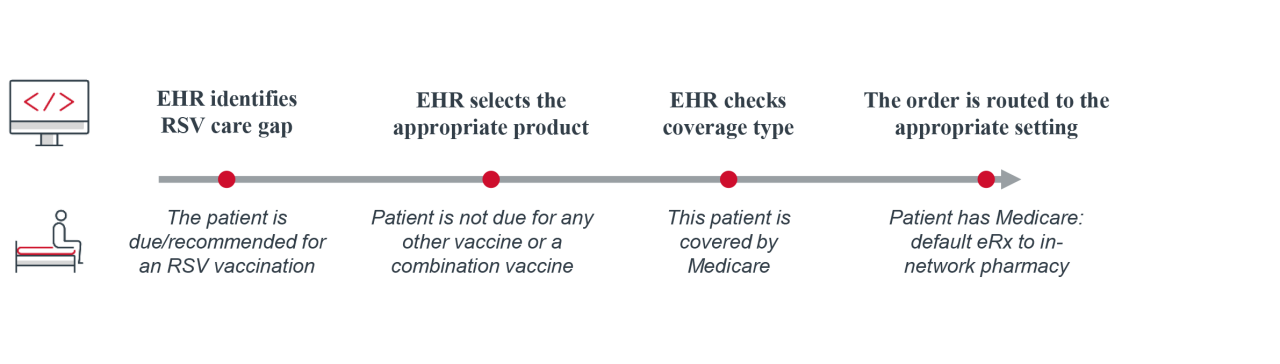
Instead of expecting clinicians to navigate reimbursement policies, inventory requirements, and administration rules on their own, Reliant incorporated those decisions into the workflow itself. The result was a simpler prescribing experience that guided clinicians to the right product, in the right setting, at the right time.
Reliant learned that clinician adoption depends less on training and more on confidence in the workflow itself. Even with years of experience building clinical decision support tools, the team recognized that providers would not immediately trust a system that influenced vaccine ordering decisions. Early on, some clinicians worried the workflow was taking clinical judgment out of their hands and questioned whether the recommendations were accurate.
That skepticism faded as clinicians experienced the workflow in practice. Providers appreciated that the system removed the burden of navigating complex coverage, reimbursement, and billing requirements while helping them avoid inappropriate vaccine orders. As the workflow consistently guided patients to the correct product and site of care, clinicians spent less time resolving billing issues and fielding complaints from patients who received unexpected vaccine charges. Over time, trust in the workflow grew because it reliably reduced work rather than creating more of it.
"When we initially went live, people would say, 'The computer’s wrong.' Now we don't get calls or emails saying the decision support is wrong. Instead, we hear, 'Can you explain why this patient needs this particular vaccine?'"
Dr. Lloyd Fisher
Reliant Medical Group
Reliant's experience with clinical decision support also shaped where and how recommendations appeared in the workflow. Rather than interrupting clinicians with information they couldn't act on, the team embedded guidance at the points where providers needed to make decisions. As confidence grew, conversations shifted from questioning the system's recommendations to understanding the rationale behind them.

Results
MIIS and pharmacy claims help Reliant better understand vaccine uptake
Combining state registry and pharmacy benefit claims data can help health systems close visibility gaps created when vaccinations occur outside their own facilities.
If a vaccine is administered in their state, then Reliant has access to vaccination data through the Massachusetts Immunization Information System (MIIS).6 When a patient receives a vaccine at a participating in-state pharmacy, that administration is reported to MIIS and automatically flows back into Reliant's EHR. If registry data are unavailable — due to the data not being recorded or the vaccine being administered out of state — then Reliant can cross-reference the pharmacy benefit claim to provide additional confirmation that a vaccine was administered.
Despite positive results, eRx success is more than just vaccine uptake
In the last twelve months, Reliant sent nearly 6,000 electronic vaccine prescriptions across Td/Tdap, hepatitis B, RSV, and shingles for patients who could not receive those vaccines in-clinic. So far, more than 1,500 of those prescriptions have resulted in a documented immunization, all of which were patients who would otherwise not have been able to receive the vaccine in-clinic and would have relied on a verbal referral with no mechanism to track completion.7 Because some patients were vaccinated out of state or weren’t matched correctly in the registry, the true completion rate is possibly higher than what Reliant could observe.
While Reliant did not capture vaccination data before implementing eRx, outside evidence suggests the effect is meaningful: Some retailers have reported increases of 45% in eRx-related vaccine administrations after implementing an eRx protocol.8 Because uptake also reflects factors well beyond any single workflow, health systems should track other, more proximate measures of success alongside it. For example, Reliant observed:
- Reduced inappropriate vaccine administration: Dr. Fisher reported that instances of administering vaccines in the wrong setting fell to "close to zero.“
- Reduced administrative burden for clinicians and staff: The workflow eliminated manual coverage determinations, so providers and nurses no longer navigate eligibility and reimbursement rules patient by patient.
- Increased clinician trust in decision support: When clinicians saw guidance in the workflow that was different than they expected, they used it as an opportunity to probe for what they may have missed instead of dismissing it.
National market data
65%
Of PCPs who use eRx workflows believe it increases the likelihood of patient compliance*
*See endnote 8.
56%
Of PCPs who use eRx workflows believe it strengthens the vaccine recommendation*
*See endnote 8.
1 Unless otherwise noted, all information in this case study came from Advisory Board interviews with officials from Reliant Medical Group.
2 Hung MC, Srivastav A, et al. Vaccination Coverage among Adults in the United States, National Health Interview, 2023. Centers for Disease Control and Prevention. January 9, 2026.
3 Vaccine-Preventable Adult Diseases. Centers for Disease Control and Prevention. July 14, 2024.
4 Reliant Medical Group delivers care that meets your needs. Reliant Medical Group. July 22, 2026.
5 Medicare Part D Vaccines. Centers for Medicare & Medicaid Services. June 2025.
6 Massachusetts Immunization Information System (MIIS). Mass.gov. August 4, 2026. [mass.gov]
7 Reliant Medical Group Data on File. Reliant Medical Group, Massachusetts.
8 Data on file. Pfizer Inc., New York, NY.
At Pfizer, we’re in relentless pursuit of breakthroughs that change patients’ lives. We innovate every day to make the world a healthier place. Our unique resources allow us to do more for people. Using our global presence and scale, we’re able to make a difference in local communities and the world around us.
Pfizer supports the global healthcare community’s independent quality improvement initiatives to improve patient outcomes in areas of unmet medical need that are aligned with Pfizer’s medical and/or scientific strategies. For more information, please visit www.pfizer.com.
This report is sponsored by Pfizer, an Advisory Board member organization. Representatives of Pfizer helped select the topics and issues addressed. Advisory Board experts wrote the report, maintained final editorial approval, and conducted the underlying research independently and objectively. Advisory Board does not endorse any company, organization, product or brand mentioned herein.
To learn more, view our editorial guidelines.
This case study is sponsored by Pfizer. Advisory Board experts conducted the underlying research independently and objectively.

Atticus Raasch
Senior analyst, Custom research services and production assistant, Radio Advisory
Emily Schmidt
Senior writer and editor, Sponsorship
Posted on October 12, 2026

Don't miss out on the latest Advisory Board insights
Create your free account to access 1 resource, including the latest research and webinars.
Want access without creating an account?
You have 1 free members-only resource remaining this month.
1 free members-only resources remaining
1 free members-only resources remaining
You've reached your limit of free insights
Become a member to access all of Advisory Board's resources, events, and experts
Never miss out on the latest innovative health care content tailored to you.
Benefits include:
Unlimited access to research and resources
Member-only access to events and trainings
Expert-led consultation and facilitation
The latest content delivered to your inbox
You've reached your limit of free insights
Become a member to access all of Advisory Board's resources, events, and experts
Never miss out on the latest innovative health care content tailored to you.
Benefits include:
Unlimited access to research and resources
Member-only access to events and trainings
Expert-led consultation and facilitation
The latest content delivered to your inbox
This content is available through your Curated Research partnership with Advisory Board. Click on ‘view this resource’ to read the full piece
Email ask@advisory.com to learn more
Click on ‘Become a Member’ to learn about the benefits of a Full-Access partnership with Advisory Board
Never miss out on the latest innovative health care content tailored to you.
Benefits Include:
Unlimited access to research and resources
Member-only access to events and trainings
Expert-led consultation and facilitation
The latest content delivered to your inbox
This is for members only. Learn more.
Click on ‘Become a Member’ to learn about the benefits of a Full-Access partnership with Advisory Board
Never miss out on the latest innovative health care content tailored to you.
Benefits Include:
Unlimited access to research and resources
Member-only access to events and trainings
Expert-led consultation and facilitation
The latest content delivered to your inbox