Auto logout in seconds.
Continue Logout
The challenge
Patients in rural America often struggle to access high-quality care. For example, many North Dakota public school students don’t have access to an on-site nurse. This issue is even more prevalent in the field of behavioral health (BH), where access and stigma are still challenges for the entire nation. Even if schools do find a way to bring behavioral health care to their students, it’s often too expensive to be feasible.
The organization
Established in 1989, the Blue Cross Blue Shield of North Dakota (BCBSND) Caring Foundation is a private 501(c)(3) charitable organization. Through charitable giving and investing, the Caring Foundation focuses on key issues that help improve the health and well-being of North Dakotans and their communities. Caring Foundation staff work with grantees to support nonprofit sustainability, collaborate on shared outcomes, and create lasting change.
The approach
BCBSND Caring Foundation connects schools with health systems to bring tele-behavioral health to schools. School district administrators can apply for a grant from BCBSND Caring Foundation and then use the grant to contract with BH professionals for remote services at a discounted rate. BCBSND Caring Foundation grants allow schools to negotiate with providers for the appropriate amount of behavioral health care coverage to support their needs.
The result
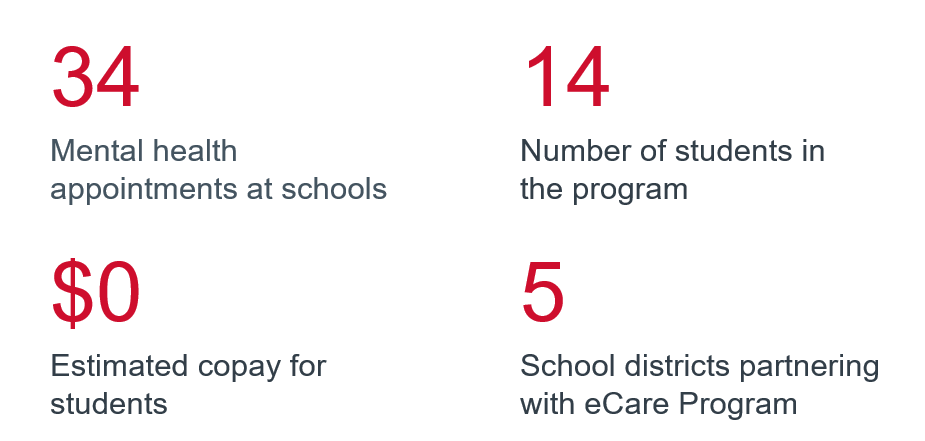
The award-winning partnership from BCBSND Caring Foundation has worked with five school districts to contract with Avera Health System’s eCare program. Fourteen students have been treated so far. BCBSND Caring Foundation plans to expand the program across the state and for more conditions.
How BCBSND Caring Foundation brought behavioral health to rural schools
Instead of embedding therapists in schools, which is the typical model, BCBSND Caring Foundation awarded grants to schools, allowing them to choose their virtual provider partner. Many chose to work with Avera Health Systems to provide tele-behavioral health care to students. BCBSND caring foundation is confronting the stigma around behavioral health care by normalizing treatment for children and their communities.
The three components
BCBSND focused on three factors: why they should partner with students, which providers they should partner with, and how they should use grant funding. This case study will examine how BCBSND approached each of these questions.
BCBSND Caring Foundation decided to invest in behavioral health services because there was a clear need. The organization chose to focus on students since they’re the future of the community. In fact, even students without BCBSND coverage can receive care through this program.
Providing behavioral health services in schools confronts the stigma around mental health. Stigma causes many people with behavioral health concerns to avoid care.
This program teaches students from a young age that behavioral health care is a normal part of health care. Consequently, children, parents, and the community at large are more likely to accept behavioral health care. Parents are asked to attend at least the first care visit with their child to provide consent for therapy and to get familiar with what therapy entails.
BCBSND Caring Foundation considered many options when choosing partners for providing behavioral health care to students. There were two main takeaways from the foundation’s research.
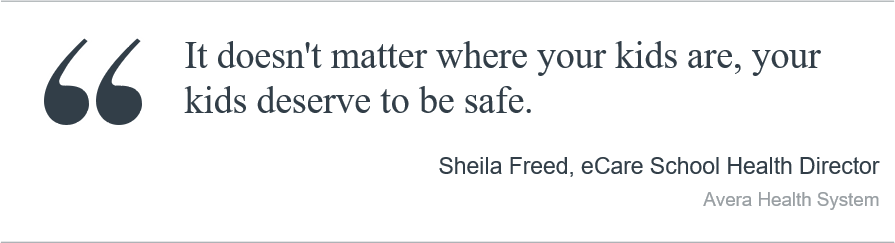
First, BCBSND Caring Foundation saw the benefits of using telehealth instead of embedding therapists at schools because access to BH providers is limited, especially in a rural environment. The grants fund 30-minute virtual sessions with master’s level social workers via iPads.
Second, BCBSND Caring Foundation wanted school districts to choose the provider that best met their needs. For example, some schools chose to partner with Avera Health Systems, which is headquartered in a neighboring state. Finding the perfect partner does not need to be restricted by state lines. While Avera is in South Dakota, its staff are also licensed to operate in North Dakota.
BCBSND Caring Foundation fully supports the school districts’ choice of provider partners. One important lesson from the partnership is that schools should work with therapists who have expertise in treating depression and anxiety, the two most common behavioral health conditions for the young population. For more severe conditions, the therapists should know other specialists they could refer the student to.
The therapists should also be trained in care coordination. If the therapist feels that medication may be useful to the student, they will contact the child’s family and primary care provider, who can assess the student and prescribe medication if necessary.
BCBSND Caring Foundation gives grants directly to school districts interested in partnering with a provider for tele-behavioral health services. The grants cover all anticipated costs for the program’s technology and most of the per-student costs. Funding is based on grant availability and on a first come first serve basis.
BCBSND Caring Foundation purposefully does not take the lead on designing each contract between school districts and care providers. That way, each grant is designed by school administrations who can tailor the program to their students’ needs.
How we know it’s working
BCBSND Caring Foundation’s program is only three years old, but early results are promising. While the sample size is only 14 students, it’s important to note that the state has a population of only 750,000 residents in total.
In 2020, the Dakota Conference on Rural and Public Health named Avera’s eCare School Health Program the “Outstanding Rural Health Program.” The award, given by a branch of the University of North Dakota, is presented annually to a program that delivers services an innovative and collaborative way.
Advisory Board resources
Case study
How Inland Empire Health Plan Trained PCPs in Behavioral Health
Read now
Our take
How COVID-19 Will Impact Behavioral Health Services
Read now
Blog post
How Montefiore, Intermountain, and Atrium Health use technology to increase behavioral health access
Read now
Cheat sheet
The Collaborative Care Model
Read now

Posted on March 19, 2021
Updated on April 04, 2023

Don't miss out on the latest Advisory Board insights
Create your free account to access 1 resource, including the latest research and webinars.
Want access without creating an account?
You have 1 free members-only resource remaining this month.
1 free members-only resources remaining
1 free members-only resources remaining
You've reached your limit of free insights
Become a member to access all of Advisory Board's resources, events, and experts
Never miss out on the latest innovative health care content tailored to you.
Benefits include:
Unlimited access to research and resources
Member-only access to events and trainings
Expert-led consultation and facilitation
The latest content delivered to your inbox
You've reached your limit of free insights
Become a member to access all of Advisory Board's resources, events, and experts
Never miss out on the latest innovative health care content tailored to you.
Benefits include:
Unlimited access to research and resources
Member-only access to events and trainings
Expert-led consultation and facilitation
The latest content delivered to your inbox
This content is available through your Curated Research partnership with Advisory Board. Click on ‘view this resource’ to read the full piece
Email ask@advisory.com to learn more
Click on ‘Become a Member’ to learn about the benefits of a Full-Access partnership with Advisory Board
Never miss out on the latest innovative health care content tailored to you.
Benefits Include:
Unlimited access to research and resources
Member-only access to events and trainings
Expert-led consultation and facilitation
The latest content delivered to your inbox
This is for members only. Learn more.
Click on ‘Become a Member’ to learn about the benefits of a Full-Access partnership with Advisory Board
Never miss out on the latest innovative health care content tailored to you.
Benefits Include:
Unlimited access to research and resources
Member-only access to events and trainings
Expert-led consultation and facilitation
The latest content delivered to your inbox
