Auto logout in seconds.
Continue Logout

Hospitals have spent years grappling with physician shortages, but many leaders are discovering that recruitment alone won't solve the problem. Physician scarcity already affects access, coverage stability, and workforce sustainability across the country, forcing health systems to rethink how they deploy clinical talent.
According to the Association of American Medical Colleges (AAMC), the U.S. could face a shortage of up to 86,000 physicians by 2036.1 Federal projections suggest the shortfall could reach more than 141,000 physicians by 2038.2 Yet for many organizations, the effects of physician scarcity are already visible in the form of longer wait times, staffing gaps, and increasing pressure on existing clinical teams.
To help health system leaders navigate these challenges, CHG Healthcare recently published a report that draws on its work helping hospitals and health systems strengthen physician workforce performance. Through its partnerships with organizations across the country, CHG identified strategies that help health systems move beyond recruitment alone by enabling physicians to practice at the top of their license, leveraging technology to improve efficiency, and creating the conditions for long-term workforce sustainability.
"We have to stop talking about the physician shortage as if it is a future event. It is already here."
Austin Chatlin, Managing Director, Advisory Services
CHG Healthcare
Strategy 1: Use virtual care to extend physician capacity
Many organizations still view virtual care primarily as an access tool. Health systems should instead think of it as a workforce strategy.
Rather than hiring additional specialists for every coverage gap, organizations can use virtual care to extend physician capacity across sites, specialties, and patient populations. Virtual models can help support rural locations, expand specialty access, and free physicians to spend more time on patients who require in-person care.
Successful virtual care programs start by identifying where physician time is constrained by geography rather than clinical need. Leaders can then determine which visit types are appropriate for virtual delivery, establish escalation pathways to in-person care, and integrate virtual coverage into existing scheduling and referral workflows. When used strategically, virtual care can distribute scarce physician expertise more efficiently across the organization.
Strategy 2: Shift appropriate work to advanced practice providers
As physician shortages intensify, many organizations are looking to advanced practice providers (APPs) to help absorb growing demand.
APPs now represent approximately 41% of the provider workforce, making them one of the fastest-growing segments of healthcare's clinical workforce.3 Yet many health systems still deploy APPs primarily as overflow support rather than integrating them into broader workforce design.
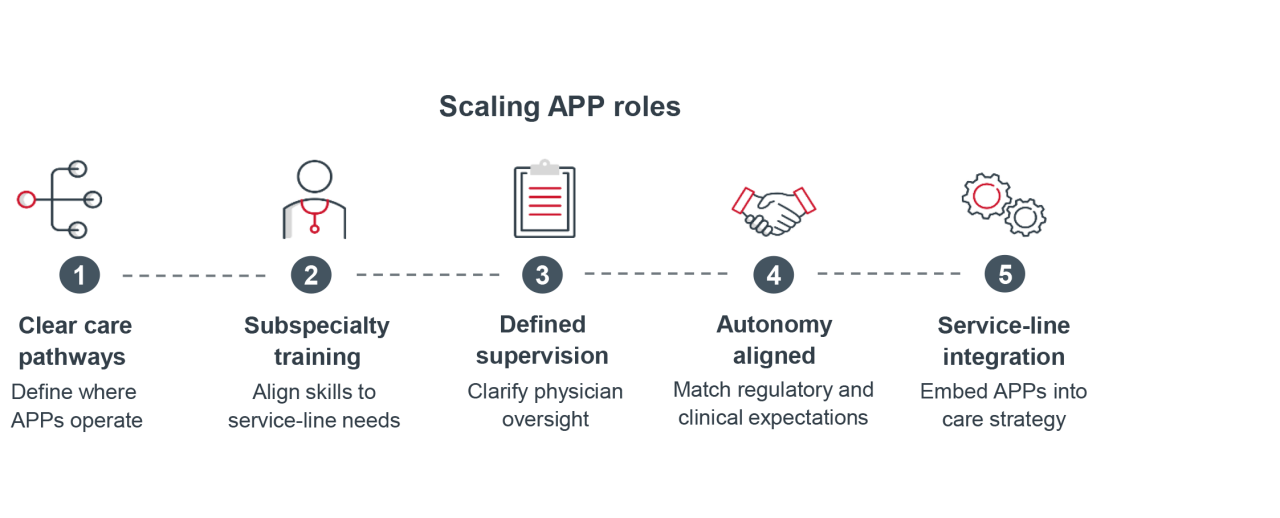
Through its work with health systems, CHG has found that organizations often see stronger results when they deliberately redesign care pathways so physicians can focus on complex cases, procedures, and high-acuity decision making. Routine follow-up visits, consult preparation, and other lower-acuity activities can often be shifted to APP-led pathways with clearly defined protocols and escalation triggers.
The payoff can be significant. For example, one outpatient neurology model used a virtual rapid-access clinic to reduce patient wait times by approximately 15 days while increasing monthly patient throughput by more than 50 visits, all without adding physician headcount.
Strategy 3: Rethink staffing models around demand
Many staffing plans are built around historical averages. That approach can create hidden vulnerabilities because patient demand rarely follows a static pattern.
Instead, health systems are increasingly using demand-driven coverage models that account for variables such as admission trends, day-of-week fluctuations, seasonal surges, discharge patterns, and service-line growth. When leaders understand when and where demand tends to peak, staffing can expand and contract accordingly.
That flexibility can be particularly valuable in hospital-based specialties where patient volume is heavily influenced by external demand. Rather than treating schedules as fixed, organizations can treat staffing as a dynamic variable that adapts alongside patient needs.
"We're definitely moving from order taking to strategic workforce planning."
Allan Cacanindin, VP of Physician and Provider Recruitment
SSM Health
Strategy 4: Build float pools to improve workforce flexibility
Unexpected physician leaves, retirements, or vacancies can quickly create operational disruptions. Many health systems are responding by building physician and APP float pools that can move where demand is greatest. Float pools create a pre-cleared layer of clinicians who are already credentialed, enrolled, and ready to practice across multiple locations. This allows organizations to redeploy capacity more quickly instead of rebuilding coverage plans every time a staffing gap emerges.
Interest among physicians appears strong. Roughly 60% of physicians report interest in taking on additional coverage beyond their core responsibilities, while nearly 80% say they would participate in an employer-sponsored float pool.4 Interest rises even further when telehealth and cross-site opportunities are available.
Organizations are partnering with CHG Healthcare to build varies different physician float pool models, including hub-and-spoke arrangements, regional specialty teams, virtual float pools, internal staffing marketplaces, and enterprise-wide coverage teams. While structures vary, each model is designed to create greater agility when demand shifts unexpectedly.
Strategy 5: Treat locums as a strategic workforce asset
Locum tenens coverage has become increasingly common as physician shortages persist. Today, locum physicians support care for as many as one in three patients each year.5
Despite that widespread use, many organizations continue to treat locums as a temporary solution used only during emergencies or vacancies. High-performing organizations are taking a different approach. Rather than cycling locums in and out of the system, they use them as a standing layer of capacity that supports continuity while permanent recruitment continues.
These organizations often prioritize longer assignments, predictable schedules, repeat engagements, and streamlined credentialing processes that allow clinicians to integrate more fully into clinical teams. The result is greater stability, less disruption, and improved workforce resilience. Many organizations are also adopting an "order of utilization" approach that evaluates all available staffing resources before capacity gaps become crises.
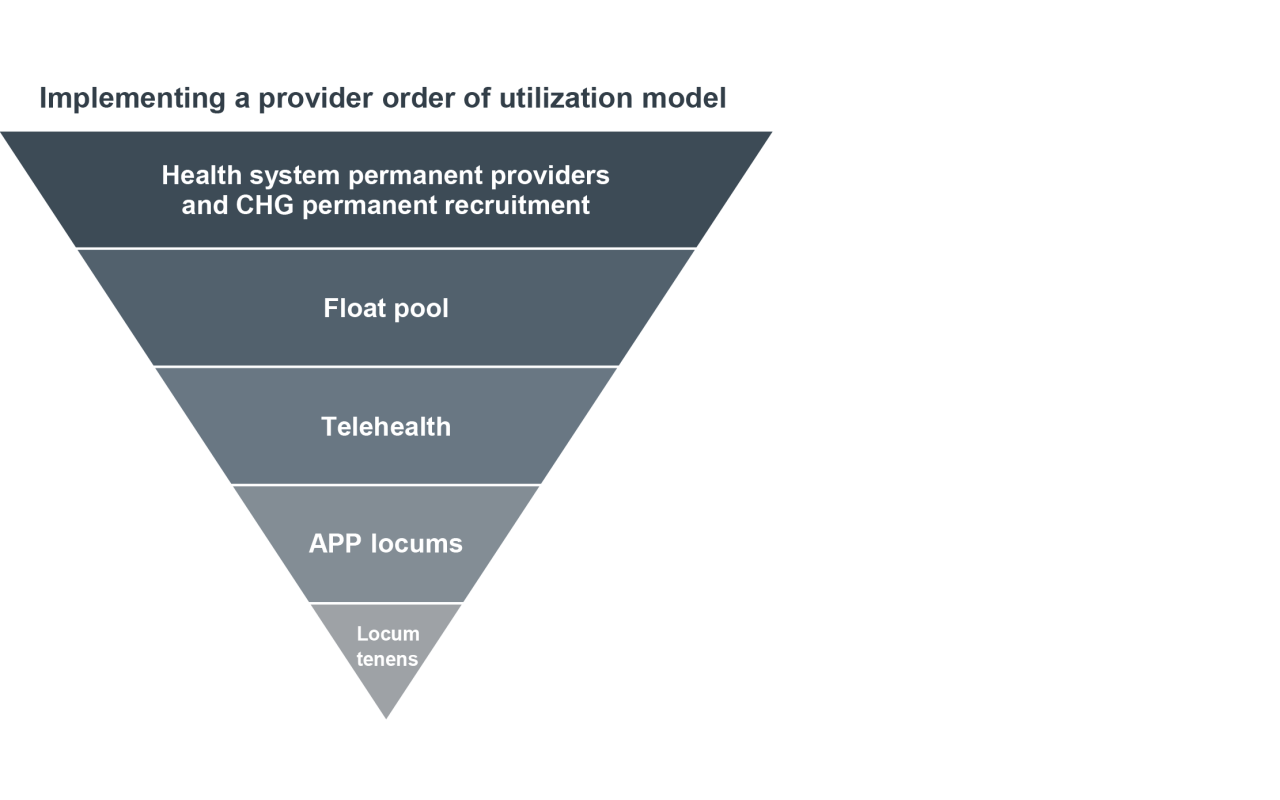
Instead of reacting to vacancies with ad hoc solutions, organizations following this model adopt a stepwise approach:
- Assess internal resources
Can existing employed providers cover demand? - Prioritize permanent recruitment
If not, begin sourcing permanent hires (noting that filling specialty roles can take 200+ days). - Leverage float pool technology
Deploy coverage based on healthcare provider preference and health system preference. - Bridge gaps strategically
Use temporary staffing solutions, such as locum tenens, telehealth, or APPs, timed to complement long-term workforce goals. - Integrate technology
A vendor management system can serve as the operational backbone for centralizing staffing data and supporting decision logic.
Parting thoughts
The combination of tight physician supply, inconsistent deployment, and rising demand has reshaped the workforce challenge. Through its work with health systems nationwide, CHG has seen organizations make the most progress when they move beyond one-off staffing fixes and build physician and APP workforces designed to perform under pressure, strengthening core physician capacity, expanding flexible coverage models, and using technology to reduce friction across recruitment, credentialing, deployment, and scheduling.
To learn more about the strategies health systems are using to build a future-ready workforce, read CHG Healthcare’s full report.
1 Association of American Medical Colleges. The Complexities of Physician Supply and Demand: Projections From 2021 to 2036.
2 Health Resources and Services Administration. Workforce projections. December 2025.
3 Advisory Board. APPs make up 41% of the provider workforce. Here's why it matters. May 19, 2025.
4 CHG Healthcare. Physician Sentiment, Engagement, and Retention Research. March 24, 2026.
5 CHG Healthcare. State of Locum Tenens Report. 2025.
As the nation’s leading physician workforce experts, CHG Healthcare connects physicians, advanced practice providers, and allied health professionals with healthcare organizations nationwide — helping deliver high-quality care to more than 20 million patients every year.
With more than 40 years of experience, CHG Healthcare and its family of brands deliver scalable, people-centered workforce solutions across the clinical spectrum — from locum tenens and permanent staffing to technology and advisory services — and are recognized for industry-leading Net Promoter Scores and partnerships with half of the nation’s largest health systems.
Headquartered in Salt Lake City with offices across the country, CHG is recognized as a top workplace for its culture of care, growth, and purpose. Learn more at CHG Healthcare.
This expert insight is sponsored by CHG Healthcare, an Advisory Board member organization. Representatives of CHG Healthcare helped select the topics and issues addressed. Advisory Board experts wrote the expert insight, maintained final editorial approval, and conducted the underlying research independently and objectively. Advisory Board does not endorse any company, organization, product or brand mentioned herein.
To learn more, view our editorial guidelines.
This expert insight is sponsored by CHG Healthcare. Advisory Board experts maintained final editorial approval, and conducted the underlying research independently and objectively.

Don't miss out on the latest Advisory Board insights
Create your free account to access 1 resource, including the latest research and webinars.
Want access without creating an account?
You have 1 free members-only resource remaining this month.
1 free members-only resources remaining
1 free members-only resources remaining
You've reached your limit of free insights
Become a member to access all of Advisory Board's resources, events, and experts
Never miss out on the latest innovative health care content tailored to you.
Benefits include:
Unlimited access to research and resources
Member-only access to events and trainings
Expert-led consultation and facilitation
The latest content delivered to your inbox
You've reached your limit of free insights
Become a member to access all of Advisory Board's resources, events, and experts
Never miss out on the latest innovative health care content tailored to you.
Benefits include:
Unlimited access to research and resources
Member-only access to events and trainings
Expert-led consultation and facilitation
The latest content delivered to your inbox
This content is available through your Curated Research partnership with Advisory Board. Click on ‘view this resource’ to read the full piece
Email ask@advisory.com to learn more
Click on ‘Become a Member’ to learn about the benefits of a Full-Access partnership with Advisory Board
Never miss out on the latest innovative health care content tailored to you.
Benefits Include:
Unlimited access to research and resources
Member-only access to events and trainings
Expert-led consultation and facilitation
The latest content delivered to your inbox
This is for members only. Learn more.
Click on ‘Become a Member’ to learn about the benefits of a Full-Access partnership with Advisory Board
Never miss out on the latest innovative health care content tailored to you.
Benefits Include:
Unlimited access to research and resources
Member-only access to events and trainings
Expert-led consultation and facilitation
The latest content delivered to your inbox