Auto logout in seconds.
Continue Logout

Study examines how comprehensive care model shapes costs
While women are more likely to live with chronic, complex health conditions, women’s healthcare is often fragmented, episodic, and centered on short-term reproductive needs rather than ongoing whole-person care. These dynamics often lead to delayed treatment, multiple specialist referrals, and faster escalation to procedures, increasing total cost of care.1 As payers navigate rising costs and healthcare systems struggle with staffing shortages, there is an urgent need for scalable approaches that improve women’s health while keeping costs down.
Against this backdrop, Optum Advisory (OA)* partnered with Visana to determine whether a virtual, comprehensive care model that combines clinical care with care navigation can reduce the total cost of care in real-world commercial populations.
*Advisory Board is a subsidiary of Optum. All Advisory Board research, expert perspectives, and recommendations remain independent.
Visana’s care model
Visana’s care model functions as a centralized medical home. Visana designed the model to support women with a range of complex conditions to address interconnected gynecologic, hormonal, metabolic, and lifestyle needs to improve clinical outcomes and reduce costs. At the center of the model is a nurse practitioner (NP) trained in Visana’s women’s health protocols, who follows patients throughout the care journey and each life stage. The NP works closely with a multidisciplinary clinical team — including a primary care provider, endocrinologist, and ob/gyn — to align on appropriate treatment pathways for each patient. Through collaboration, the NP addresses multiple symptoms over a series of virtual visits, delivering longitudinal, evidence-based care that prioritizes conservative treatments first.
Optum Advisory’s analysis
To evaluate the impact of the comprehensive women’s health and care navigation program, OA analyzed de-identified commercial claims data spanning from May 2023 to May 2025.2 Women who used Visana’s program were matched to women receiving usual care based on their age and the state they lived in.
In addition, the matching process included pre-program care needs and costs, number of medications, use of behavioral health services, and high-cost condition burden.
The primary goal of the analysis was to measure the change in the total cost of care and assess how reducing fragmentation across women’s health services impacts spending. The total cost of care was segmented into outpatient services, hospitalizations, imaging, laboratory services, and gynecological services.
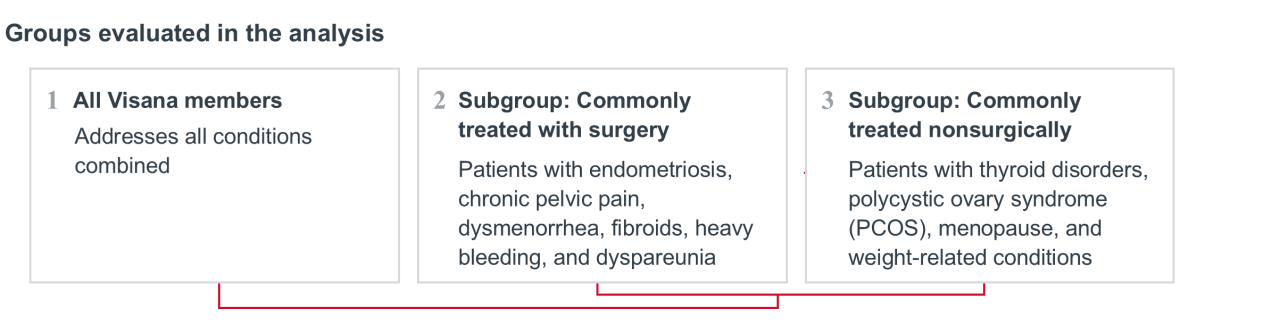
The analysis included the full Visana cohort and, within that cohort, subgroups of surgical and nonsurgical patients. The surgical subgroup included patients whose conditions are frequently treated with surgery, such as laparoscopy or hysterectomy, before more conservative management approaches can be tried. The nonsurgical subgroup consisted of patients whose conditions, such as menopause, are typically managed with long-term medical management, lifestyle intervention, and hormonal and metabolic optimization.
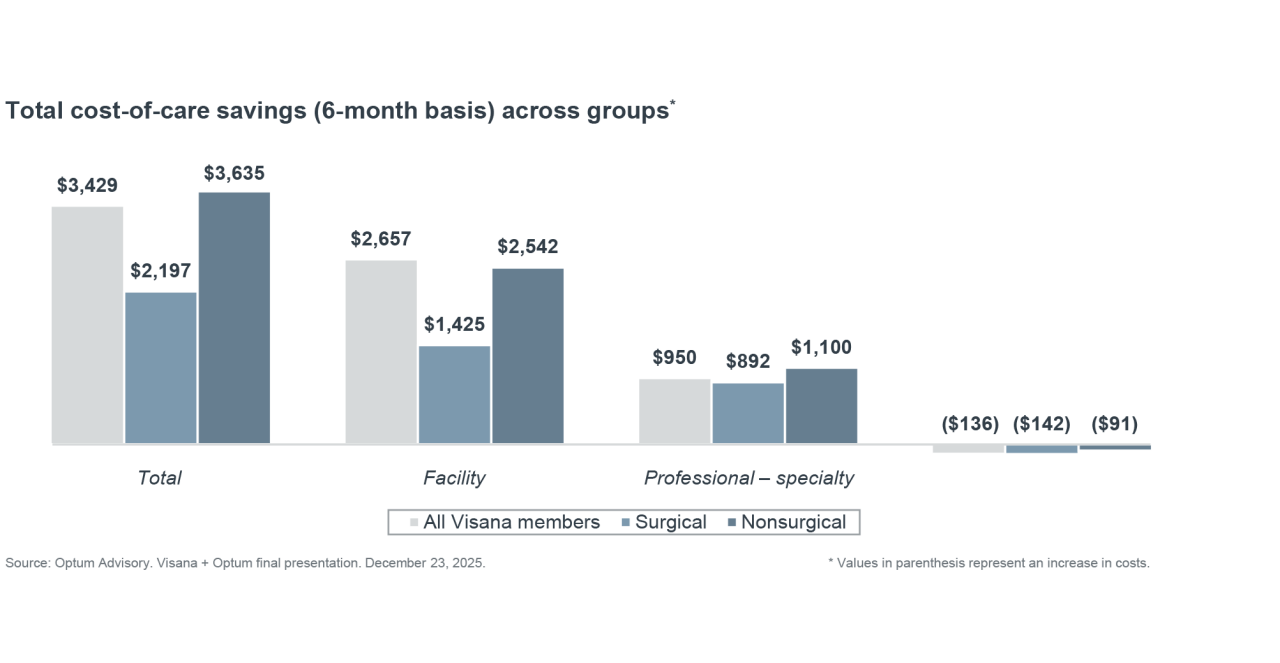
The analysis showed an average savings of $3,429 per member across the combined surgical and nonsurgical subgroups enrolled in Visana’s care delivery model. Within Visana’s nonsurgical subgroup, which was driven by menopause patients, savings reached $3,635 per member. Among patients whose conditions are often treated surgically, costs decreased by an average of $2,197 per member six months after the program began. All cost reductions were largely driven by lower spending on facility, imaging, lab, and specialist services.
$3,429
Average savings per member across the combined surgical and nonsurgical subgroups
These results suggest that fragmentation is a significant source of avoidable women’s health spending, and a comprehensive women’s health model like Visana’s can reduce total cost of care by improving healthcare efficiency and optimizing utilization.
Implications of the study
Fragmentation is a hidden driver of avoidable women’s health spending
Fragmentation, when a patient doesn’t have a single clinician who delivers the bulk of a patient’s care, is both widespread and underacknowledged within U.S. healthcare.3 Patients with complex or overlapping conditions often navigate multiple specialists, site-of-care settings, and care plans. Because each individual provider can rarely see a patient’s full clinical picture, opportunities for coordinated care are frequently missed, while clinicians may be unable to see important connections among related conditions. Tests and procedures may also be unnecessarily repeated, adding avoidable spending without improving outcomes.
OA’s analysis reflects these broad patterns: Patients who received virtual, comprehensive care used fewer healthcare services and had lower costs than similar patients who did not. Specifically, Visana patients were less likely than the control group to use facility inpatient and outpatient services. This reduction was driven by fewer inpatient admissions, fewer visits to the emergency department (ED), and less use of services like labs, imaging, and specialty visits.
Visana patients had about three fewer outpatient claims per five Visana patients and 36 fewer specialty-related claims. Finally, Visana patients had one more primary care visit than non-Visana patients, which may reflect how Visana’s model is structured to manage costs.
Overall, the data suggest that the comprehensive, virtual model helped patients avoid higher-cost settings and unnecessary specialty care, while slightly increasing primary care engagement.
Comprehensive women’s healthcare delivered with a medical home model and navigation services can reduce total cost of care
The healthcare industry has long prioritized sexual and reproductive care, despite these categories representing only 5% of women’s health needs. The remaining 95% of complex conditions in women are often chronic and best served by a whole-person, comprehensive framework, rather than episodic care.1
95%
Of complex conditions are best served by comprehensive, not episodic, care
Visana’s care model is designed to address multiple complex and costly conditions within one medical home. Patients often present with a single concern they believe explains their symptoms. By addressing multiple conditions in a single visit and then following patients longitudinally, the NP and clinician care team aim to move beyond symptom‑by‑symptom treatment and toward whole-person support for patients with overlapping or multifactorial concerns — including gathering a full history, identifying underlying causes, and creating a focused treatment plan.
Care is also coordinated to align providers, services, and clinical information across the patient’s care journey and stages of life. When care is coordinated, patients are less likely to experience fragmented pathways that lead to repeat testing, unnecessary specialty visits, or reliance on high-cost sites of service — ultimately lowering avoidable downstream spend.
Optum consulting's analysis indicates that this model leads to a more efficient use of care on a broad scale. The largest cost reductions occurred in nonsurgical, medically complex patients — such as those with menopause, PCOS, and weight-related conditions — where rates of misdiagnosis are typically high4,5 and fragmented care drives repeated specialty visits and testing. Savings were more modest among the surgical cohort, but still significant. Visana patients had lower downstream utilization following procedures, which may reflect improved care coordination, medication management, and reduced reliance on repeat emergency department and specialty visits.
These results suggest that for women with preventive, hormonal, metabolic, and gynecologic health needs, earlier engagement with comprehensive healthcare is associated with fewer avoidable hospital visits and procedures, as well as more efficient care later in the treatment pathway.
Final thoughts
By emphasizing a conservative-first, whole-person approach early in the care journey, Visana’s model has influenced overall utilization patterns, lowering the total cost of care. The approach suggests a shift away from specialist referrals and outpatient services that may not be necessary, while placing greater emphasis on coordination and appropriateness of care. From a payer’s perspective, this model aligns with existing priorities related to utilization management, network optimization, and value-based care — and may offer a framework for addressing cost and efficiency considerations.
1 Koffel A, et al. The $50 billion opportunity for US health systems to improve women’s healthcare. McKinsey & Company. November 18, 2025.
2 In this propensity score matched study, Visana patients were matched 5:1 to nonVisana controls based on a number of variables, but especially costs, in the six months before the index event. Outcomes were assessed using a difference-in-differences framework comparing healthcare utilization and spending for six months after program initiation.
3 Kern LM, et al. Care Fragmentation, Care Continuity, and Care Coordination—How They Differ and Why It Matters. JAMA Internal Medicine. January 29, 2024.
4 Krewson C. High rates of misdiagnosis reported among perimenopausal women. Contemporary OB/GYN. November 13, 2025.
5 Johnson A. This hormone condition affects millions of women but is often misdiagnosed The Washington Post. October 17, 2025.
Visana is a comprehensive, in-network virtual women’s health clinic that delivers whole-person medical care for women from menstruation through menopause. Plan members get timely, accurate diagnoses and coordinated treatment without having to seek out costly specialty providers. By replacing fragmented point solutions with a clinical medical home model for women, Visana reduces avoidable surgeries and emergency department visits while improving outcomes and member satisfaction. Visana is available in all 50 states. Learn more at www.visanahealth.com.
This expert insight is sponsored by Visana, an Advisory Board member organization. Representatives of Visana helped select the topics and issues addressed. Advisory Board experts wrote the content, maintained final editorial approval, and conducted the underlying research independently and objectively. Advisory Board does not endorse any company, organization, product or brand mentioned herein.
To learn more, view our editorial guidelines.

This expert insight is sponsored by Visana. Advisory Board experts conducted the research and maintained final editorial approval.

Jennifer Fierke
Senior writer and editor, Sponsorship
Posted on March 06, 2026

Don't miss out on the latest Advisory Board insights
Create your free account to access 1 resource, including the latest research and webinars.
Want access without creating an account?
You have 1 free members-only resource remaining this month.
1 free members-only resources remaining
1 free members-only resources remaining
You've reached your limit of free insights
Become a member to access all of Advisory Board's resources, events, and experts
Never miss out on the latest innovative health care content tailored to you.
Benefits include:
Unlimited access to research and resources
Member-only access to events and trainings
Expert-led consultation and facilitation
The latest content delivered to your inbox
You've reached your limit of free insights
Become a member to access all of Advisory Board's resources, events, and experts
Never miss out on the latest innovative health care content tailored to you.
Benefits include:
Unlimited access to research and resources
Member-only access to events and trainings
Expert-led consultation and facilitation
The latest content delivered to your inbox
This content is available through your Curated Research partnership with Advisory Board. Click on ‘view this resource’ to read the full piece
Email ask@advisory.com to learn more
Click on ‘Become a Member’ to learn about the benefits of a Full-Access partnership with Advisory Board
Never miss out on the latest innovative health care content tailored to you.
Benefits Include:
Unlimited access to research and resources
Member-only access to events and trainings
Expert-led consultation and facilitation
The latest content delivered to your inbox
This is for members only. Learn more.
Click on ‘Become a Member’ to learn about the benefits of a Full-Access partnership with Advisory Board
Never miss out on the latest innovative health care content tailored to you.
Benefits Include:
Unlimited access to research and resources
Member-only access to events and trainings
Expert-led consultation and facilitation
The latest content delivered to your inbox