Auto logout in seconds.
Continue Logout

Electronic health records (EHRs) are no longer just clinical documentation tools — they are foundational platforms that shape how care is delivered, how teams work, and how organizations perform. When thoughtfully optimized, the EHR becomes a strategic asset that advances safety, efficiency, and decision-making across the enterprise. In this series, we explore how leaders in pharmacy, nursing, and operations can unlock that value.
Electronic health records (EHRs) play a central role in nursing care, but their impact on nursing is often underestimated. When organizations optimize EHRs, they can support nursing by improving care quality and safety, reducing documentation burden, strengthening operational oversight, and supporting workforce sustainability. While CNOs may not lead enterprise EHR strategy, the growing influence of these systems on nursing practice requires nurse executives to play a far more active role.
Benefit 1: Clear governance accelerates EHR value realization
EHR optimization delivers value when ownership is unambiguous. In organizations where governance is diffuse or largely IT led, optimization tends to be reactive and episodic, driven by upgrades, complaints, or vendor roadmaps rather than nursing priorities.
High-performing organizations take a different approach. They formalize governance that clearly anchors EHR value to nursing leadership, most often through a CNO-CNIO dyad or a closely aligned CNO-CIO partnership. In this model, the CNO defines what matters for nursing practice, safety, and workforce sustainability, while the informatics partner translates those priorities into build decisions, standards, and measurement. In organizations where CNOs and CNIOs jointly sponsor documentation design and optimization, practice-based evidence shows that time spent on common nursing documentation tasks can be reduced by up to 50%.1 Optimization becomes part of normal operations rather than a series of disconnected fixes, and frontline engagement is built into the process rather than added after the fact.
This clarity of ownership changes outcomes because it collapses the distance between clinical priorities and digital execution. Documentation changes align more closely to real workflows, upgrades create fewer unintended consequences, and optimization efforts compound over time instead of resetting each year. In organizations that treat governance as an operating model rather than a formality, the EHR shifts from a constraint on nursing practice to a platform for improvement.
AI-enabled decision support, predictive analytics, and virtual nursing models all depend on consistent, high-quality data to function effectively.
Benefit 2: Standardized nursing data strengthens visibility and accountability
Most nurse executives lack a reliable, enterprise-wide picture of how nursing work is actually performed. This is rarely due to a lack of data, but rather to inconsistent nursing documentation standards and uneven use of structured data. When assessments and care plans vary by unit or individual preference, dashboards tell incomplete stories and comparisons across settings lose meaning.2
Organizations that prioritize standardized nursing data unlock a fundamentally different level of visibility. By aligning documentation to consistent terminologies and data definitions, CNOs gain clearer insight into nurse-sensitive outcomes; variation in practice; and the relationship between staffing, workload, and quality. Decisions about improvement, investment, and staffing are grounded in shared evidence rather than anecdotes.
This foundation becomes increasingly important as health systems adopt more advanced digital capabilities. AI-enabled decision support, predictive analytics, and virtual nursing models all depend on consistent, high-quality data to function effectively. Without standardization, these tools amplify noise and variability. With it, they reinforce accountability and trust, allowing nursing leaders to see both current performance and emerging risk with confidence.
Benefit 3: Measuring documentation burden on nurses enables targeted reduction
Documentation burden persists in part because it is more often discussed than measured. Nurse executives routinely hear that workflows are inefficient or that the EHR consumes too much time but lack consistent metrics to identify where burden is concentrated or which changes deliver meaningful relief. Without measurement, burden becomes accepted as inevitable rather than managed as an operational problem.
Organizations that treat burden as a measurable construct shift this dynamic. By tracking a focused set of indicators such as documentation time per shift, incrementable overtime attributable to EHR work, alert volume per nurse, and clicks required for core workflows, leaders gain clarity on what drives inefficiency.
This level of measurement allows CNOs to prioritize optimization efforts with intent and demonstrate results over time. Redesigning flowsheets, care plans, or navigation paths becomes a disciplined process rather than an act of goodwill toward frontline staff. As burden reduction becomes visible and repeatable, EHR optimization competes more effectively for leadership attention and resources, and nursing time is reclaimed in ways that endure.
Benefit 4: Embedded dashboards improve operational decision-making
Many health systems already produce dashboards that track nursing quality and performance, but too often those insights arrive after decisions have already been made. When data lives in retrospective reports or static summaries, leaders are forced to manage yesterday’s problems instead of anticipating today’s risks.
High-performing organizations embed role specific dashboards directly into daily nursing workflows and leadership routines.3 Charge nurses and unit leaders have access to near real-time indicators that support staffing adjustments and escalation, while nurse executives maintain consistent visibility into system-level trends without relying on periodic reports. Evidence shows that well designed clinical dashboards can improve safety and reduce errors when they are integrated into routine practice rather than used solely for review.
The result is a shift in how leaders lead. Decisions become faster and more confident because they are grounded in timely, actionable information. Instead of reacting to trends once they solidify, leaders can intervene earlier, redistribute resources, and support frontline teams proactively. In this context, the EHR becomes not just a patient record, but a management platform for nursing operations.
Over the next several years, the EHR will function less as a documentation system and more as a care delivery platform.
Considerations for nurse executives
Even in organizations that have made progress with EHR optimization, interoperability and usability constraints continue to shape what is feasible. Gaps across devices and ancillary systems can still fragment workflows or drive duplicate documentation, underscoring the need for ongoing governance and targeted investment rather than onetime fixes.
These considerations become more consequential as health systems expand AI-enabled decision support and virtual nursing models. Advanced tools increasingly depend on reliable nursing data and clearly defined workflows. Without those foundations, innovation risks amplifying variability and cognitive load rather than supporting practice. Virtual nursing and alert-based decision support are particularly sensitive to this dynamic, succeeding when roles, documentation, and escalation pathways are tightly integrated into the EHR, and stalling when layered onto fragile workflows.
For nurse executives, this shifts the goal from “solving the EHR” to stewarding it over time. Optimization must be treated as continuous operational work, supported by clear governance, sustained executive sponsorship, and active frontline engagement.
Over the next several years, the EHR will function less as a documentation system and more as a care delivery platform. Its ability to enhance nursing practice, and strengthen quality and safety will depend on the strength of nursing leadership, standardized data, and a unified digital strategy.
To accelerate progress, health systems can adopt a focused, practical roadmap.
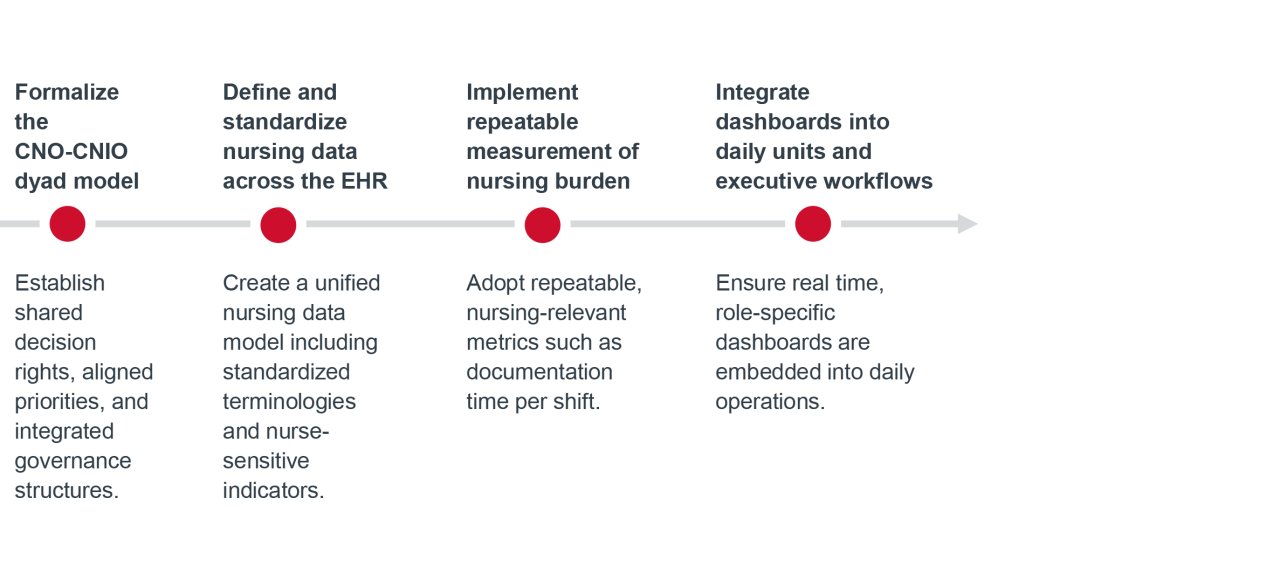
Taken together, this governance‑led approach allows nurse executives to move beyond incremental fixes and position the EHR as a durable engine for nursing quality, efficiency, and workforce sustainability.
1 Hager C. Led by Practice, Supported by IT: Reimagining Nursing Documentation. Epic Systems Corporation. March 2025.
2 Moy AJ, Schwartz JM, Chen R, et al. Measurement of clinical documentation burden among physicians and nurses using electronic health records: A scoping review. Journal of the American Medical Informatics Association. January 12, 2021.
3 Young L, Johnson AH, et al. From an Informatics Lens: Dashboards for Hospital Nurse Managers Influencing Unit Patient Outcomes. Computers Informatics, Nursing: CIN. February 1, 2025.


Don't miss out on the latest Advisory Board insights
Create your free account to access 1 resource, including the latest research and webinars.
Want access without creating an account?
You have 1 free members-only resource remaining this month.
1 free members-only resources remaining
1 free members-only resources remaining
You've reached your limit of free insights
Become a member to access all of Advisory Board's resources, events, and experts
Never miss out on the latest innovative health care content tailored to you.
Benefits include:
Unlimited access to research and resources
Member-only access to events and trainings
Expert-led consultation and facilitation
The latest content delivered to your inbox
You've reached your limit of free insights
Become a member to access all of Advisory Board's resources, events, and experts
Never miss out on the latest innovative health care content tailored to you.
Benefits include:
Unlimited access to research and resources
Member-only access to events and trainings
Expert-led consultation and facilitation
The latest content delivered to your inbox
This content is available through your Curated Research partnership with Advisory Board. Click on ‘view this resource’ to read the full piece
Email ask@advisory.com to learn more
Click on ‘Become a Member’ to learn about the benefits of a Full-Access partnership with Advisory Board
Never miss out on the latest innovative health care content tailored to you.
Benefits Include:
Unlimited access to research and resources
Member-only access to events and trainings
Expert-led consultation and facilitation
The latest content delivered to your inbox
This is for members only. Learn more.
Click on ‘Become a Member’ to learn about the benefits of a Full-Access partnership with Advisory Board
Never miss out on the latest innovative health care content tailored to you.
Benefits Include:
Unlimited access to research and resources
Member-only access to events and trainings
Expert-led consultation and facilitation
The latest content delivered to your inbox
