Auto logout in seconds.
Continue Logout

For the bulk of 2023, I have been investigating how health systems are partnering with other health systems, universities, public research institutions, private companies, and governments abroad to achieve core objectives. The five objectives we are seeing the most activity around are: recruiting, training, and retaining staff; delivering on mission; advancing research and innovation; generating new revenue; and reducing supply costs.
In June, I hosted webinars for health system executives and directors on the topic. More than 50 representatives from organizations across the United States, Canada, Brazil, Australia, and New Zealand joined across the two sessions. These webinars also served as an opportunity to conduct in-the-moment research through live surveys. Below is our analysis of the polling results, and the three things that stuck out to us as the most surprising responses across the two sessions.
Participants across both sessions ranked “advancing innovation” as a key motivator for partnering abroad. We asked participants to choose which strategies they were currently or most interested in pursuing to achieve this objective.
You can see the results from the poll below – most health systems are still focused on traditional clinical research, or advancing scientific knowledge, rather than creating net – new products.
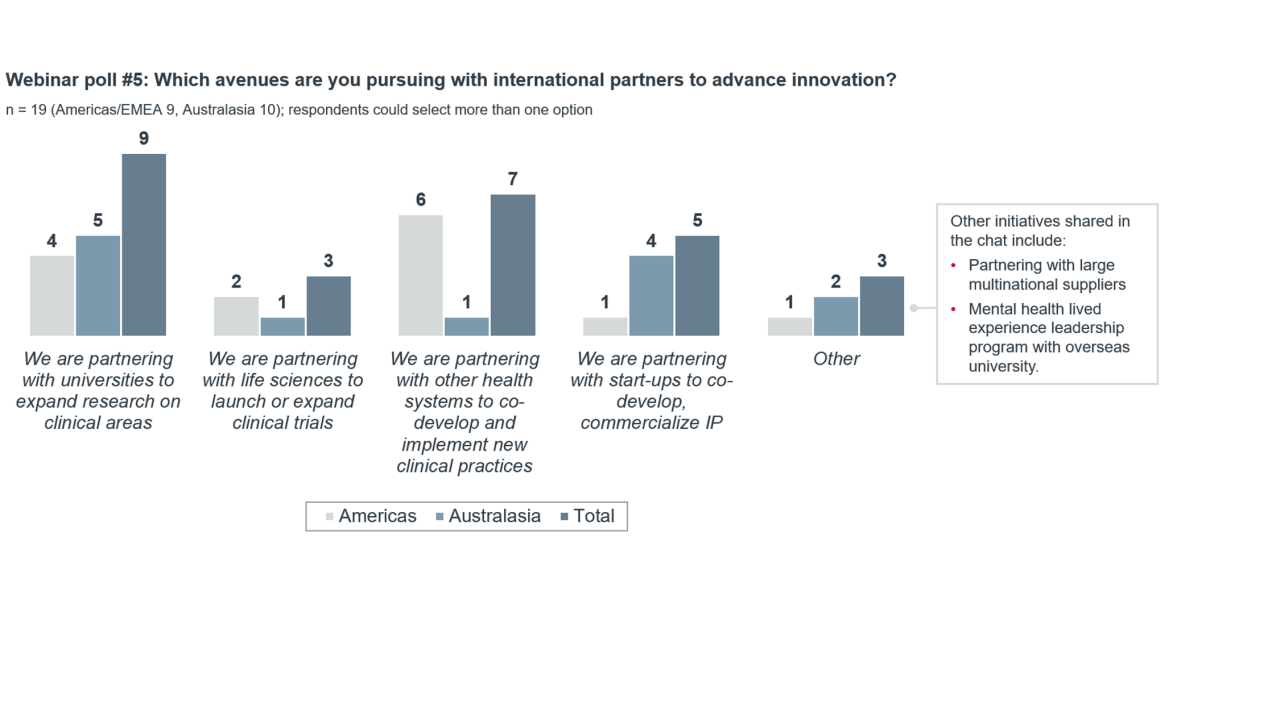
We know that the future financial environment will reward health systems that create and commercialize IP. In fact, we predict rapid growth in the number of systems entering into innovation or data sharing ecosystems as a means to achieving this advantage. Health systems are missing early opportunities to leverage existing partnerships to co-develop IP, such as clinical models and practices or AI tools, that they can license or sell to other providers.
Health systems have an array of opportunities to generate revenue abroad—from providing consulting services, to managing foreign-owned organizations, to forming affiliations to increase inbound international patient volumes. The two most popular approaches, as you can see below, were consulting engagements and partnerships with foreign governments.
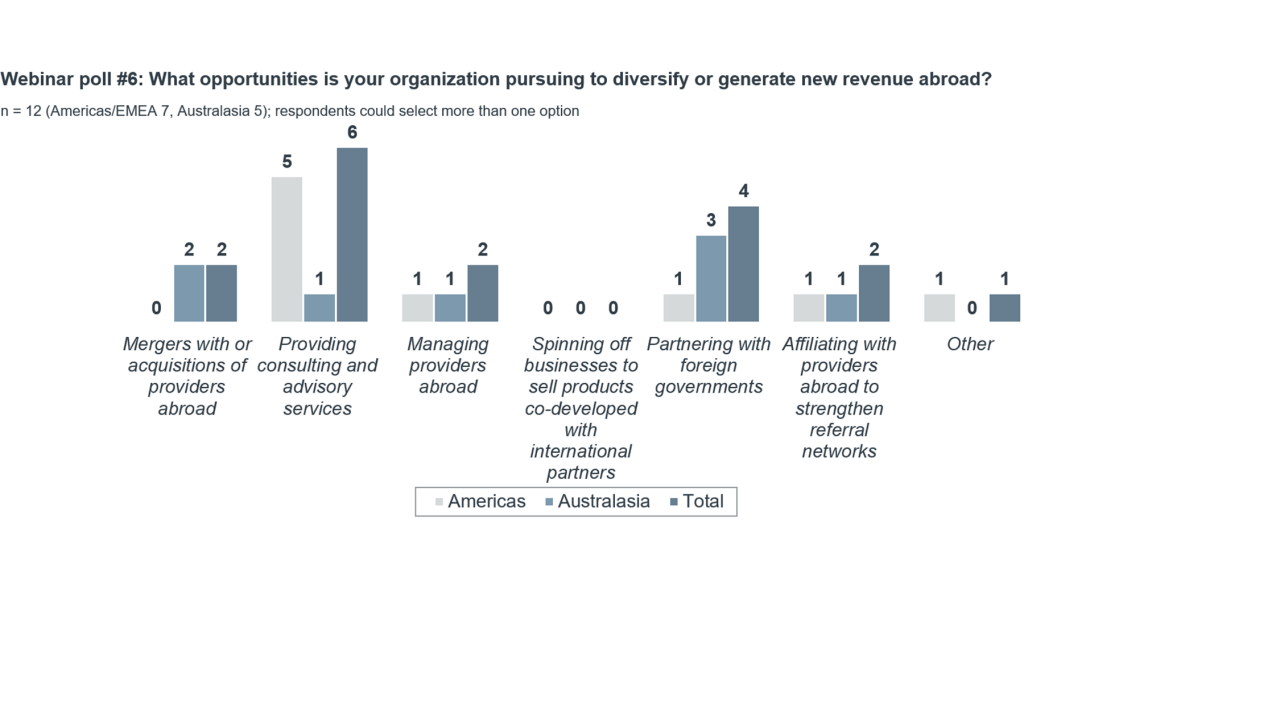
These two responses point to polarizing approaches: Consulting engagements suggest an approach with a short-term exit strategy, while partnering with governments point to an ambition to establish a long-term presence in a market.
An effective international partnership approach requires intentionality—and health systems pursuing both strategies simultaneously will eventually have to make a choice about what their identity is the markets where they operate. In interviews, executives of health systems with decades-long partnership experience told us they have all had to make this trade-off recently. Their current, intentional approach focuses their resources on only the activities and markets that best enable their organization to meet their other core objectives.
Despite “delivering on mission” being one of the key motivators for partnering internationally, the poll results, as shown below, reveal that most health systems are still mainly focused on their local patients or are concentrating resources within fewer markets.
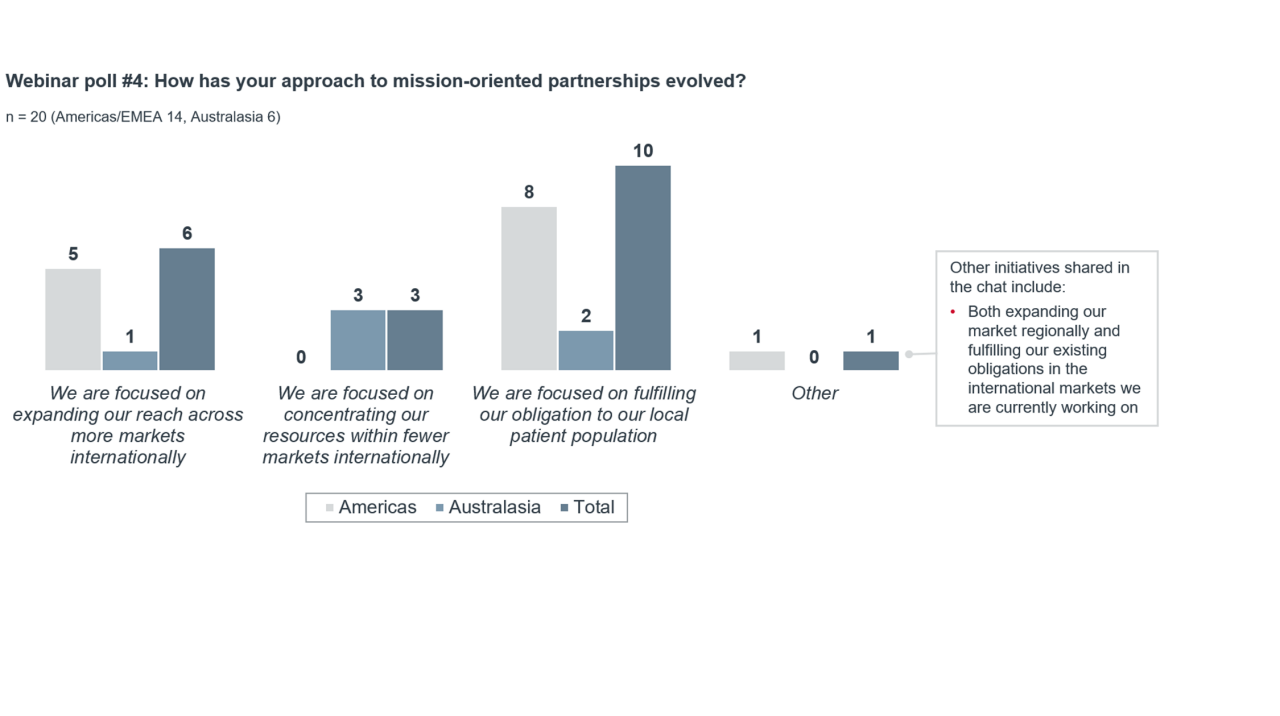
Respondents’ focus on their local patients is likely a sign of economic pressures pushing organizations to prioritize core business. But research interviews with leading systems suggest that it’s also a sign that demand for external expertise is shrinking in markets that were previously hotspots for mission-driven ventures as providers develop capabilities to deliver services domestically, such as countries across the Middle East.
Our position is that health systems’ focus on their local patients illustrates a common misconception that mission-driven international ventures don’t benefit local populations. On the contrary, health systems have shown for years that they can improve care for patients abroad and at home by practicing cultural humility and importing practices and knowledge from their international peers. Additionally, mission-driven ventures can be leveraged as a retention tool for staff who find opportunities to work with clinicians and patients abroad engaging.

Paul Trigonoplos
Director, Hospital and health system research
Posted on September 12, 2023
Updated on January 03, 2024

Don't miss out on the latest Advisory Board insights
Create your free account to access 1 resource, including the latest research and webinars.
Want access without creating an account?
You have 1 free members-only resource remaining this month.
1 free members-only resources remaining
1 free members-only resources remaining
You've reached your limit of free insights
Become a member to access all of Advisory Board's resources, events, and experts
Never miss out on the latest innovative health care content tailored to you.
Benefits include:
Unlimited access to research and resources
Member-only access to events and trainings
Expert-led consultation and facilitation
The latest content delivered to your inbox
You've reached your limit of free insights
Become a member to access all of Advisory Board's resources, events, and experts
Never miss out on the latest innovative health care content tailored to you.
Benefits include:
Unlimited access to research and resources
Member-only access to events and trainings
Expert-led consultation and facilitation
The latest content delivered to your inbox
This content is available through your Curated Research partnership with Advisory Board. Click on ‘view this resource’ to read the full piece
Email ask@advisory.com to learn more
Click on ‘Become a Member’ to learn about the benefits of a Full-Access partnership with Advisory Board
Never miss out on the latest innovative health care content tailored to you.
Benefits Include:
Unlimited access to research and resources
Member-only access to events and trainings
Expert-led consultation and facilitation
The latest content delivered to your inbox
This is for members only. Learn more.
Click on ‘Become a Member’ to learn about the benefits of a Full-Access partnership with Advisory Board
Never miss out on the latest innovative health care content tailored to you.
Benefits Include:
Unlimited access to research and resources
Member-only access to events and trainings
Expert-led consultation and facilitation
The latest content delivered to your inbox
