Quick Guide

5 minute read

Computer vision in healthcare

Computer vision is a growing field of artificial intelligence with transformative potential to improve patient diagnosis, treatment, and monitoring. Learn about the advancing technologies and discover the different ways healthcare leaders can implement computer vision to enhance care quality and address workforce challenges.

What is it?

Computer vision is a field of artificial intelligence that focuses on training computers to identify and understand information from images or videos. On a basic level, computer vision replicates the human capability of interpreting what we see.

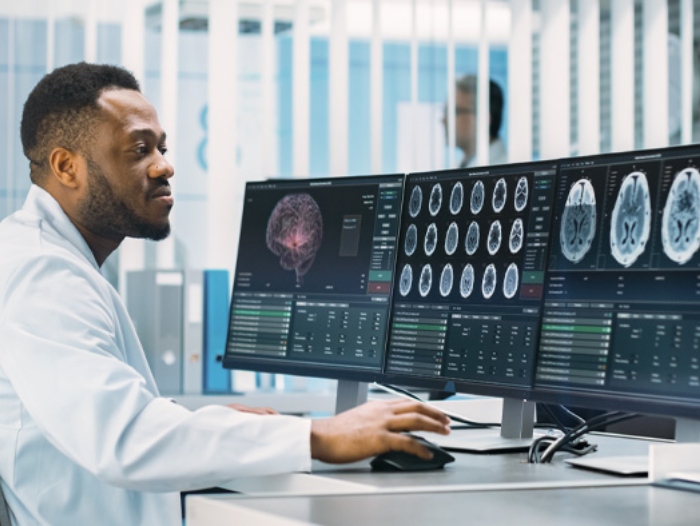
Healthcare is one of the leading industries applying computer vision technology because it generates a vast amount of visual data from various imaging modalities.¹ Doctors and medical researchers are predominately using computer vision on static images, such as X-rays, MRIs, CT scans, ultrasounds, and cellular and molecular structures. Medical image interpretation is popular in specialties such as radiology, pathology, ophthalmology, and dermatology.² This is due to the ability to detect subtle changes or recognize patterns in medical images is critical for early detection, diagnosis, and effective treatment.

The primary focus for computer vision in healthcare has been medical image interpretation, but there is growing interest and research in video interpretation. This is because there are transformative applications in patient monitoring, surgical guidance, and behavioral analysis. Despite transformative potential, there has been slower progress in this space for two main reasons. First, computational techniques and datasets for video analysis evolved more slowly compared to images. Generally, images are easier to handle than video data, which contains multiple frames per second and higher volumes of data. Second, image interpretation has a greater clinical relevance. Nevertheless, advancements in computational power and algorithm development are poised to quicken the pace of video interpretation in healthcare, unlocking its full potential for real-time and procedural applications.

Uses for computer vision in healthcare

  • Analyze medical images to diagnose diseases and abnormalities.
  • Help surgeons during procedures by providing real-time guidance and feedback.
  • Track human activity in healthcare settings, such as hospitals and nursing homes.
  • Analyze patient behavior and expressions to assess pain levels, emotional states, and cognitive impairments.
  • Track vital signs, such as heart rate and respiratory rate, by analyzing facial and body movements.
  • Detect falls and abnormal movements, especially in older and at-risk patients.
  • Track disease progression by analyzing changes in visual data over time. 

Why does it matter?

By integrating computer vision technologies into workflows, healthcare organizations have the potential to improve the quality of patient care and the efficiency of the workforce. These are both pressing concerns due to an aging population with increasingly complex needs.

Computer vision algorithms can be used for the initial analysis of medical images,³ which not only saves time but also improves clinician speed and accuracy. In this process, the computer vision systems can acquire medical images from various sources, standardize the images, and analyze them with high accuracy and efficiency. This allows more time for medical professionals to focus on interpreting complex cases, consulting with patients, making treatment decisions, and performing other tasks that require their specialized knowledge and skills.

Computer vision can also analyze video content and augment patient monitoring. Healthcare professionals often need to monitor patients' activities, vital signs, and adherence to prescribed treatments. Computer vision can automate some of this process by tracking movement, analyzing facial expressions, and checking vital signs through visual cues. This reduces the burden on healthcare professionals, allowing them to focus on critical tasks and patients requiring immediate attention.

Key impacts on quality of care⁴

  • Improved patient diagnosis, treatment, and monitoring
  • Earlier/more accurate disease detection
  • Safer care
  • Reduced likelihood of patient falls
  • Advanced/smart operating rooms
  • Improved patient identification
  • Faster medical research

Key impacts on workforce challenges

  • Task automation
  • Efficiency improvement
  • Reduced burnout
  • Better training and education

How does it work?

Computer vision is founded on pattern recognition. Humans can train a computer how to understand visual data by feeding it millions of images or video content, then subjecting them to various software techniques or algorithms that allow the computer to hunt down patterns in all the elements that relate to those labels.⁵

In many instances, a sensing device — often a camera — will capture an image or video and send it to an interpreting device. The device uses pattern recognition to compare against its library of known patterns. A user can then ask for information about the image or video from the device.

Most computer vision applications involve trying to recognize things in images or videos. There is a lot of variability in visual data, and it can often be difficult to interpret the semantic content of images or videos, such as object recognition, scene understanding, and context. The three main capabilities of computer vision include:

  1. Object classification: Classifies objects according to a defined category.
  2. Object identification: Identifies a particular object in a photo, video, or image.
  3. Object tracking: Analyzes a video to process the location of a moving object.

For computer vision in healthcare to be successful and have a tangible impact, several key components and considerations must be in place beyond the technology itself:

  • Reliable alert systems: Solutions should provide timely and accurate alerts to make sure staff immediately act on critical findings. Timeliness and accuracy of alerts will help reduce alert fatigue, which can occur if staff are overwhelmed by frequent or false alarms.
  • Clear protocols and guidelines: There should be established protocols for how to respond to several types of alerts or findings from the computer vision system. Staff should know the steps to take, who to notify, and how to document actions taken in response to system outputs.
  • Integration with clinical workflows: Computer vision tools must be seamlessly integrated into existing clinical workflows to ensure they support healthcare professionals without causing disruptions.
  • User training and acceptance: Staff must be adequately trained not only on how to use the computer vision system but also on its capabilities and limitations.

Conversations you should be having
01
Identify specific areas within your organization where computer vision technology can be effectively applied.
02
Start with small-scale pilot projects to test the feasibility and effectiveness of computer vision technology in your organization.
03
Consider factors such as integration capabilities, scalability, ongoing support, and cost-effectiveness of the computer vision solutions that might be a good fit for your organization.
04
Continuously monitor advancements in computer vision technology and stay informed about emerging trends, research, and best practices.

Remember, each healthcare organization is unique, so it's essential to tailor this guidance to your specific goals. By taking a strategic and informed approach, healthcare provider executives can successfully leverage computer vision technology to enhance patient care, improve operational efficiency, and drive innovation in their organizations. Additionally, it's imperative to keep this tool under human supervision, reinforcing that computer vision complements but does not replace essential human judgment.

1 Piefer R. Google launches suite of AI tools. HealthcareDive, October 6, 2022.

2 Esteva A, Chou K, Yeung S, et al. Deep learning-enabled medical computer vision. NPJ, January 8, 2021.

3 What is computer vision? AWS. 2024

4 Goldsmith J. The Value of Computer Vision in Healthcare. Healthcare HIMMS. July 22, 2021.

5 Mihajlovic, I. Everything You Ever Wanted To Know About Computer Vision. Medium. April 25, 2019.


SPONSORED BY

INTENDED AUDIENCE
  • Digital health
  • Health plans
  • Hospitals and health systems

AFTER YOU READ THIS
  • You'll understand how computer vision can transform healthcare.
  • You'll learn how to tackle computer vision adoption challenges.
  • You'll gain insights on computer vision use cases and strategies.

Don't miss out on the latest Advisory Board insights

Create your free account to access 1 resource, including the latest research and webinars.

Want access without creating an account?


You have 1 free members-only resource remaining this month.

1 free members-only resources remaining

1 free members-only resources remaining

You've reached your limit of free insights

Become a member to access all of Advisory Board's resources, events, and experts

Never miss out on the latest innovative health care content tailored to you.

Benefits include:

Unlimited access to research and resources
Member-only access to events and trainings
Expert-led consultation and facilitation
The latest content delivered to your inbox

You've reached your limit of free insights

Become a member to access all of Advisory Board's resources, events, and experts

Never miss out on the latest innovative health care content tailored to you.

Benefits include:

Unlimited access to research and resources
Member-only access to events and trainings
Expert-led consultation and facilitation
The latest content delivered to your inbox

This content is available through your Curated Research partnership with Advisory Board. Click on ‘view this resource’ to read the full piece

Email ask@advisory.com to learn more

Click on ‘Become a Member’ to learn about the benefits of a Full-Access partnership with Advisory Board

Never miss out on the latest innovative health care content tailored to you. 

Benefits Include:

Unlimited access to research and resources
Member-only access to events and trainings
Expert-led consultation and facilitation
The latest content delivered to your inbox

This is for members only. Learn more.

Click on ‘Become a Member’ to learn about the benefits of a Full-Access partnership with Advisory Board

Never miss out on the latest innovative health care content tailored to you. 

Benefits Include:

Unlimited access to research and resources
Member-only access to events and trainings
Expert-led consultation and facilitation
The latest content delivered to your inbox
AB
Thank you! Your updates have been made successfully.
Oh no! There was a problem with your request.
Error in form submission. Please try again.