Auto logout in seconds.
Continue Logout

What is slowing CV care?
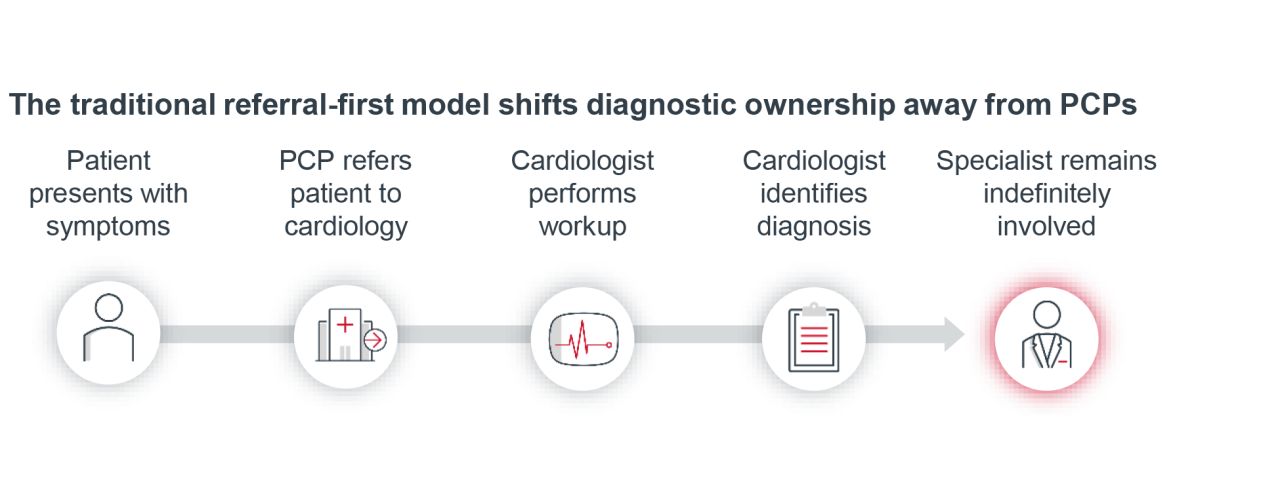
Referral-first cardiovascular (CV) care can delay diagnosis and strain specialist capacity
By default, many CV care pathways rely on specialist when patients present with symptoms such as palpitations, dizziness, fatigue, or shortness of breath.1 This is because primary care providers (PCPs) often lack the time, diagnostic resources, or specialist support needed to complete a meaningful workup before referral.2,3 As a result, patients may face a fragmented diagnostic journey that can span primary care, cardiology, urgent care, and other settings.4
"Being specialist dependent creates episodic care for the patient, which they may perceive as trust, but … that is the fragmented healthcare system."
Dr. Nehal Gheewala, CMO
Claremedica
These patterns can create challenges across the care continuum. For practice leaders, it may be more difficult to preserve specialist access, coordinate care across settings, and keep patients connected within the system. Meanwhile, PCPs may lose opportunities to build trust and guide the patient journey, and cardiologists have to spend valuable capacity on diagnostic workups that could have started earlier. As referral volumes rise, specialists may need to spend significant time determining whether a cardiovascular condition is present at all, contributing to longer wait times, repeated testing, and reduced specialist availability.
What’s the solution?
Leading organizations are enabling PCPs to gather more diagnostic information before escalating to cardiology
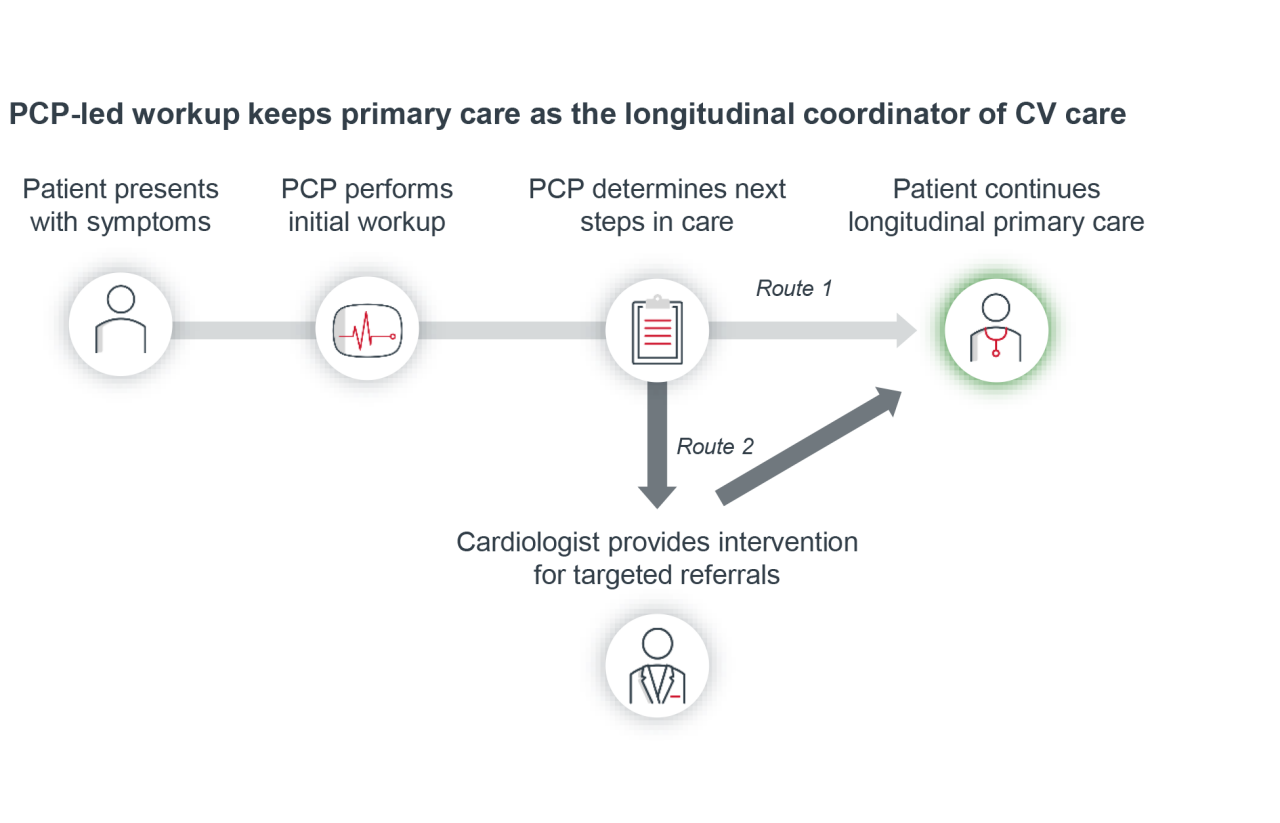
Rather than immediately referring patients to cardiology, leading organizations equip PCPs with diagnostic tools, clinical workflows, and specialist support to gather more information before escalating care to cardiology. This approach helps PCPs determine whether a cardiovascular condition is likely present and whether specialty involvement is warranted.
As a result, PCPs can take a more active role in evaluating CV concerns, cardiologists receive more targeted referrals, and patients reach the appropriate level of care sooner. When PCPs help identify potential issues and guide next steps, they are also better positioned to build trust with patients and remain the coordinator of care throughout the CV journey.
What gets in the way?
Large panel sizes can limit PCPs' ability to fully evaluate CV concerns
Because PCPs frequently manage large patient panels and competing priorities, it can be difficult to conduct additional testing, revisit unresolved concerns, and stay engaged throughout the diagnostic process. As a result, patients with CV symptoms are often referred before enough information has been gathered to determine if they actually have a CV issue.5
"PCPs have everything on their plate. Everything."
Christine Handy, Program manager in cardiac electrophysiology
Health system in the Pacific Northwest
Under these time and capacity constraints, referrals can become the most practical next step, even when additional evaluation in primary care may be appropriate. But that decision carries downstream impact: specialists often have to conduct additional workup to gather information and better understand the underlying issue — which can contribute to longer wait times, repeated testing, and fragmented care.
Diagnostic programs introduce new operational responsibilities, creating opportunities for delay
Change management is often hard, with existing referral pathways deeply ingrained and difficult to implement. As diagnostic testing expands beyond specialty settings, organizations must establish processes to ensure results are received, reviewed, routed, communicated, and acted upon appropriately. Manual workflows, multiple handoffs, and disconnected systems can create opportunities for delays and errors. Sustaining diagnostic programs often requires a dedicated champion for oversight, clearly defined responsibilities, and workflows that reduce administrative burden while ensuring patients don’t fall through the cracks.
What are leading organizations doing?
Move diagnostic evaluation closer to the first point of care
Leading organizations are expanding ambulatory rhythm monitoring beyond cardiology clinics and into primary care, urgent care, and emergency departments. By collecting rhythm data earlier in the patient journey, clinicians can begin evaluating patients closer to the time of symptom presentation and better determine which patients warrant specialty involvement, which can continue to be managed by PCPs, and which may require evaluation for noncardiac causes.
Many organizations are prioritizing these efforts based on referral patterns, wait times, and other indicators of specialty demand, helping direct diagnostic resources where they can have the greatest impact. While these approaches are often discussed in the context of value-based care, they can also benefit organizations operating in fee-for-service environments. For example, reducing unnecessary specialist visits preserves access for higher-acuity patients. Earlier detection can also surface findings that drive appropriate downstream utilization, and PCPs can earn trust to keep patients connected to the system over time.
How do provider organizations make this approach work?
Pair PCPs with specialists instead of transferring ownership
Successful programs don't expect PCPs to become cardiologists. Instead, they create clear pathways for consultation, education, and shared decision-making. Many organizations support PCPs through regular specialist outreach, webinars, newsletters, physician champion programs, and direct communication between primary care and cardiology leaders. Some also address capacity directly by prioritizing manageable panel sizes or automating administrative work. These organizations recognize that PCPs can only stay engaged in the diagnostic process when they have the capacity to follow patients over time.
"If the PCP completes the workup and packages it up for the specialist, the specialist can target the problem, correct it, and send the patient back."
Dr. Nehal Gheewala, CMO
Claremedica
Medical directors, physician champions, and specialists can further support PCPs by helping them understand which patients should be monitored, how to use monitoring technology, what findings warrant escalation, and when specialty involvement is appropriate. The goal is to help PCPs narrow the problem before referral while ensuring specialists receive patients with a clearer clinical question.
Leverage nurse navigators and dedicated program owners as champions to keep patients from falling through the cracks
As diagnostic programs expand upstream beyond specialty care, organizations often rely on nurse navigators, care coordinators, and other dedicated staff to maintain continuity across the diagnostic process. These roles can also help work around panel-size constraints. By absorbing some of the tracking and follow-through that PCPs managing large panels cannot realistically sustain, navigators allow physicians to stay engaged in the workup without adding to their visit load.
Additionally, navigator and coordinator roles become increasingly important as patients move between primary care, specialty care, urgent care, and emergency settings, since responsibility for next steps can become unclear. By providing consistent oversight of testing, results, and patient communication, these teams help ensure potential findings don't fall through the cracks. Without clear ownership, delays in review and follow-up can undermine the value of the program.
Redesign workflows to reduce administrative burden and support scale
As organization gained experience, they adjusted patient selection criteria, modified monitoring approaches, and redesigned workflows. For example, some organizations found that certain monitoring strategies created substantial operational burden without meaningfully changing management decisions, while others discovered that manual report routing and disconnected EHR systems became major barriers to scale. Rather than treating implementation as complete once technology is deployed, leading organizations continually refine workflows to improve efficiency and reduce administrative burden.
Case-in-brief
How one health system used upstream patch monitoring to improve cardiology access6
The challenge: A large health system in the Pacific Northwest faced growing demand for CV services and long cardiology wait times. Many patients with palpitations waited four to six weeks for a cardiology appointment, underwent ECGs, Holter monitoring, echocardiograms, and other tests, and were ultimately ruled out for a cardiac condition. This lengthy process consumed specialist capacity, prolonged patient uncertainty, and delayed investigation of other causes of symptoms.
The approach: In 2018, the health system replaced its traditional Holter monitoring program with portable patch monitors that could be deployed outside of cardiology clinics. The organization initially expanded monitoring into primary care, enabling PCPs to gather rhythm data before deciding if referral is appropriate.
Because many patients with palpitations were ultimately ruled out for arrhythmias, leaders shifted to a monitor-first pathway, reserving cardiology referrals for patients with findings that warranted specialty evaluation. The program later expanded into the ED and was supported by collaboration across primary care, cardiology, nursing, and operational teams. The program also included physician champions, nurse navigator support, and ongoing provider education.
The result: Leaders reported improved specialist access, faster answers for patients, and a greater role for PCPs in symptom evaluation. ED expansion also allowed some patients to be discharged with outpatient monitoring, reducing unnecessary hospital time while maintaining diagnostic oversight. |
1 Working With Your AFib Care Team. American Heart Association. May 14, 2025.
2 Porter J, et al. Revisiting the Time Needed to Provide Adult Primary Care. Journal of General Internal Medicine. July 1, 2022.
3 Wójcik C, Shapiro MD. Bridging the Gap Between Cardiology and Family Medicine. Circulation. August 17, 2019.
4 Witowski N. 4 overlooked growth opportunities in cardiovascular care. Definitive Healthcare. February 6, 2026.
5 Satterwhite S, et al. “Good Care is Slow Enough to Be Able to Pay Attention”: Primary Care Time Scarcity and Patient Safety. Journal of General Internal Medicine. February 15, 2024.
6 Advisory Board interview with Christine Handy on August 17th, 2026
7 Unless otherwise noted, all information in this quick guide came from Advisory Board interviews, research, and analysis.
iRhythm is a leading digital health care company that creates solutions that detect, predict, and prevent disease. Combining wearable biosensors and cloud-based data analytics with powerful proprietary algorithms, iRhythm distills data from millions of heartbeats into clinically actionable information. Through a relentless focus on patient care, iRhythm’s vision is to deliver better data, better insights, and better health for all. Learn more about iRhythm’s Population Health Solutions for Arrhythmia Detection.
*Zio® monitor safety information and Zio AT® safety information
iRhythm, Zio, Zio XT, Zio AT, MyZio, and ZioSuite are trademarks of iRhythm Technologies, Inc. © 2026 iRhythm Technologies, Inc. MAT-0390-2.
This quick guide is sponsored by iRhythm Technologies, an Advisory Board member organization. Representatives of iRhythm Technologies helped select the topics and issues addressed. Advisory Board experts wrote the report, maintained final editorial approval, and conducted the underlying research independently and objectively. Advisory Board does not endorse any company, organization, product or brand mentioned herein.
To learn more, view our editorial guidelines.

This quick guide is sponsored by iRhythm Technologies. Advisory Board experts conducted the underlying research independently and objectively and maintained final editorial approval.
Learn more about iRhythm

Emily Schmidt
Senior writer and editor, Sponsorship
Posted on October 30, 2026

Don't miss out on the latest Advisory Board insights
Create your free account to access 1 resource, including the latest research and webinars.
Want access without creating an account?
You have 1 free members-only resource remaining this month.
1 free members-only resources remaining
1 free members-only resources remaining
You've reached your limit of free insights
Become a member to access all of Advisory Board's resources, events, and experts
Never miss out on the latest innovative health care content tailored to you.
Benefits include:
Unlimited access to research and resources
Member-only access to events and trainings
Expert-led consultation and facilitation
The latest content delivered to your inbox
You've reached your limit of free insights
Become a member to access all of Advisory Board's resources, events, and experts
Never miss out on the latest innovative health care content tailored to you.
Benefits include:
Unlimited access to research and resources
Member-only access to events and trainings
Expert-led consultation and facilitation
The latest content delivered to your inbox
This content is available through your Curated Research partnership with Advisory Board. Click on ‘view this resource’ to read the full piece
Email ask@advisory.com to learn more
Click on ‘Become a Member’ to learn about the benefits of a Full-Access partnership with Advisory Board
Never miss out on the latest innovative health care content tailored to you.
Benefits Include:
Unlimited access to research and resources
Member-only access to events and trainings
Expert-led consultation and facilitation
The latest content delivered to your inbox
This is for members only. Learn more.
Click on ‘Become a Member’ to learn about the benefits of a Full-Access partnership with Advisory Board
Never miss out on the latest innovative health care content tailored to you.
Benefits Include:
Unlimited access to research and resources
Member-only access to events and trainings
Expert-led consultation and facilitation
The latest content delivered to your inbox