Auto logout in seconds.
Continue Logout
In our Trending Now in Cancer Care survey, over 290 cancer programs told us how they are addressing health disparities and helping patients overcome barriers to care, particularly the rising cost of cancer care. Keep reading below to see what we learned and how your program stacks up against your peers.
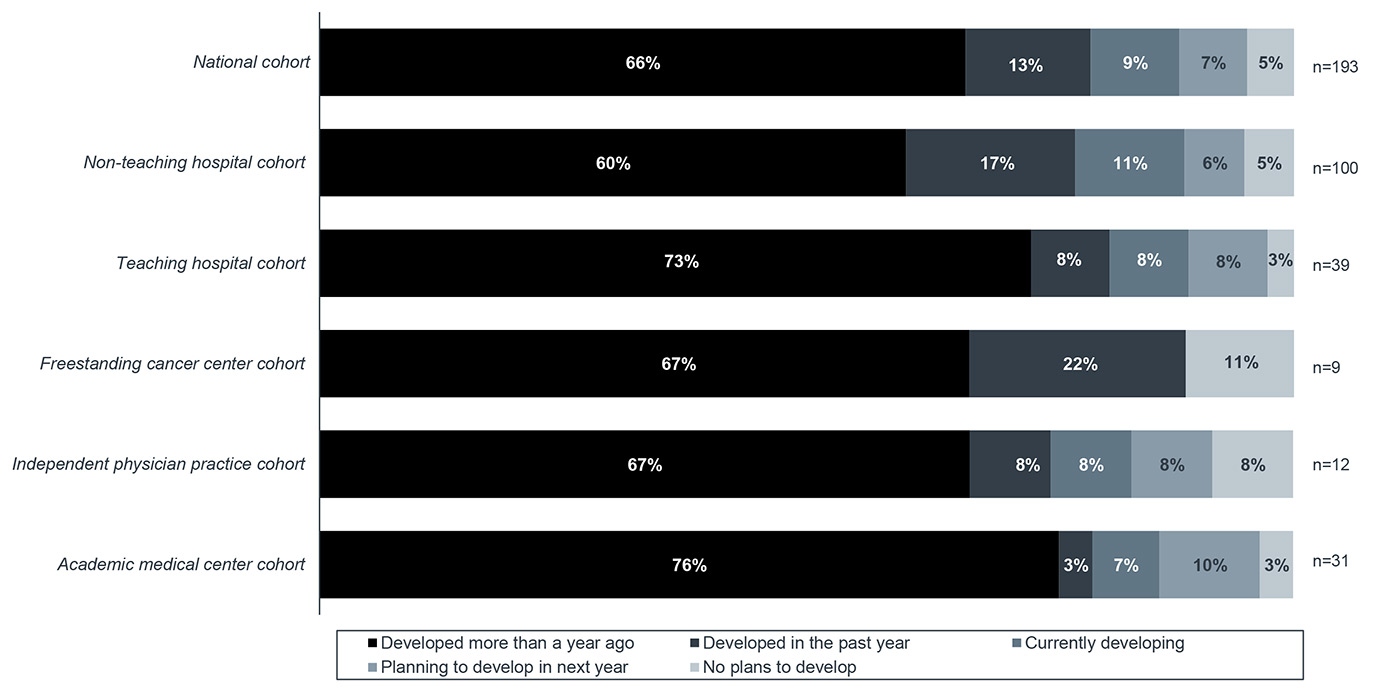
80% of all cancer programs offer financial advocacy services
In response to the growing recognition of financial toxicity, the vast majority of respondents indicated that they offer financial advocacy services. Across types of organizations, academic cancer centers were the most likely to both currently offer financial advocacy and indicate plans for developing these services in the next year. Only 5% of all respondents said that they currently do not offer and have no plans to develop a financial advocacy program.
Please indicate the extent to which your organization has developed a financial advocacy support program for cancer patients
Percentage of respondents, 2017
Most programs have dedicated financial advocacy staff, but only 31% meet with all patients
To better understand how cancer programs are meeting patients' financial needs, we asked them which patients meet with financial advocates. While 77% of respondents have dedicated staff, they are likely not meeting with all patients who would benefit. Nationally, only 41% of cancer programs meet with all patients who indicate financial concerns (e.g., through distress screening) and only 7% of cancer programs meet with all Medicaid patients.
To improve performance, cancer programs should develop red flag checklists to make sure patients who would benefit are meeting with financial advocacy staff. This list should include, among other indicators:
- All uninsured patients
- All Medicaid patients
- All Medicare patients without secondary insurance
- All patients with a high deductible (e.g., over $2,600 for a family)
Do you have dedicated financial advocacy staff | Which cancer patients are referred to financial advocacy staff?1 |
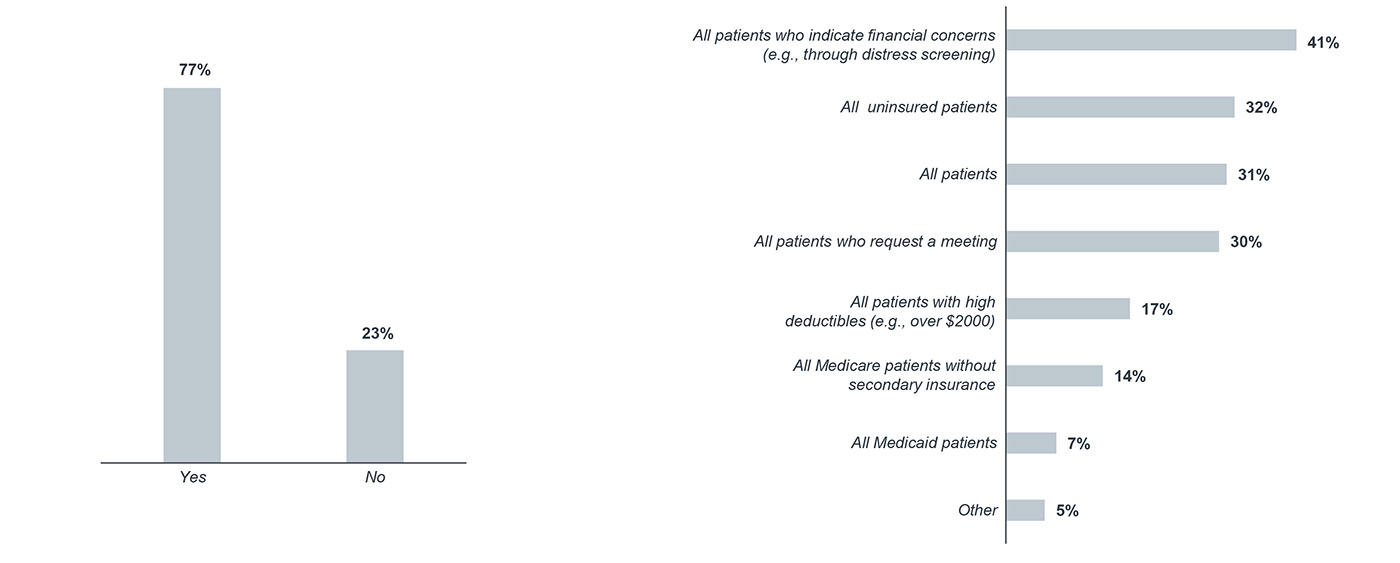
1) Respondents were only asked this question if they indicated having dedicated financial advocacy staff
Some cancer programs have seen patients increasingly make treatment decisions based on cost
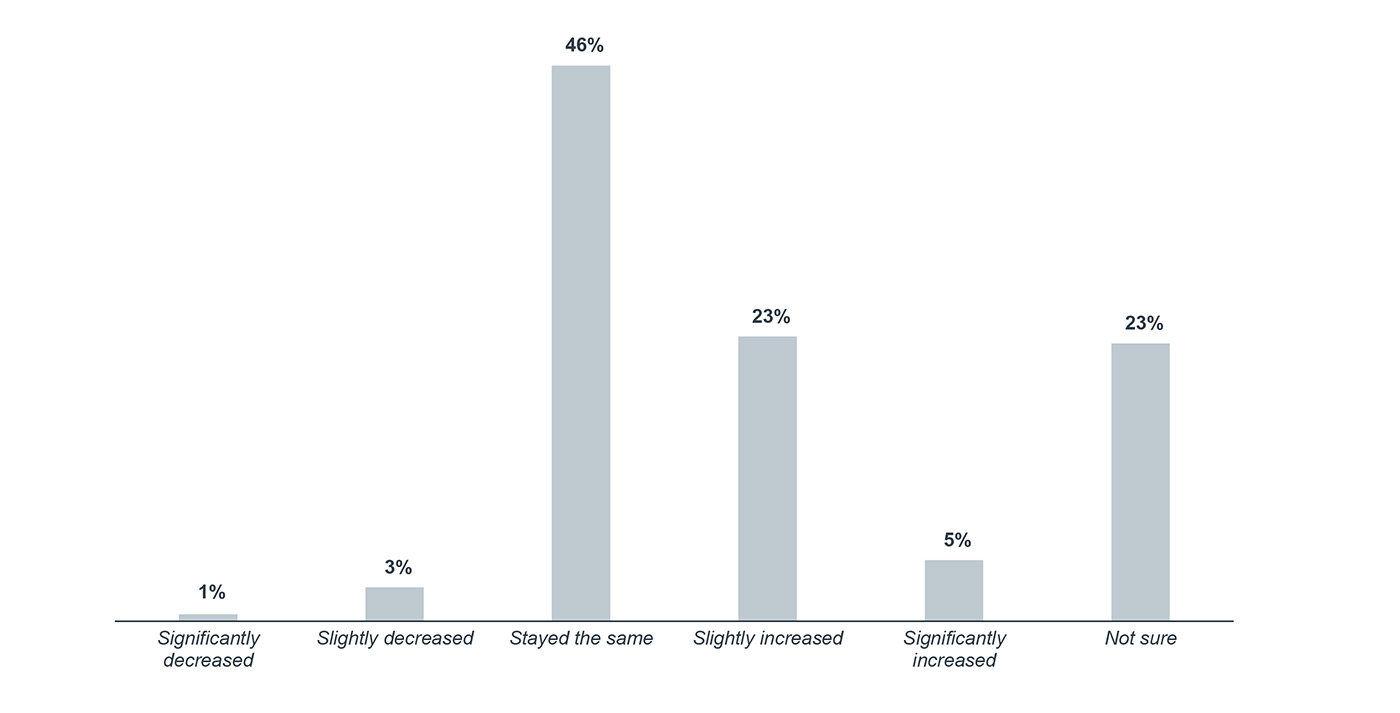
To understand how costs are impacting patients' care decisions, we asked cancer programs, "How has the number of cancer patients refusing treatment due to cost or requesting a cheaper treatment option changed during the past 12 months?"
Almost one-quarter of respondents reported that the number of patients refusing treatment due to cost or asking for cheaper options slightly increased. Twenty-three percent of respondents reported that they were not sure about the answer to this question, underscoring a need for program leaders to better understand how costs are impacting patients' treatment decisions.
Many programs (46%) also reported that the number of patients refusing treatment due to cost or asking for cheaper options stayed the same. This could be due to a variety of factors, such as improved coverage nationwide and/or the increased investment in financial advocacy resources.
How has the number of cancer patients refusing treatment due to cost or requesting a cheaper treatment option changed during the past 12 months?
Percentage of respondents, 2017
n=180
Programs deploying multiple strategies to address barriers to care
In addition to helping address patients' financial needs, cancer programs are investing significant resources in helping patients overcome other barriers to care. The majority of programs use a number of strategies—the most common being partnering with community organizations (84%), using translators (84%), using clinical navigators (80%), and offering health literacy support (73%).
When analyzing the data by organization type, academic cancer centers were twice as likely to use a non-clinical lay navigator to help underserved patients (75%) than other respondents (35%). Independent physician practices were less likely to partner with community organizations (40%) compared to other respondents (84%). Across all cohorts, offering telehealth services for patients in rural locations was the least common strategy (14%) to address barriers to care. Check out our telehealth primer to learn how it can benefit your program and your patients.
What strategies do you use to address health care disparities and/or access to care issues?1
Percentage of respondents, 2017
n=184
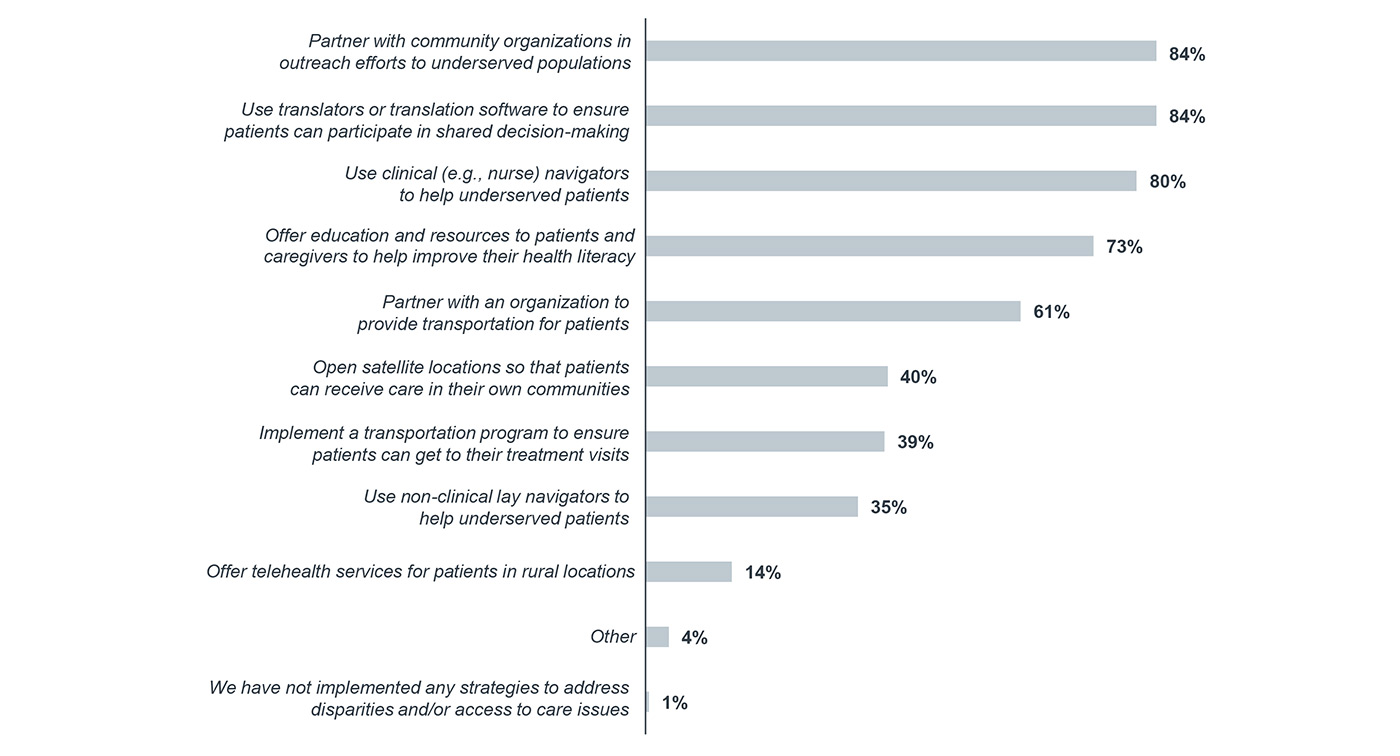
1) Respondents were asked to select all that apply
Check out the full survey results
For more information on trends in financial advocacy and support services at cancer programs nationwide, download our report of the full survey results.

Don't miss out on the latest Advisory Board insights
Create your free account to access 1 resource, including the latest research and webinars.
Want access without creating an account?
You have 1 free members-only resource remaining this month.
1 free members-only resources remaining
1 free members-only resources remaining
You've reached your limit of free insights
Become a member to access all of Advisory Board's resources, events, and experts
Never miss out on the latest innovative health care content tailored to you.
Benefits include:
Unlimited access to research and resources
Member-only access to events and trainings
Expert-led consultation and facilitation
The latest content delivered to your inbox
You've reached your limit of free insights
Become a member to access all of Advisory Board's resources, events, and experts
Never miss out on the latest innovative health care content tailored to you.
Benefits include:
Unlimited access to research and resources
Member-only access to events and trainings
Expert-led consultation and facilitation
The latest content delivered to your inbox
This content is available through your Curated Research partnership with Advisory Board. Click on ‘view this resource’ to read the full piece
Email ask@advisory.com to learn more
Click on ‘Become a Member’ to learn about the benefits of a Full-Access partnership with Advisory Board
Never miss out on the latest innovative health care content tailored to you.
Benefits Include:
Unlimited access to research and resources
Member-only access to events and trainings
Expert-led consultation and facilitation
The latest content delivered to your inbox
This is for members only. Learn more.
Click on ‘Become a Member’ to learn about the benefits of a Full-Access partnership with Advisory Board
Never miss out on the latest innovative health care content tailored to you.
Benefits Include:
Unlimited access to research and resources
Member-only access to events and trainings
Expert-led consultation and facilitation
The latest content delivered to your inbox
