Auto logout in seconds.
Continue Logout
Overview
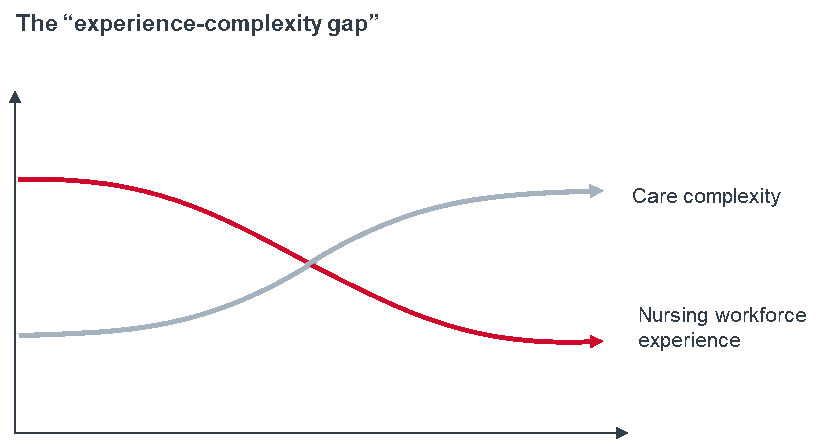
Nurse leaders today are facing a new challenge: “the experience-complexity gap.”
As retirement-age nurses exit the workforce while the influx of new nurses continues to grow, the net effect is a decline in the overall experience of the nursing workforce. At the same time, the patient population is becoming older and more complex, with more chronic comorbidities. Simply put, more novice nurses must deliver more complex care. If left unaddressed, the experience-complexity gap will widen, and could put clinical quality and safety at risk.
Use the strategies and best practices in this report to close the experience-complexity gap.
Hospitals and health systems around the world are facing a new kind of shortage among the nursing workforce: a shortage of experience. As mass retirements continue, there is an exodus of experience leaving organizations across the country. With the quickly growing nursing workforce, leaders will need to rely on the influx of novice nurses to backfill vacant positions.
At the same time, care complexity is rising. On average, patients are older and have more chronic comorbidities. Care processes—including electronic documentation and more standardized protocols—are becoming more complex, while length of stay is getting shorter.
As a result of this rising complexity, it’s more difficult for nurses to transition to practice, for at least three reasons. First, nurses have more to learn to be considered competent. They must have a richer understanding of pathophysiology, understand a wide range of treatment options, and be prepared to deliver highly complex care. Second, it’s harder for nurses today to learn on the job. There are no more “easy” patients to assign to new graduates as low-stakes learning opportunities. And because there is more to do in less time, nurses have less time to focus and reflect on their own development. Finally, the shortage of experience means there are fewer expert nurses to mentor and provide feedback.
As the collective experience of the workforce declines and care complexity rises, a new challenge is emerging, which the Nursing Executive Center has termed the “experience-complexity gap.” This gap is projected to grow as nurses continue to retire. If unaddressed, the experience-complexity gap has the potential to result in increased adverse care outcomes and negatively impact care quality.
The three paths this study presents to close the experience-complexity gap are:
- Teach novice nurses more effectively by fiercely scoping weeks 1-12 and standardizing preceptor work.
- Redistribute experience across the organization by creating career pathways to select units and care sites.
- Differentiate practice for experienced nurses by positioning competent and proficient RNs “at-the-hip” and scaling the impact of expert RNs.
Use this report to learn how to close the experience-complexity gap.
Teach novice nurses more effectively
Fiercely scope weeks 1-12:
- Practice 1: Streamlined RN orientation (p. 20)
Supporting Tool: Dartmouth Hitchcock’s new RN competencies - Practice 2: Targeted skills intensive (p. 26)
Supporting Tools: Additional resources from Indiana University Health - Practice 3: Unit-based learning intervals (p. 34)
Standardize preceptor work:
Redistribute experience across the organization
Create career pathways to select units and care sites:
Differentiate practice for experienced nurses
Position competent and proficient RNs “at-the-hip”:
Scale the impact of expert RNs:

Don't miss out on the latest Advisory Board insights
Create your free account to access 1 resource, including the latest research and webinars.
Want access without creating an account?
You have 1 free members-only resource remaining this month.
1 free members-only resources remaining
1 free members-only resources remaining
You've reached your limit of free insights
Become a member to access all of Advisory Board's resources, events, and experts
Never miss out on the latest innovative health care content tailored to you.
Benefits include:
Unlimited access to research and resources
Member-only access to events and trainings
Expert-led consultation and facilitation
The latest content delivered to your inbox
You've reached your limit of free insights
Become a member to access all of Advisory Board's resources, events, and experts
Never miss out on the latest innovative health care content tailored to you.
Benefits include:
Unlimited access to research and resources
Member-only access to events and trainings
Expert-led consultation and facilitation
The latest content delivered to your inbox
This content is available through your Curated Research partnership with Advisory Board. Click on ‘view this resource’ to read the full piece
Email ask@advisory.com to learn more
Click on ‘Become a Member’ to learn about the benefits of a Full-Access partnership with Advisory Board
Never miss out on the latest innovative health care content tailored to you.
Benefits Include:
Unlimited access to research and resources
Member-only access to events and trainings
Expert-led consultation and facilitation
The latest content delivered to your inbox
This is for members only. Learn more.
Click on ‘Become a Member’ to learn about the benefits of a Full-Access partnership with Advisory Board
Never miss out on the latest innovative health care content tailored to you.
Benefits Include:
Unlimited access to research and resources
Member-only access to events and trainings
Expert-led consultation and facilitation
The latest content delivered to your inbox
