Auto logout in seconds.
Continue Logout
Overview
With declining reimbursements, ongoing capital pressures, unpredictable volumes, and, above all, continued disruption to the fundamental mechanics of the industry, hospital and health system leaders appear increasingly inclined to seek strength in size and numbers.
Yet while mergers and acquisitions dominate headlines, a deeper trend of hospital integration is underway: the emergence of non-M&A partnerships that secure many of the same benefits of provider integration without the financial and legal commitment.
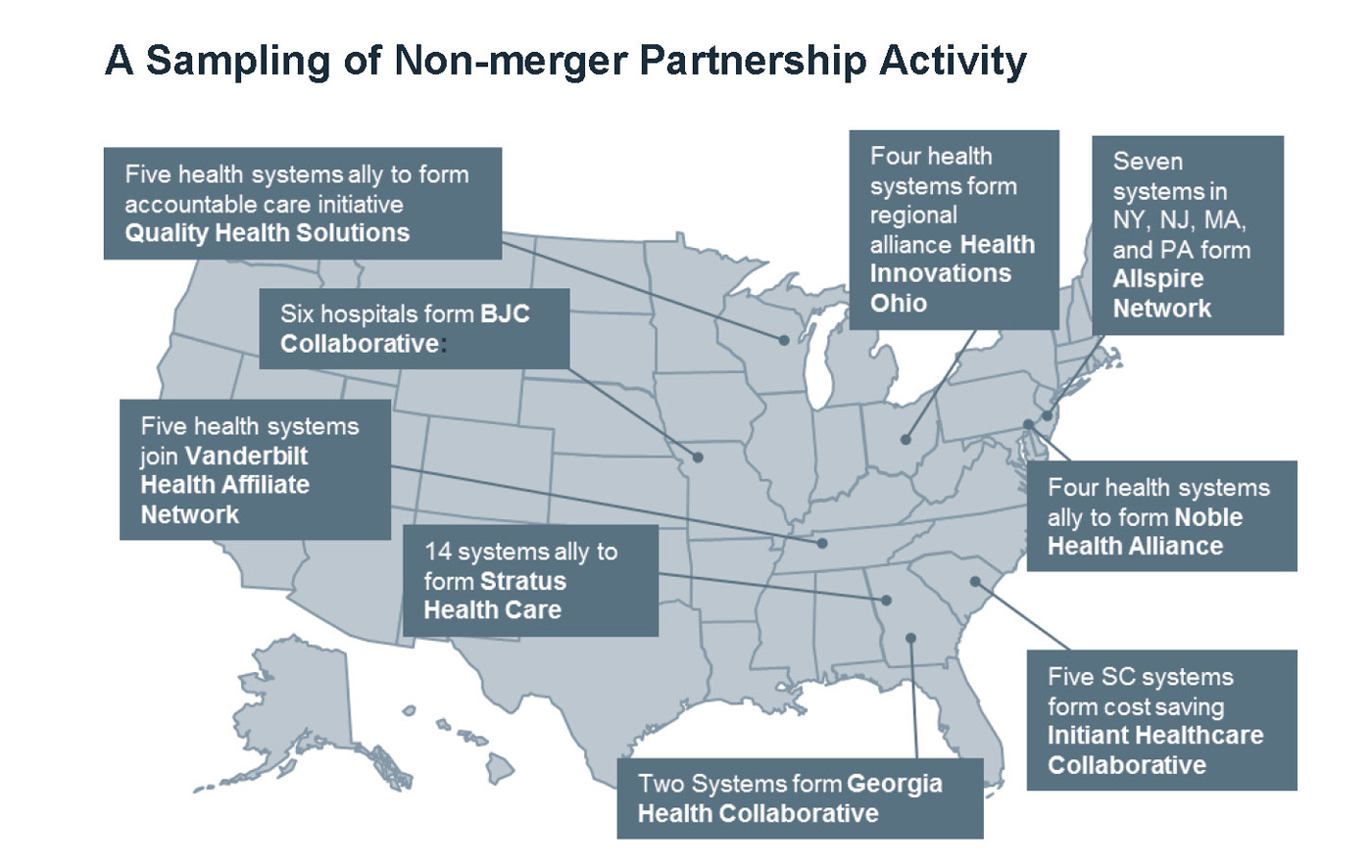
The right way to assess the wave of partnerships—and any potential partnership your organization may be considering—is on a case-by-case basis.
To help you get started, we developed this four-part framework for rapidly identifying partnership opportunities and avoiding reactive deal-making.
Our strategic framework for partnership decisions
1. What strategic aims is your partnership intended to support?
A merger might prove very effective at improving access to capital but do little to reduce operational costs. Similarly, a clinical affiliation may bolster a particular service line but have a negligible impact on payer contracting. Whether or not such partnerships should be deemed "successful" depends on their intended objectives. Clarity on this point—and agreement with potential partners—must be the starting place of any due diligence.
2. What are the specific elements of integration that must be in place?
Once the aims of partnership are known, attention may be turned to a detailed assessment of the various functions that may or may not be included in a partnership. An organization that can identify which elements of integration are essential for achieving each goal and which are extraneous will be able to craft a focused, impactful partnership structure.
3. Which organizations are the most attractive partners?
The ideal partner brings complementary strengths that align with your strategic aims and is also willing and able to cooperate in the specific, concrete ways needed. Considerations include the choice between local and national partners and the tension between cultural affinity and the benefit of a diversified perspective.
4. Which legal structure offers the most appropriate environment for pursuing meaningful integration?
Only once the preceding questions have been answered should discussion of the overall partnership model begin in earnest. Legal architecture and ownership structure guarantee nothing, but they do influence the feasibility of certain elements of integration like joint contracting. Hospital and health system leaders will need to strike a balance between the more powerful but also more complex and committal structure of a merger and the flexibility of a less-intensive arrangement.

Don't miss out on the latest Advisory Board insights
Create your free account to access 1 resource, including the latest research and webinars.
Want access without creating an account?
You have 1 free members-only resource remaining this month.
1 free members-only resources remaining
1 free members-only resources remaining
You've reached your limit of free insights
Become a member to access all of Advisory Board's resources, events, and experts
Never miss out on the latest innovative health care content tailored to you.
Benefits include:
Unlimited access to research and resources
Member-only access to events and trainings
Expert-led consultation and facilitation
The latest content delivered to your inbox
You've reached your limit of free insights
Become a member to access all of Advisory Board's resources, events, and experts
Never miss out on the latest innovative health care content tailored to you.
Benefits include:
Unlimited access to research and resources
Member-only access to events and trainings
Expert-led consultation and facilitation
The latest content delivered to your inbox
This content is available through your Curated Research partnership with Advisory Board. Click on ‘view this resource’ to read the full piece
Email ask@advisory.com to learn more
Click on ‘Become a Member’ to learn about the benefits of a Full-Access partnership with Advisory Board
Never miss out on the latest innovative health care content tailored to you.
Benefits Include:
Unlimited access to research and resources
Member-only access to events and trainings
Expert-led consultation and facilitation
The latest content delivered to your inbox
This is for members only. Learn more.
Click on ‘Become a Member’ to learn about the benefits of a Full-Access partnership with Advisory Board
Never miss out on the latest innovative health care content tailored to you.
Benefits Include:
Unlimited access to research and resources
Member-only access to events and trainings
Expert-led consultation and facilitation
The latest content delivered to your inbox