Auto logout in seconds.
Continue Logout

Patients who take cancer treatment orally (called oral oncolytics) may need wraparound support, including help with prior authorization, financial assistance, refills, and medication side effects. As part of their service delivery strategy, one specialty pharmacy developed a risk stratification protocol to help ensure that patients with different health-related needs receive fit-for-purpose and ongoing follow-up and staff could sustainably manage their time and resources.
The challenge
Patients taking cancer treatments orally (called oral oncolytics) face a number of challenges, including coordinating their care, avoiding financial toxicity, and managing the adverse effects of therapy.1 Without support mechanisms in place, patients may modify or discontinue their treatment without consulting with their healthcare provider, which is one of many reasons for avoidable visits to the emergency department (ED). At the same time, creating support programs without considering their effect on staff time and resources can lead to overburdened staff.
The organization
A specialty pharmacy at one of the largest health systems in the United States ships prescriptions to patients at five oncology clinics in several states. Initially launched for employees who used the health system’s employer-sponsored health plan (ESHP), the specialty pharmacy later expanded to serve all health system patients one year later.
The approach
The specialty pharmacy developed a risk stratification protocol to help ensure that patients with different needs receive the appropriate level of support without unnecessarily burdening pharmacy staff. The protocol is part of the pharmacy’s patient workflow on oral oncolytics, a system that provides wraparound support for patients throughout their oncology care journey, including financial advocacy, prior authorization management, patient education, and ongoing follow-up.
The result
The specialty pharmacy’s unique patient workflow and risk stratification protocol allow the pharmacy team to focus a higher level of support on patients at higher risk, while also maintaining appropriate oversight of all patients. Partially as a result of these efforts, the health system reported that in 2024 the pharmacy covered 92.3% of prescription days and had a 99.3% medication adherence rate, in addition to a Net Promoter Score (NPS) of 96.2.
96.2
Net Promoter Score (NPS) from patient satisfaction surveys in 2024
The health system’s specialty pharmacy developed a risk stratification protocol as part of their workflow to ensure that oral oncolytics patients receive the right level of follow-up.
The 3 keys to success
The specialty pharmacy developed a risk stratification strategy that helps pharmacists determine how much follow-up is optimal for each patient’s unique needs. Based on a variety of factors, risk stratification ensures that the pharmacy team allocates their time and resources to most effectively support patients.
Regimen-specific factors used in risk stratification
When the pharmacy receives an oral oncolytic prescription, a clinical pharmacist assesses the patient’s risk profile using a checklist for consistency. For each criterion, points are assigned to calculate the patient’s risk score, grouping patients into categories. For example, if a patient needs to inject their medication at home, they receive one point. Some factors, such as the number and intensity of potential side effects for a medication, could be assigned one to three points. The higher the score, the more follow-up calls the patient receives.2 Regimen-specific factors considered include:


Patient-specific factors considered in determining follow-up cadence
In addition to the risk score, the clinical pharmacist also considers factors from the patient’s profile — including age, physical or mental disability, and underlying chronic conditions — to determine the appropriate level of support. Using their clinical judgement, a pharmacist may even override a relatively low-risk score for a patient who has additional risk factors in their profile. For instance, an elderly patient with a lower risk score may still receive a high number of follow-up calls because advanced age is considered higher risk.
The specialty pharmacy’s mapping protocol for risk stratification supports a multipronged workflow for oral oncolytics patients at all points in the oncology care journey. An interdisciplinary care team and clear communication are central to their approach. Clinical pharmacists and pharmacy liaisons (advanced pharmacy technicians trained in oncology) work with providers and nurse educators to help patients understand their therapy, have the financial support to continue it, and receive refills in a timely manner.
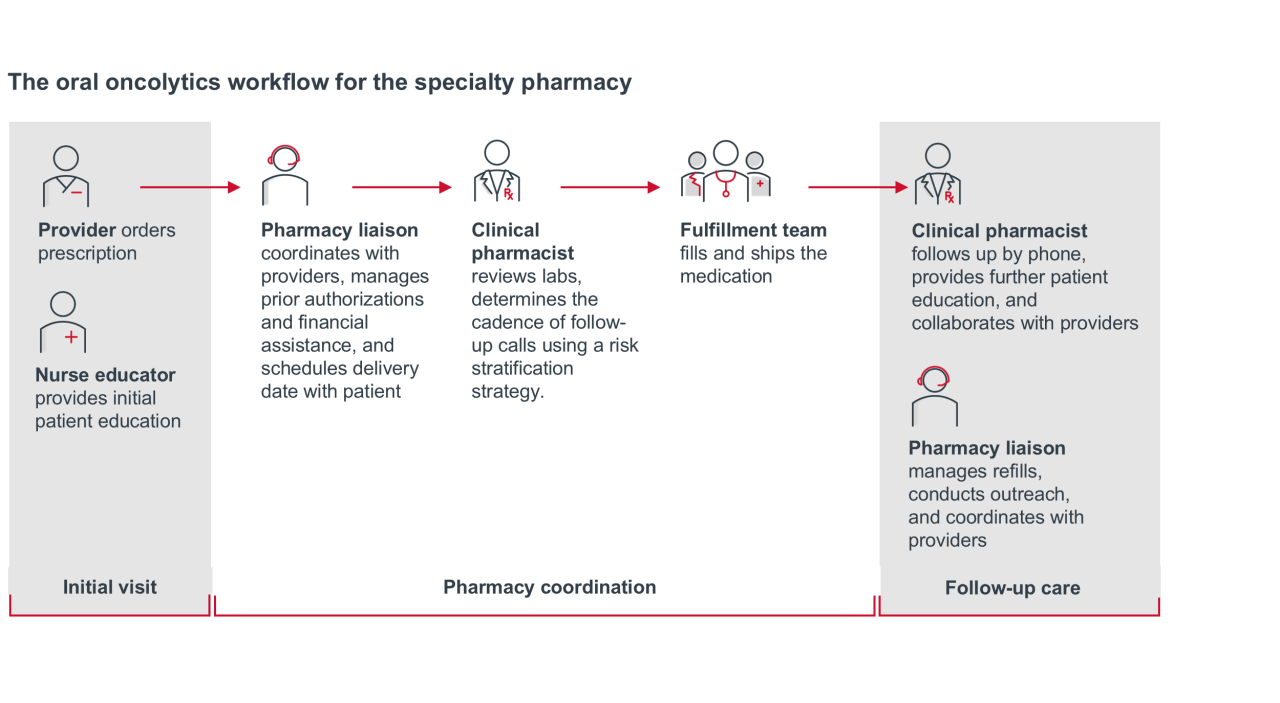
- Before therapy begins, a nurse educator ensures that the patient understands how and when to take their medications and how to respond to potential side effects.
- When the provider sends the specialty pharmacy a prescription, a pharmacy liaison manages the prior authorization process and helps the patient secure other financial assistance, if necessary. For example, if a copay is more than $40, the pharmacy liaison may look into the possibility of the patient receiving financial assistance.
- A clinical pharmacist assigns the patient a score using the risk stratification strategy (Section 1). The score is used to determine the number and cadence of follow-up calls.
- The fulfillment team — which includes clinical pharmacists, pharmacy liaisons, and pharmacy technicians — fills and ships the medication overnight in temperature-controlled packaging.
- Once therapy is underway, the clinical pharmacist follows up with the patient at predetermined intervals based on the patient’s risk score. The pharmacist uses those calls to help the patient manage side effects, address other medication-related issues, and provide ongoing patient education.
- At the same time, the pharmacy liaison manages refills and coordinates with the patient’s provider, if needed. If a patient doesn’t respond to outreach or there are issues with the refill, the liaison notifies the clinical pharmacist and prescribing provider for additional outreach.
Finally, because coordinating with providers is crucial to the success of the oral oncology workflow, the pharmacy reached out to educate clinic leadership, physicians, and other providers about the workflow and how it fit into patients’ care journey.

"My [pharmacy] contacts have been kind, efficient and supportive. I was very grateful for a little handholding."
A patient at the specialty pharmacy
The health system’s specialty pharmacy began by focusing on a small patient population so they could effectively build a foundation for managing patient therapies.
When the specialty pharmacy opened, its services were available only to health system employees who were members of the organization’s employer-sponsored health plan (ESHP). Serving a smaller patient population for the first year both gave the specialty pharmacy a focused subset of patients and time to hone their processes before expanding their services to all appropriate health system patients one year later.

Results
How we know it’s working
The specialty pharmacy has used patient education, financial assistance, and careful follow-up to ensure that their patients stay on their medication, when appropriate. Partly due to these efforts, the health system reported that in 2024 the pharmacy achieved a turnaround time of two days or less for prior authorizations, secured $20 million for financial assistance, and reduced ED visits and unplanned hospitalizations by more than 7% since 2021.
2024 results reported by the health system
92.3%
Of prescription days covered
99.3%
Medication adherence rate based on missed doses (up from 98.6% in 2023)
96.2
Net Promoter Score (NPS) from patient satisfaction surveys (compared to a national average of 77.1)*
*See endnote 3.
88%
Change in the prescription capture rate among patients who are in-network (from 24% in 2022 to 45% in 2024)
Looking to the future
Due to the specialty pharmacy’s success in serving its current region, the health system is working to reach more patients by expanding the program to cover additional oncology clinics throughout the health system. In addition, the pharmacy hopes to reach more patients by expanding their insurance options.
"Prescriptions are filled promptly. I especially appreciate the staff contacting me when my medications are nearing a refill date, so I don’t run out of anything. We’re fortunate to have access to this pharmacy."
A patient at the specialty pharmacy
1 Unless otherwise noted, all information in this case study came from Advisory Board interviews with officials from the leadership team at the specialty pharmacy.
2 All patients receive their first follow-up call within 7 to 10 days after their initial onboarding call. For patients with a high-risk score, the clinical pharmacist will follow up again in 30 to 90 days. For patients with a medium-risk score, the clinical pharmacist will follow up in 3 to 6 months. And for patients with a low-risk score, the clinical pharmacist will follow up in 10 to 11 months. The clinical judgement of the pharmacist determines where within the time range the follow up call is made.
3 The specialty pharmacy’s Net Promoter Score (NPS) was calculated by SullivanLuallin Group, which reported a national average NPS of 77.1 from the specialty pharmacies they surveyed in 2024.
At Pfizer, we’re in relentless pursuit of breakthroughs that change patients’ lives. We innovate every day to make the world a healthier place.
Our unique resources allow us to do more for people. Using our global presence and scale, we’re able to make a difference in local communities and the world around us.
Pfizer supports the global healthcare community’s independent quality improvement initiatives to improve patient outcomes in areas of unmet medical need that are aligned with Pfizer’s medical and/or scientific strategies. For more information, please visit www.pfizer.com.
This case study is sponsored by Pfizer, an Advisory Board member organization. Representatives of Pfizer helped select the topics and issues addressed. Advisory Board experts wrote the report, maintained final editorial approval, and conducted the underlying research independently and objectively. Advisory Board does not endorse any company, organization, product, or brand mentioned herein.
To learn more, view our editorial guidelines.
This case study is sponsored by Pfizer. Advisory Board experts conducted the underlying research independently and objectively.

Don't miss out on the latest Advisory Board insights
Create your free account to access 1 resource, including the latest research and webinars.
Want access without creating an account?
You have 1 free members-only resource remaining this month.
1 free members-only resources remaining
1 free members-only resources remaining
You've reached your limit of free insights
Become a member to access all of Advisory Board's resources, events, and experts
Never miss out on the latest innovative health care content tailored to you.
Benefits include:
Unlimited access to research and resources
Member-only access to events and trainings
Expert-led consultation and facilitation
The latest content delivered to your inbox
You've reached your limit of free insights
Become a member to access all of Advisory Board's resources, events, and experts
Never miss out on the latest innovative health care content tailored to you.
Benefits include:
Unlimited access to research and resources
Member-only access to events and trainings
Expert-led consultation and facilitation
The latest content delivered to your inbox
This content is available through your Curated Research partnership with Advisory Board. Click on ‘view this resource’ to read the full piece
Email ask@advisory.com to learn more
Click on ‘Become a Member’ to learn about the benefits of a Full-Access partnership with Advisory Board
Never miss out on the latest innovative health care content tailored to you.
Benefits Include:
Unlimited access to research and resources
Member-only access to events and trainings
Expert-led consultation and facilitation
The latest content delivered to your inbox
This is for members only. Learn more.
Click on ‘Become a Member’ to learn about the benefits of a Full-Access partnership with Advisory Board
Never miss out on the latest innovative health care content tailored to you.
Benefits Include:
Unlimited access to research and resources
Member-only access to events and trainings
Expert-led consultation and facilitation
The latest content delivered to your inbox