Auto logout in seconds.
Continue Logout

In September 2026, CMS updated requirements for transcatheter aortic valve replacement (TAVR) workflows, allowing heart teams flexibility in how they evaluate and treat patients. It’s up to each heart team to determine what workflows to preserve and which to adapt to improve patient access without sacrificing quality. Advisory Board interviewed five heart teams to learn how leaders plan to respond. Review their profiles to guide your own team’s approach.
Expanding TAVR capacity under the updated NCD
TAVR has transformed the treatment of severe aortic stenosis, providing an alternative for patients who require a less invasive option than surgery.1 Patient demand for the procedure has grown rapidly, often faster than health systems can provide care. So far, access delays have made long wait times the norm, limiting TAVR growth. Longer wait times are also associated with worse patient outcomes, including increases in rates of death and hospitalization.2
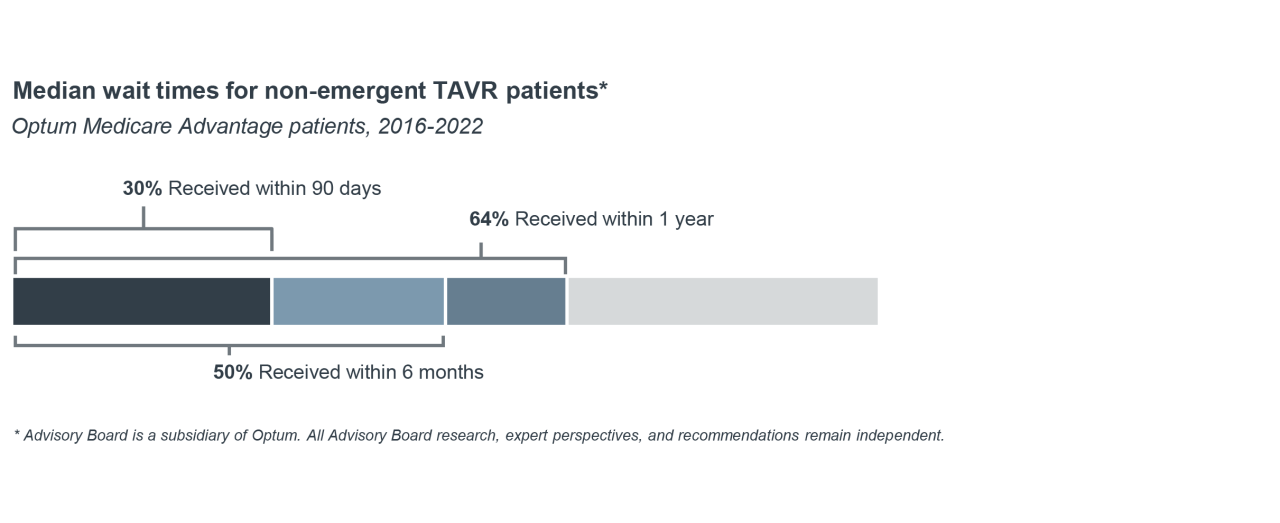
Advisory Board projects that TAVR volumes will increase 85% between 2025 and 2035, from approximately 136,000 to 252,000 annual procedures nationally. For many cardiac programs, addressing the drivers of longer wait times — such as the limited availability of cardiac surgeons, patient transportation barriers, or limited facility capacity — will influence their ability to handle rising TAVR volumes.
85%
Projected increase in TAVR volumes by 2035.
How an updated NCD may ease capacity pressures
In September 2026, CMS updated the national coverage determination (NCD) to reflect how TAVR has evolved from a novel procedure, performed under highly prescriptive requirements, to a mature therapy supported by clinical evidence, experienced operators, and established structural heart programs.3
Depending on their response to the NCD update, cardiac programs across the country could see significant impacts. NCD changes could improve patient access to TAVR, reduce scheduling conflicts for interventional cardiologists (IC) and cardiac surgeons, allow intervention before symptoms or irreversible cardiac damage develop, and reduce administrative burden.
How heart teams are responding to the updated TAVR NCD
To gain insight into how heart teams are planning to respond to NCD changes in the short- and long-term, Advisory Board interviewed clinical leaders from five TAVR programs.
While responses varied by health system size, capacity constraints, and patient population, most programs welcomed the NCD update’s added flexibility for its potential to extend capacity. In addition, most sought to implement changes in ways that preserve TAVR data sharing and a multidisciplinary, team-based approach to TAVR care decisions.
Review each profile to understand the range of options available and consider the right approach for your heart team and patient population.
The 2026 NCD update for TAVR
Five major changes to the NCD offer greater flexibility in how cardiac programs deliver TAVR care while preserving the multidisciplinary involvement of ICs, cardiac surgeons, other clinicians, and staff.3
5 key updates to NCD requirements and how programs plan to respond*
*See endnote 3.
| Updated NCD requirements | Planned responses across 5 programs |
|---|---|
Greater operator and procedural flexibility. A single IC or cardiac surgeon may perform the procedure, but two operators can participate at the heart team’s discretion, and their participation is reimbursable. Operator qualifications are grounded in ongoing transcatheter experience. |
|
More flexible patient evaluations. Only one in-person evaluation is required before the day of the procedure. Documentation of asynchronous review by another member of the heart team is required. A second evaluation with a TAVR operator is optional and reimbursable. |
|
Medicare coverage for TAVR now includes asymptomatic patients. This allows heart teams to intervene before symptoms or cardiac damage develops. |
|
Coverage with evidence development (CED) focus shifts from symptomatic to asymptomatic patients. Heart teams are required to participate in CED for asymptomatic patients. Participation in CED for symptomatic patients is now optional. |
|
Minimum procedural volume thresholds lifted. No minimum number of TAVR cases per year is required for a hospital to receive Medicare payment for TAVR. Hospitals must still meet other operational and quality standards. |
|
How heart teams are responding to NCD updates
Advisory Board researchers spoke to clinical leaders at five TAVR programs to understand how they plan to respond to new flexibilities granted by the updated NCD. While common themes emerged, no two organizations had the same response. Review each profile to understand the range of options available to help determine the right approach for your heart team and patient population.
Preserve the original TAVR workflow with modifications for urgent cases
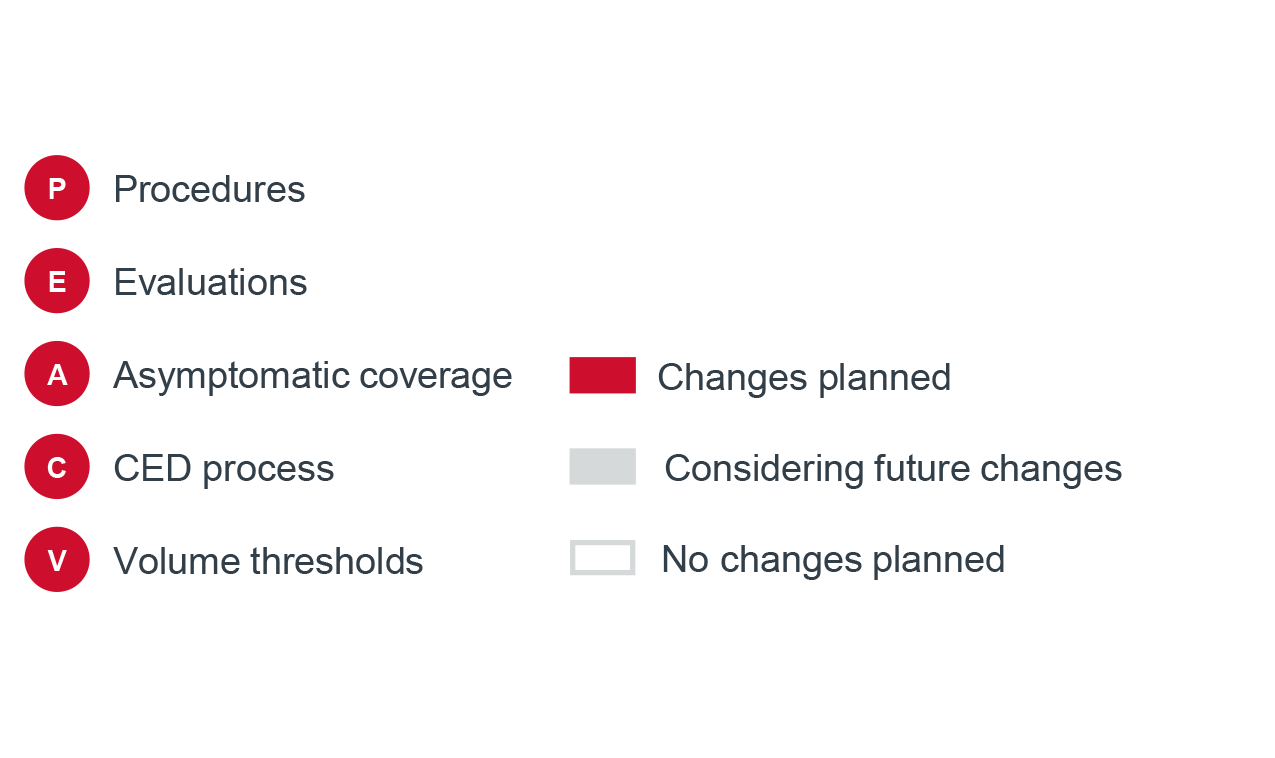
Henry Ford plans to take a restrained approach to the NCD changes, largely preserving their current TAVR pathway. The heart team designed their TAVR workflow to be patient-centered with a strong culture of collaboration between cardiology and cardiac surgery. To maintain these relationships, clinical leaders advocated for both ICs and cardiac surgeons to stay heavily involved in TAVR procedures and evaluations.
Henry Ford Medical Center is a referral destination for complex TAVR cases, including alternative-access procedures, electrosurgery-assisted interventions, VA-ECMO-supported cases, and patients in cardiogenic shock.
|
Aside from lowering the threshold for offering TAVR to asymptomatic patients, Henry Ford doesn’t expect to make significant changes to their workflow due to expanded Medicare coverage. Clinical leaders at Henry Ford have seen few severe aortic stenosis patients who are truly without symptoms. Those who initially appear asymptomatic often reveal symptoms during the testing or history gathering process.
The team has no plans to expand their program to other sites as minimum volume thresholds are lifted and no immediate plans to stop registry participation for symptomatic patients.
Planned changes

Create flexibility in the evaluation process
Heart team ICs will evaluate all aortic stenosis referrals and send a note to surgeons asking if a second evaluation is warranted. The surgeon will refer to chart information such as patient age and surgical risk level to determine if that patient needs a full second evaluation. Patients who don’t receive a surgical evaluation will be reviewed at a weekly multidisciplinary conference attended by cardiac surgeons, ICs, and other clinicians.
Flex to single-operator model for some urgent cases
Henry Ford will maintain their dual-operator model but may take advantage of the flexibility of a single-operator option for select cases.

Coordinating a high-volume cardiology program means capacity is sometimes strained. At Henry Ford, TAVR procedures are scheduled on dedicated Tuesdays and Thursdays, which requires coordination across multiple clinicians’ schedules. When a cardiac surgeon is unavailable, the heart team will allow their highly-skilled ICs to perform as single or dual TAVR operators to avoid delaying urgent cases. Occasionally, the heart team may do cases on Monday, Wednesday, or Friday when there is an urgent add-on case or a TAVR backlog.
"This change adds flexibility when the situation really calls for it, like an inpatient add-on during a non-TAVR day when your surgeons are tied up in the OR."
Tiberio Frisoli, MD
Interventional Cardiologist Henry Ford Medical Center
Long-term plans
- Reconsider participation in the TVT registry for symptomatic TAVR patients. The heart team may reevaluate if other programs opt out and the available data becomes less robust.
- Adjust approach to gathering data about symptomatic patients. If other programs opt out of participating for symptomatic patients, the heart team may track a less comprehensive set of data points, focusing on data such as rates of stroke, paravalvular leak (PVL), deaths within 30 days, and case continuous quality improvement (CQI).
Projected impacts

Implement a dual-IC approach to TAVR with potential for a single-operator approach
Due to rising cardiac surgical volumes, University of California-San Francisco (UCSF) Health is looking to expand capacity while preserving the multidisciplinary support that has long been central to their heart team approach. Like most of the TAVR programs interviewed, UCSF Health plans to embrace the flexibility introduced by the NCD update to improve access to evaluations and procedures.
UCSF Health is an academic medical center based in San Francisco, California. They are focused on timely evaluation, referral, and treatment for TAVR patients as part of the American Heart Association aortic stenosis initiative. While most UCSF TAVR patients come from the metro area, many travel several hours from rural and underserved areas.
|
The heart team already manages asymptomatic patients closely and will continue to review these patients on a case-by-case basis. They will also continue to trial digital tools that can identify severe aortic stenosis in patients with or without symptoms.
UCSF Health has no short-term plans related to changing CED requirements or the removal of minimum volume thresholds.
Planned changes

Create a single-evaluation pathway based on patient age
UCSF Health plans to transition certain TAVR candidates to a single evaluation by an IC, reserving dual evaluations by an IC and a cardiac surgeon for cases where the choice between surgical aortic valve replacement (SAVR) and TAVR requires more nuanced discussion. Age will be the biggest criteria for which candidates receive an in-person surgical consultation, but the heart team will also factor in surgical risk, patient preference, and poor surgical candidacy due to frailty or significant comorbidities. Regardless of whether they receive a surgical consult, all patients will receive multidisciplinary review through the heart team and weekly valve conference.
Patients under 75 years old* | Patients aged 75 and older* |
|---|---|
Two evaluations: one from an IC and one from a cardiac surgeon | One evaluation from an IC, especially for patients with advanced age, frailty, or significant comorbidities |
* ICs and surgeons may also evaluate patients of any age based on anatomy, surgical risk, or patient preference. | |
"If we know it's just a formality, sending patients to cardiac surgery is not good medicine. It takes up the surgeon's time and can be a huge inconvenience for patients who are elderly or have comorbidities."
Sammy Elmariah, MD
Chief of Interventional Cardiology UCSF Health
Use two ICs to perform most TAVR procedures
UCSF plans to officially transition most TAVR procedures to an operator model with two ICs. The change reflects growing capacity constraints within cardiac surgery, where rising surgical volumes often make it difficult to schedule surgeons for TAVR procedures. By shifting routine procedures to two ICs, UCSF hopes to reduce these scheduling challenges. Cardiac surgeons will continue to participate in alternative access procedures and other complex cases.
At UCSF, a second IC and an interventional fellow are often already in the room to support the TAVR procedure. The difference is financial support for the second IC: The NCD update provides the opportunity to reimburse both ICs, boosting the relative value unit (RVU) share for the structural heart team.
Long-term plans
- A single IC may perform TAVRs. As demand for structural heart interventions grows and capacity constraints intensify, UCSF may transition to a model where one IC and one structural heart fellow, when available, perform straightforward TAVR procedures.
- Expand capacity to potential new sites of care. UCSF may shift some minimally invasive cardiac procedures to a recently acquired community hospital with three operating rooms and a catheterization lab. If the regulatory environment remains favorable and demand continues to grow, the health system may eventually use the hospital as a TAVR site.

Projected impacts


Evolve their shared responsibility approach for valve patients
Saint Alphonsus Regional Medical Center also plans to embrace the flexibility for procedures and evaluations introduced by NCD changes. Because their TAVR program emphasizes shared responsibility and the relationship between ICs and cardiac surgeons, multidisciplinary decision-making will remain central to TAVR care.
Saint Alphonsus Regional Medical Center is a tertiary referral center in Boise, Idaho. Because they serve a large rural and geographically dispersed patient population, patient access to specialty evaluations and procedures is an important consideration.
|
Saint Alphonsus has no plans to stop tracking symptomatic patients for CED or expand to other sites due to the removal of volume requirements. The heart team expects asymptomatic coverage to have a bigger impact on referring cardiologists than on their own workflow, but they plan to continue proactive review of echo alerts to identify severe aortic stenosis patients before symptom onset.
Planned changes

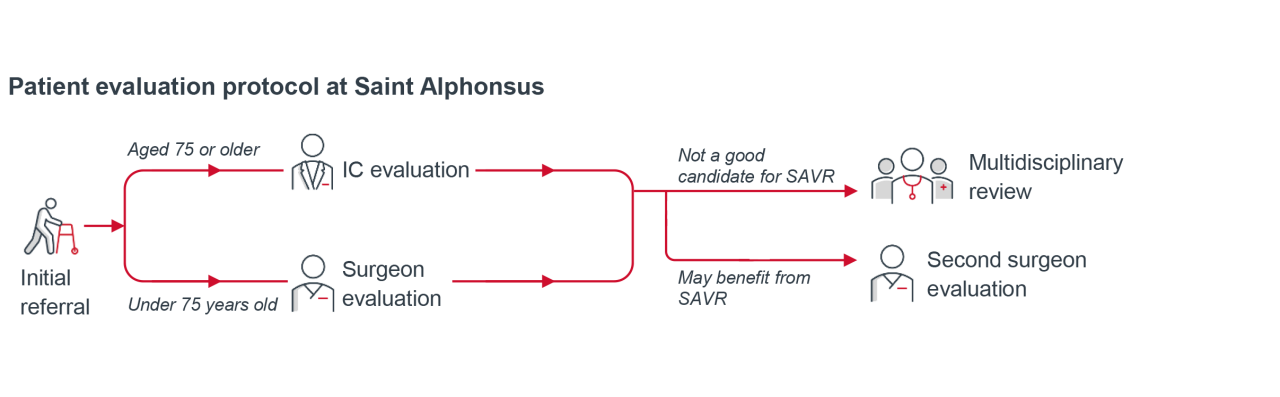
Replace second evaluation by a cardiac surgeon with multidisciplinary review
Saint Alphonsus plans to use the evaluation flexibility introduced by the NCD to reduce scheduling bottlenecks, especially for rural patients, and help improve the heart team’s referral-to-implant time, which currently stands at an average of 40 days.
For the first evaluation, patients aged 75 or older are automatically referred to the structural heart team for a consult with an IC, and patients younger than 75 are referred to a cardiac surgeon. Patients who clearly aren’t good candidates for SAVR will then receive a deep multidisciplinary review by the heart team instead of a second evaluation from a surgeon. Those surgical consults will be reserved for patients who may benefit more from SAVR than TAVR.
In addition to streamlining the scheduling process, Saint Alphonsus hopes that deeper heart team conferences will further strengthen multidisciplinary decision-making, collaboration, and discussion about lifetime management strategies.
Adopt a specialist-agnostic two-operator model
Saint Alphonsus believes that TAVR is best performed by two operators. In addition, the heart team’s two surgeons and two ICs share responsibility for their valve patients and are equally involved in the TAVR program.
However, the team also has experience performing TAVRs without a cardiac surgeon. During the COVID-19 pandemic, public health emergency measures relaxed requirements for TAVR procedures in similar ways to the NCD update. Through this experience, the heart team learned they can perform TAVRs effectively without a surgeon.
The heart team plans to introduce more flexibility into its shared responsibility approach while keeping both surgeons involved in the TAVR program. When a cardiac surgeon is available, one IC and one surgeon will continue to perform TAVRs, especially in more complex cases. When a surgeon is unavailable, two ICs can do the procedure. Adding this flexibility may allow the heart team to add an additional day for urgent or inpatient cases to their usual two-day TAVR schedule.
"We feel TAVR is a two-operator procedure, but some days surgeons need to schedule emergent surgeries or reduce a surgical backlog. So, we’re happy to do this procedure with two interventional cardiologists. Every patient is going to get two of us, no matter what."
Joseph Walsh, MD
Interventional Cardiologist Saint Alphonsus Medical Group
Long-term plans
Add more positions to the structural heart team. Saint Alphonsus is expecting a rise in TAVR volumes, so they are actively recruiting a third IC. With two rooms that can hold up to eight procedures a day already reserved for TAVR, the heart team has the capacity to expand.
Projected impacts


Adopt an APP-driven TAVR pathway
Adventist Health plans to take a unique approach to evaluations and procedures, with advanced practice providers (APPs) playing a leading role. Adventist’s TAVR volumes are constrained in part by scheduling challenges. Roughly half of patients travel from outside the local area, which makes it difficult to coordinate evaluations with one of the program’s two cardiac surgeons. Like other programs, Adventist will build flexibility into TAVR evaluations and procedures, elevating APPs to support both elements. The heart team hopes more flexible staffing will improve capacity and patient access.
Adventist Health, based in Portland, Oregon, serves a mix of urban, rural, local, and regional patients. Adventist’s heart team considers itself a small- to medium-sized program with one IC and two cardiac surgeons.
|
Adventist does not plan to make significant changes related to the CED, volume requirements, or asymptomatic coverage.
Planned changes

Create APP-led fast track for evaluations
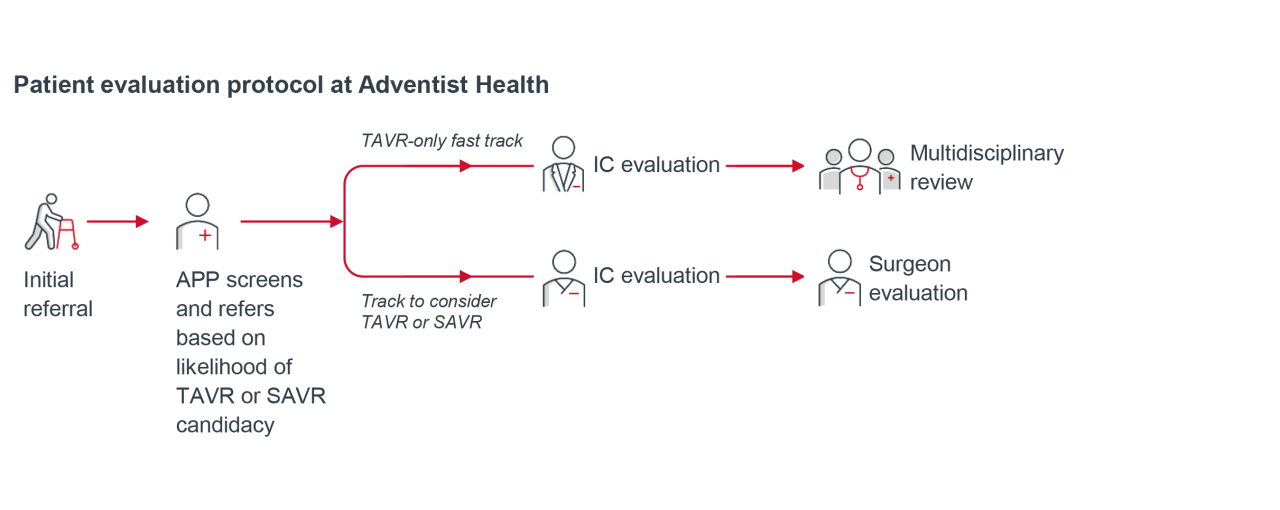
Adventist’s heart team plans to train an APP to screen referred patients and direct them into either the current dual-evaluation pathway or an expedited single-evaluation pathway. Patients unlikely to be surgical candidates — such as those with advanced age, significant comorbidities, frailty, limited mobility, or early cognitive decline — will see an IC, then be reviewed in a multidisciplinary valve conference attended by a cardiac surgeon. At the valve conference, a templatized note will document the surgical team’s input to satisfy the NCD requirement. Candidates for surgery will still receive a formal IC and a surgical consultation before valve conference review.
The heart team will monitor time from referral-to-APP call, referral-to-IC visit, and time-to-procedure metrics to ensure individual steps in the evaluation pathway are effective.

Train APPs to assist in TAVR procedures
Adventist Health is training a structural heart APP (a cardiac catheterization nurse) to serve as the second operator during lower risk TAVR procedures. The team expects to schedule these TAVR cases when a surgeon is on-site and available, should their expertise be needed. Cardiac surgeons will always participate in higher-risk cases.
During periods of surgical backlog, Adventist Health expects to use single-operator TAVR days strategically to free surgeon capacity for higher-priority cardiac surgery cases. This would allow the organization to balance structural heart and surgical volumes more effectively.
Long-term plans
- Reassess the TAVR operator model as volume grows. The heart team expects that if the program exceeds roughly 150 cases, it will need another TAVR operator (e.g., another cardiac surgeon or interventional cardiologist).
- Continue to evaluate registry participation based on whether the CED data meaningfully improves quality and outcomes.
- Monitor possibilities for other Adventist sites. While the Oregon site will remain focused on the existing TAVR center, Adventist leaders will monitor whether the NCD changes create new opportunities for structural heart program collaboration across the enterprise.
Projected impacts


Proactive engagement for asymptomatic patients and single-operator options
Alexian is the only TAVR program profiled that plans to modify its approach to asymptomatic patients through proactive patient engagement. Like other heart teams, they will leverage evaluation flexibility and plan to perform single-operator TAVRs when needed.
Alexian operates two hospitals in the Northwest suburbs of Chicago, Illinois. Alexian often takes in TAVR cases other centers turn down, such as complex patients and leaflet modifications. Because of that, many patients are willing to travel up to 200 miles to receive care.
|
The heart team doesn’t plan to make any changes related to the minimum volume thresholds being lifted and no immediate plans to stop tracking symptomatic patients for CED.
Planned changes

Prioritize asymptomatic patient referrals
Alexian plans to adjust their referral process to better serve newly covered asymptomatic patients. Since the early 2020s, the team has sent letters recommending valve clinic referral to the referring physicians of patients with severe aortic stenosis, and now the team is shifting to an automatic referral system. Flagged patients will be automatically referred to the valve clinic unless their cardiologist actively blocks the process.
Alexian expects the primary benefit of this process to be earlier treatment, improved outcomes, and decreased costs rather than increased volumes from new asymptomatic patients. Not every patient seen in the valve clinic will undergo immediate TAVR treatment: Patients who are managed medically will be closely observed longitudinally in an APP-lead process.
"We’re moving the treatment earlier, which could lead to fewer complications, a shorter length of stay, and better outcomes for patients and the team. Treating healthier patients is less expensive and less dangerous."
Andrei Pop, MD
Interventional Cardiologist Alexian Brothers Hospital
Boost an already efficient evaluation process
Alexian already has an efficient evaluation process and schedules two physician evaluations, a computed tomography (CT), and echo on the same day. The heart team now plans to allow for a single evaluation when TAVR is the clear choice, or when two physician evaluations on the same day are not feasible.
For Alexian, a successful single evaluation process depends on a flexible scheduling approach and a strong relationship between ICs and cardiac surgeons. For example, while an IC will often perform the single evaluation, surgeons are trusted to fill in when the IC is not available.
When it’s less clear whether a patient would benefit from TAVR or SAVR, the case will be referred for multidisciplinary review with multiple heart team members. The team will discuss the treatment approach and procedural plan based on patient characteristics and CT analysis. Alexian noted that asymptomatic coverage will strengthen the importance of multidisciplinary review, as younger patients with less severe aortic stenosis are referred to the valve team.
Leverage skilled staff for single-operator TAVR
Alexian is confident that both their ICs and cardiac surgeons can perform TAVRs as single operators. This is largely because their catheterization lab staff is trained to support TAVR balloon inflation and regularly works without an operating room (OR) team. Staff will include a nurse, a recorder, a nurse anesthetist (CRNA), an echo technologist, and a surgical technologist (or scrub tech), who becomes more important in one-operator procedures. This model allows the OR heart team, who are a limited resource, to focus their efforts on open-heart cases.
Long-term plans
- Invest in more technologies to identify aortic stenosis patients earlier, such as data monitoring tools that can scan echo results and medical records.
- Expand the broader valve program by scaling valve clinic operations, adding APP and coordinator support where needed, and supporting transcatheter and surgical valve patients through a single pathway.
- While Alexian will continue participating in the TVT registry, leaders believe that the future should include more automated data capture, reduced manual abstraction burden, more targeted evidence-generation efforts, and continued outcome monitoring for new patient populations.
Projected impacts


6 common themes across heart teams
There isn’t a one-size-fits-all approach for TAVR programs responding to the NCD flexibilities. Each profiled organization plans to respond differently as they weigh the unique strengths of their heart teams alongside the severity of patient access barriers. Six common themes emerged:
- Surgeons’ level of interest in TAVR is unique to each organization and often guides the heart team response to NCD changes.
- Most programs will remove the second surgery evaluation for straightforward non-surgical cases.
- Most programs will go beyond simply preserving their multidisciplinary heart teams. They will leverage NCD updates to further strengthen heart team collaboration.
- All programs will take advantage of the operator flexibility. Plans range from a dual IC-operator model, using a single operator only in urgent cases, or transitioning fully to a single-operator model.
- Organizations that already value their registries will preserve them, those that don’t will re-evaluate participation.
- Asymptomatic coverage will impact referring physicians' workflows more than TAVR program operations.
1 Unless otherwise noted, all information in this case study came from Advisory Board interviews with officials from the profiled organizations.
2 Elbaz-Greener G, Masih S, et al. Temporal Trends and Clinical Consequences of Wait Times for Transcatheter Aortic Valve Replacement: A Population-Based Study. Circulation. July 31, 2018.
3 Transcatheter Aortic Valve Replacement (TAVR) Decision Summary. CMS. Accessed October 1, 2026.
Edwards Lifesciences is the global leader in patient-focused medical innovations for structural heart disease, critical care, and surgical monitoring. Driven by a passion to help patients, Edwards partners with clinicians and healthcare stakeholders to improve outcomes and enhance lives through innovative technologies, evidence, and education.
This case compendium is sponsored by Edwards, an Advisory Board member organization. Representatives of Edwards helped select the topics and issues addressed. Advisory Board experts wrote the case compendium, maintained final editorial approval, and conducted the underlying research independently and objectively. Advisory Board does not endorse any company, organization, product or brand mentioned herein.

This case compendium is sponsored by Edwards. Advisory Board experts conducted the underlying research independently and objectively.

Jennifer Fierke
Senior writer and editor, Sponsorship
Posted on November 19, 2026

Don't miss out on the latest Advisory Board insights
Create your free account to access 1 resource, including the latest research and webinars.
Want access without creating an account?
You have 1 free members-only resource remaining this month.
1 free members-only resources remaining
1 free members-only resources remaining
You've reached your limit of free insights
Become a member to access all of Advisory Board's resources, events, and experts
Never miss out on the latest innovative health care content tailored to you.
Benefits include:
Unlimited access to research and resources
Member-only access to events and trainings
Expert-led consultation and facilitation
The latest content delivered to your inbox
You've reached your limit of free insights
Become a member to access all of Advisory Board's resources, events, and experts
Never miss out on the latest innovative health care content tailored to you.
Benefits include:
Unlimited access to research and resources
Member-only access to events and trainings
Expert-led consultation and facilitation
The latest content delivered to your inbox
This content is available through your Curated Research partnership with Advisory Board. Click on ‘view this resource’ to read the full piece
Email ask@advisory.com to learn more
Click on ‘Become a Member’ to learn about the benefits of a Full-Access partnership with Advisory Board
Never miss out on the latest innovative health care content tailored to you.
Benefits Include:
Unlimited access to research and resources
Member-only access to events and trainings
Expert-led consultation and facilitation
The latest content delivered to your inbox
This is for members only. Learn more.
Click on ‘Become a Member’ to learn about the benefits of a Full-Access partnership with Advisory Board
Never miss out on the latest innovative health care content tailored to you.
Benefits Include:
Unlimited access to research and resources
Member-only access to events and trainings
Expert-led consultation and facilitation
The latest content delivered to your inbox