Auto logout in seconds.
Continue Logout
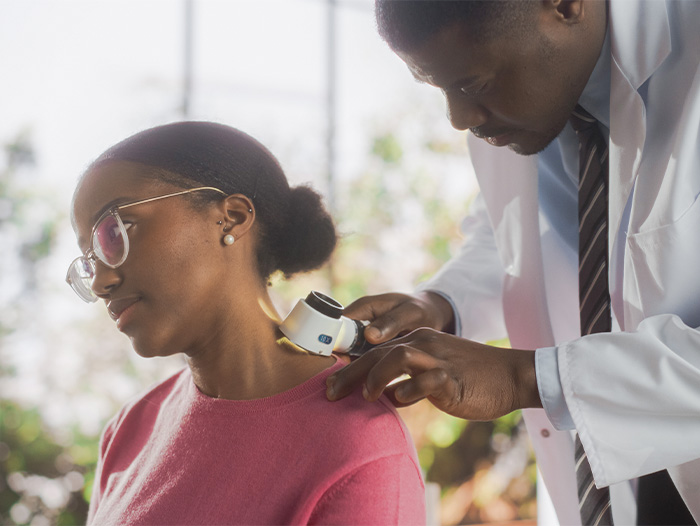
Skin and hair disorders disproportionately affect patients with skin of color, yet persistent access, trust, and capacity challenges — such as a lack of staffing, space, clinician bandwidth, and funding — limit timely dermatological care. At Baylor College of Medicine, the Skin of Color Clinic is a visible, embedded specialty model that signals commitment while expanding access without creating a standalone clinic. The result: a scalable approach to advancing equitable dermatology care while addressing both patient experience and system capacity constraints.1
The challenge
Skin and hair disorders like alopecia areata and atopic dermatitis (also called eczema) disproportionately affect patients with skin of color.2,3 Yet those patients face persistent barriers to timely, quality dermatology care.4,5
Not all dermatologists are trained to treat diverse skin tones and hair types.3,4 In addition, dermatology is among the least racially and ethnically diverse specialties:5 A lack of clinicians of color can signal to patients of color that their needs may not be fully understood or prioritized. These gaps can erode trust among patients of color, who may believe that most dermatology spaces are unable to meet their needs.
At the same time, dermatology clinics and programs face funding issues. First, clinics are reimbursed less for conditions that don’t require a procedure, such as alopecia areata and atopic dermatitis. Second, payers and grant funders can perceive treatment for skin and hair conditions as purely cosmetic — not understanding that these conditions can have significant physical and psychosocial impacts on patients’ quality of life.6,7 Because they can affect the ability to create space for and staff clinics, funding challenges like these make it harder to sustain and scale clinics focused on complex, non-procedural dermatologic care, including skin of color programs.
Ultimately, fewer dermatologists — with limited availability — are left caring for a large, geographically dispersed population, leading to longer wait times for first-time appointments.
In addition, uninsured or underinsured patients may have limited access to specialty dermatology clinics,8 leaving even fewer pathways to timely diagnosis and treatment.
Addressing these overlapping challenges requires rethinking how dermatologic care is designed and delivered so it can better meet the needs of patients who have been historically underserved.
The organization
Located in Houston, Texas, Baylor College of Medicine (BCM) is an academic medical center dedicated to clinical care, research, and education. Because BCM serves one of the most diverse patient populations in the country,9 it considers the Skin of Color Clinic an essential part of the Department of Dermatology.
The approach
BCM’s Skin of Color Clinic aims to improve access to care for patients with hair loss, pigmentary disorders, and eczema. Rather than being a standalone office, the clinic consists of trained specialists within the broader Department of Dermatology. The clinic functions both as a site of care and a signal to patients of color that services are available to them. To expand equitable dermatology access even further, the clinic trains providers across departments to recognize disorders in diverse hair types and skin tones, holds community screening and referral events, uses social media to convey accurate information to the public, and gives lectures across the United States.
Approach 1: Signal commitment and build trust through a visible, embedded specialty clinic
Embedded in BCM’s Department of Dermatology, the Skin of Color Clinic functions as both a specialized site of care and a signal that services are available to patients with skin of color. Although the clinic’s dermatologists can treat any patient, they are uniquely qualified to speak to the concerns and cultural context of patients with various skin tones and hair types.
To support the Skin of Color Clinic’s launch and continued functioning, BCM set aside time for dermatologists to dedicate time to the clinic. A BCM marketing team contributed a website, news stories, and radio ads to give the clinic visibility.
After finding a provider focused on culturally responsive dermatology, patients have reported an increased willingness to seek care. As a result, the Skin of Color Clinic is usually booked for eight to nine months in advance.
"The Skin of Color Clinic is not a different physical space than where I see my other patients. I see all patients, but the main point is that it is advertisable so that patients understand that it's meant for them."
Oyetewa Asempa, MD
Assistant Professor of Dermatology and Director, Skin of Color Clinic, Baylor College of Medicine

Approach 2: Build trust through community education and screening
Through community outreach events, the Skin of Color Clinic brings screening and care to patients where they live. Events are held in a trusted community center and structured as education first, followed by screenings for skin and hair disorders. Before the event, hairstylists and barbers are trained to screen for and educate community members about skin and hair disorders. Community health workers are also available to help people navigate their insurance, if necessary.
The clinic reported that participants in these community outreach events became more knowledgeable about their skin condition and confident about which conditions required specialty skin care, which could lead to reduced clinic appointments for conditions that can be treated at home.
When it became clear that grants alone wouldn’t adequately fund each event, the clinic partnered with industry sponsors to help staff events, scale up efforts, and collect data to continually improve the program. For instance, the clinic and an industry partner sponsored a free alopecia areata education session and screening. Between 200 and 300 community members attended each education and dermatology screening event.
200+
Community members attended each education and screening event
BCM’s department of dermatology has an official social media account, and individual physicians sometimes use their own social media accounts for trust-building and education — often to counteract misinformation. Social media isn’t intentionally used to recruit because the Skin of Color Clinic already has so many patients. Even so, many patients have found the clinic based on these social media channels.
For uninsured patients unable to access in clinic or community-based specialty care, digital education and outreach also offers a connection point. In parallel, BCM is conducting focus groups to better understand the needs, experiences, and information gaps of populations the clinic is unable to serve directly, helping inform how the department can support these patients outside of traditional clinical settings.

Approach 3: Equip clinicians by becoming a center of training and advocacy
The Skin of Color Clinic also trains residents and clinicians across BCM to recognize dermatological conditions for all skin tones and hair types and practice culturally responsive communication.
Training should reflect language spoken by different communities. A culturally responsive clinician understands how different patient populations talk about skin and hair disorders and treatments. To illustrate, some patients use the word ashy to refer to visibly dry skin. Without learning what some patients mean by “ashy,” a provider misses crucial information about the patient’s experience.
"If a doctor is unaware that different words or terms may be used in different communities, they may not have the skills to ask the right questions when patients try to communicate their experiences in treatment."
Oyetewa Asempa, MD
Assistant Professor of Dermatology and Director, Skin of Color Clinic, Baylor College of Medicine
Recognizing that change goes beyond BCM as an institution, clinic dermatologists also educate providers and give lectures on caring for skin of color at other organizations. They also regularly advocate to update the American Board of Dermatology’s certification exams to better reflect a diverse patient population. For example, photos of disorders used in study guides and exams need to include different skin tones, so that graduating dermatologists can recognize different conditions in skin of color.

Results
BCM’s Skin of Color Clinic illustrates how an academic medical center can expand equitable access to specialty dermatology care without building a separate physical clinic. This, combined with community-based education, clinician training, and digital engagement, addressed both patient trust and capacity constraints. Results included:
- A scalable framework for addressing access gaps in specialty care.
- Improved access with broader reach to underserved patients in Houston.
- Increased patient trust and earlier engagement.
- Enhanced downstream care as patients more consistently engage with — and adhere to — treatments.
- Education and navigation support for community members, even when clinic access is limited.
1 Unless otherwise noted, all information in this case study came from an Advisory Board interview with Dr. Asempa from Baylor College of Medicine’s Skin of Color Clinic. This case study is intended to describe a single approach to a challenge, not suggest a one-size-fits-all model.
2 Sy N, et al. Overall and Racial and Ethnic Subgroup Prevalences of Alopecia Areata, Alopecia Totalis, and Alopecia Universalis. JAMA Dermatology. March 1, 2023.
3 Adawi W, et al. Diagnosing Atopic Dermatitis in Skin of Color. Dermatologic Clinics. April 12, 2023.
4 Lim HW, et al. International Expert Consensus on Defining Skin of Color and Delivering Equitable Dermatologic Care. International Journal of Dermatology. November 6, 2025.
5 Narla S, et al. Racial disparities in dermatology. Archives of dermatological research. December 12, 2022.
6 Christou E, et al. Psychosocial burden and the impact of illness perceptions and stigma on quality of life, anxiety and depression in alopecia areata: results from the Alopecia + Me study. British Journal of Dermatology. July 16, 2025.
7 Talamonti M, et al. Quality of Life and Psychological Impact in Patients with Atopic Dermatitis. Journal of Clinical Medicine. March 21, 2021.
8 Alghothani L, et al. Disparities in Access to Dermatologic Care According to Insurance Type. JAMA Dermatology. August 1, 2012.
9 About Us: Life in Houston. Baylor College of Medicine. Accessed March 10, 2026.
At Pfizer, we’re in relentless pursuit of breakthroughs that change patients’ lives. We innovate every day to make the world a healthier place.
Our unique resources allow us to do more for people. Using our global presence and scale, we’re able to make a difference in local communities and the world around us.
Pfizer supports the global healthcare community’s independent quality improvement initiatives to improve patient outcomes in areas of unmet medical need that are aligned with Pfizer’s medical and/or scientific strategies. For more information, please visit www.pfizer.com.
This case profile is sponsored by Pfizer, an Advisory Board member organization. Representatives of Pfizer helped select the topics and issues addressed. Advisory Board experts wrote the report, maintained final editorial approval, and conducted the underlying research independently and objectively. Advisory Board does not endorse any company, organization, product, or brand mentioned herein.
To learn more, view our editorial guidelines.

This case profile is sponsored by Pfizer. Advisory Board experts conducted the underlying research independently and objectively.


Abner Russom
Senior research analyst
Jennifer Fierke
Senior writer and editor, Sponsorship
Posted on August 18, 2026

Don't miss out on the latest Advisory Board insights
Create your free account to access 1 resource, including the latest research and webinars.
Want access without creating an account?
You have 1 free members-only resource remaining this month.
1 free members-only resources remaining
1 free members-only resources remaining
You've reached your limit of free insights
Become a member to access all of Advisory Board's resources, events, and experts
Never miss out on the latest innovative health care content tailored to you.
Benefits include:
Unlimited access to research and resources
Member-only access to events and trainings
Expert-led consultation and facilitation
The latest content delivered to your inbox
You've reached your limit of free insights
Become a member to access all of Advisory Board's resources, events, and experts
Never miss out on the latest innovative health care content tailored to you.
Benefits include:
Unlimited access to research and resources
Member-only access to events and trainings
Expert-led consultation and facilitation
The latest content delivered to your inbox
This content is available through your Curated Research partnership with Advisory Board. Click on ‘view this resource’ to read the full piece
Email ask@advisory.com to learn more
Click on ‘Become a Member’ to learn about the benefits of a Full-Access partnership with Advisory Board
Never miss out on the latest innovative health care content tailored to you.
Benefits Include:
Unlimited access to research and resources
Member-only access to events and trainings
Expert-led consultation and facilitation
The latest content delivered to your inbox
This is for members only. Learn more.
Click on ‘Become a Member’ to learn about the benefits of a Full-Access partnership with Advisory Board
Never miss out on the latest innovative health care content tailored to you.
Benefits Include:
Unlimited access to research and resources
Member-only access to events and trainings
Expert-led consultation and facilitation
The latest content delivered to your inbox