Auto logout in seconds.
Continue Logout

Medical malpractice claims are more common than many realize, and they carry serious consequences for patients and providers alike. These claims allege that a healthcare provider’s negligence caused harm, whether through an error in diagnosis, treatment, or procedure.
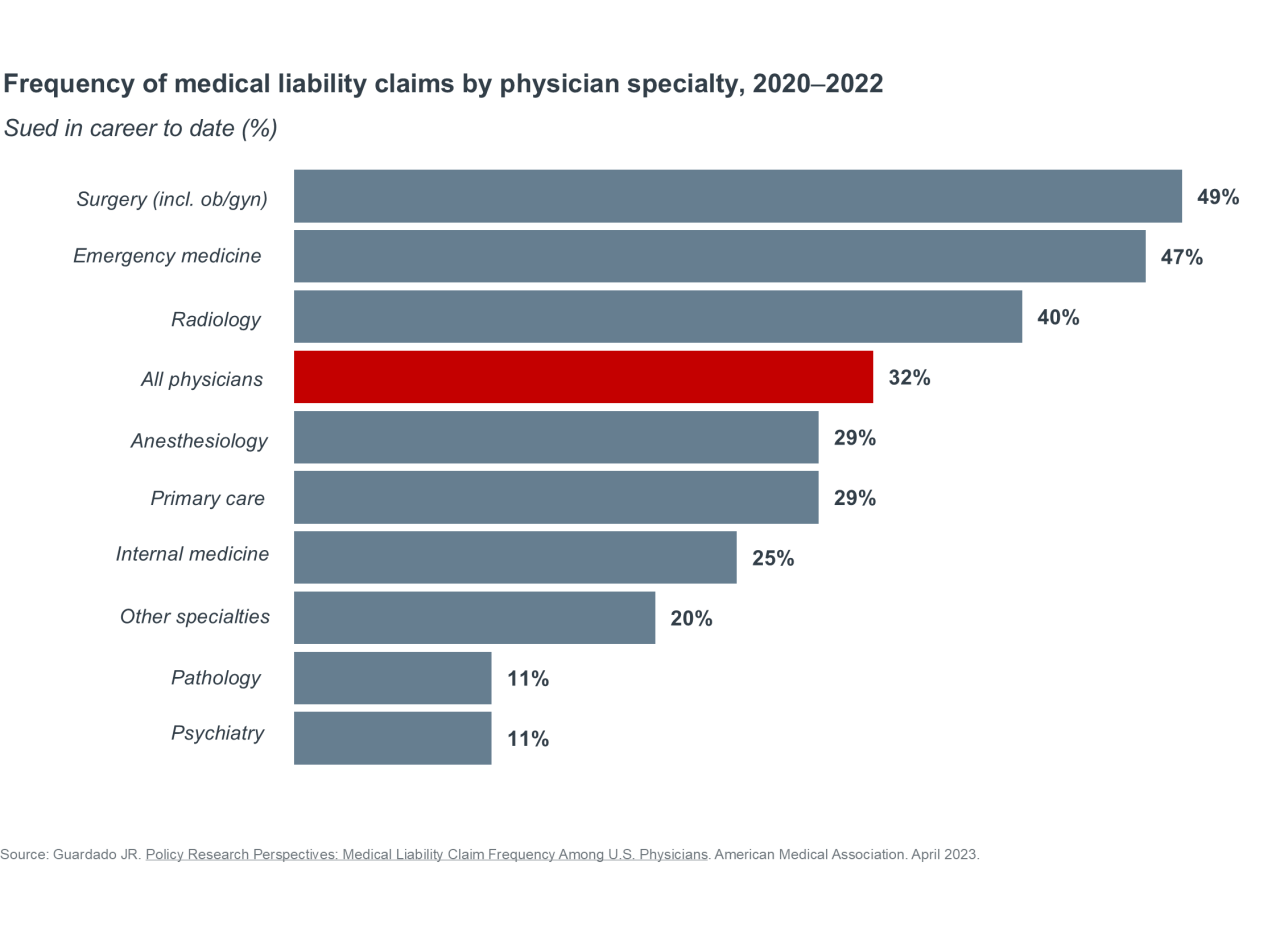
As of 2022, more than one-third of physicians have reported being sued at least once in their careers.1 The longer a physician has been practicing, the greater their risk: Almost half (47%) of doctors aged 55 and older have been sued, compared to just 9.5% of those under 40.1 Specialty choice adds another layer of exposure. Obstetrician/gynecologists (ob/gyns) and general surgeons top the list of high-risk fields.1 For example, more than 75% of ob/gyns over 55 have been sued, while only 27.7% of pediatricians report similar experiences.1
These numbers underscore why proactive risk reduction is essential, not only to reduce liability but also to minimize adverse outcomes.
Risk reduction builds on clinical practice guidelines
Clinical practice guidelines (CPGs) are the foundation of evidence-based medicine. Developed through rigorous, systematic methodology, they outline standardized steps for diagnosis and treatment to improve consistency and quality of care.2,3 CPGs come from trusted sources such as government agencies and specialty societies, and they help clinicians deliver care that aligns with best practices.2,3 For example, guidelines for chronic conditions often specify diagnostic criteria, recommended treatment options, and follow-up intervals to ensure optimal outcomes.
However, CPGs have a critical limitation: They don’t address malpractice liability drivers or operational vulnerabilities that can lead to litigation.2 Risk reduction guidance fills that gap. Building on CPGs, it targets areas of greatest liability exposure by using malpractice claims data to identify patterns that contribute to adverse outcomes.2,4 This guidance covers key areas such as documentation, communication, and operational consistency.2,4 For example, risk reduction guidance may recommend structured protocols for documenting patient consent and ensuring timely follow-up on test results — steps that can prevent misunderstandings and reduce the likelihood of claims.
| Clinical practice guidelines (CPGs) | Risk reduction guidance |
|---|---|
|
|
Why risk reduction guidance is essential
Even when physicians follow CPGs, malpractice liability doesn’t disappear. Guidelines are designed to standardize care and improve outcomes, but they don’t address the operational gaps that often lead to claims. Common risk factors include:2,5
- Communication breakdowns: Misunderstandings between providers, staff, and patients can result in missed information or unclear instructions.
- Missed follow-ups: Failure to track diagnostic tests, referrals, or patient compliance creates gaps in care that can escalate into claims.
- Systemic issues: Inefficient workflows, inadequate documentation, and lack of standardized protocols for high-risk scenarios increase exposure.
The impact of malpractice claims goes far beyond the courtroom. Financial strain from legal defense costs and indemnity payments can disrupt practice operations. A single claim can damage a provider’s reputation, eroding patient trust and professional standing.2 The emotional toll is equally serious. Litigation stress often leads to burnout, and in some cases what experts call “medical malpractice stress syndrome,” which can affect both personal well-being and clinical performance.6,7
Risk reduction guidance is essential because it proactively addresses these vulnerabilities. By analyzing malpractice claims data, it identifies high-risk scenarios and offers practical steps to reduce exposure.2 More importantly, it fosters a culture of accountability and continuous improvement, enhancing patient safety while reducing liability risk for providers.2
How MagMutual’s risk reduction guidance can help providers
MagMutual, through their own risk consultancy, MyAdvice, supplies healthcare providers with robust, data-driven resources to help mitigate malpractice liability. At the core is one of the largest searchable databases of claims, billing, and procedure data available in the country. Providers can also access specialty- and state-specific risk reports that analyze top risk drivers for 28 different specialties, including ob/gyn, internal medicine, emergency medicine, pediatrics, and surgery.
Specialty risk mitigation reports
Each report breaks down the most common and costly types of claims for per specialty. For example, the ob/gyn report identifies key presenting medical conditions and adverse outcomes.8 Specialty risk mitigation reports also offer practical solutions that doctors and their teams can use right away, such as:
| The MyAdvice by MagMutual Risk Mitigation Report for each specialty is available for download, offering additional strategies to reduce risk in the top areas where claims occur. |
- Standardized checklists and documentation: Checklists for high‑risk scenarios (e.g., shoulder dystocia, postpartum hemorrhage) ensure comprehensive, streamlined documentation of clinical findings and interventions.
- Simulation training and team-based drills: Regular simulation exercises allow teams to practice emergency responses and refine communication protocols, reducing the likelihood of errors during critical events.
- Enhanced communication: Clear and timely communication during handoffs and informed‑consent discussions, including debriefs after unscheduled procedures, support safer care and maintains patient trust.
- Clinical decision support: CPGs associated with common malpractice‑risk drivers, along with other evidence‑based tools (e.g., ACOG algorithms for labor and delivery) and real‑time monitoring, help support timely interventions.
76%
The percent of MagMutual policyholders who plan to implement recommended strategies from risk mitigation reports into their practice.*
*See endnote 10.
Risk environment reports
The MyAdvice by MagMutual national and state-level reports reveal how local factors (e.g., urbanization, attorney marketing, and legislative changes) impact claim frequency and severity. For example, California has experienced a sharp rise in legal services advertising, with more than $238 million spent in 2023 alone, a trend that may increase claimant awareness and pressure on malpractice filings.9 Meanwhile, Georgia’s 2025 tort reforms revised how medical damages are calculated and limited certain lawsuit practices to reduce costs and improve predictability for providers and insurers.9
Providers who use MagMutual’s risk mitigation tools see measurable benefits. According to internal analysis, engaging with these resources leads to a significant reduction in malpractice losses overall. Providers who completed four or more courses focused on malpractice risk drivers were associated with a 25% reduction in loss costs and a 20% reduction in loss frequency. By combining specialty-specific insights with practical strategies, MyAdvice helps providers not only reduce liability but also improve patient safety and confidence in their care.
1 Guardado JR. Policy Research Perspectives: Medical Liability Claim Frequency Among U.S. Physicians. American Medical Association. April 2023.
2 Kanich WS. Risk Reduction in Healthcare: Why Clinical Practice Guidelines Alone Aren’t Enough. MagMutual. Accessed December 3, 2025.
3 Murad MH. Clinical Practice Guidelines: A Primer on Development and Dissemination. Mayo Clinic Proceedings. March 2017.
4 Alder S. What is Risk Management in Healthcare?. The HIPAA Journal. April 11, 2025.
5 Kusumoto F, Ross J, et al. Analysis of Closed Claims Among All Medical Specialties: Importance of Communication and Other Non-Clinical Contributing Factors. Dovepress. February 29, 2024.
6 Vizcaíno-Rakosnik M, Martin-Fumadó C, et al. The Impact of Malpractice Claims on Physicians’ Well-Being and Practice. Journal of Patient Safety. January 2022.
7 Ryll NA. Living Through Litigation: Malpractice Stress Syndrome. Journal of Radiology Nursing. March 2015.
8 Risk Mitigation Report: Obstetrics/Gynecology. MagMutual. Accessed December 3, 2025.
9 Risk Environment Report. MagMutual. Accessed January 30, 2026.
10 Kanich WS. Mutual Matters: How Risk Reports Help Minimize Risk and Improve Outcomes. MagMutual. Accessed December 3, 2025.
For more than four decades, MagMutual has been a leading provider of medical professional liability insurance. Today, the company is the largest mutual medical professional liability carrier in the U.S., delivering healthcare liability insurance coverage to more than 40,000 healthcare providers and organizations nationwide. MagMutual offers customized advice, claims support and financial benefits that result in improved outcomes and stronger policyowners.
Learn more about MagMutual.
This report is sponsored by MagMutual, an Advisory Board member organization. Representatives of MagMutual helped select the topics and issues addressed. Advisory Board experts wrote the content, maintained final editorial approval, and conducted the underlying research independently and objectively. Advisory Board does not endorse any company, organization, product or brand mentioned herein.
To learn more, view our editorial guidelines.

This report is sponsored by MagMutual. Advisory Board experts conducted the research and maintained final editorial approval.

Don't miss out on the latest Advisory Board insights
Create your free account to access 1 resource, including the latest research and webinars.
Want access without creating an account?
You have 1 free members-only resource remaining this month.
1 free members-only resources remaining
1 free members-only resources remaining
You've reached your limit of free insights
Become a member to access all of Advisory Board's resources, events, and experts
Never miss out on the latest innovative health care content tailored to you.
Benefits include:
Unlimited access to research and resources
Member-only access to events and trainings
Expert-led consultation and facilitation
The latest content delivered to your inbox
You've reached your limit of free insights
Become a member to access all of Advisory Board's resources, events, and experts
Never miss out on the latest innovative health care content tailored to you.
Benefits include:
Unlimited access to research and resources
Member-only access to events and trainings
Expert-led consultation and facilitation
The latest content delivered to your inbox
This content is available through your Curated Research partnership with Advisory Board. Click on ‘view this resource’ to read the full piece
Email ask@advisory.com to learn more
Click on ‘Become a Member’ to learn about the benefits of a Full-Access partnership with Advisory Board
Never miss out on the latest innovative health care content tailored to you.
Benefits Include:
Unlimited access to research and resources
Member-only access to events and trainings
Expert-led consultation and facilitation
The latest content delivered to your inbox
This is for members only. Learn more.
Click on ‘Become a Member’ to learn about the benefits of a Full-Access partnership with Advisory Board
Never miss out on the latest innovative health care content tailored to you.
Benefits Include:
Unlimited access to research and resources
Member-only access to events and trainings
Expert-led consultation and facilitation
The latest content delivered to your inbox
