Auto logout in seconds.
Continue Logout

Hospital and health system M&A activity continues to accelerate. Although every deal is built on a specific and defensible strategic rationale, many organizations struggle to realize the value that justified the merger in the first place.
Completing a merger is a significant achievement in its own right. However, organizations too often treat deal close as the finish line rather than the starting point for value creation. Health systems frequently struggle to translate gains in scale into gains in enterprise performance because they approach integration as a collection of disconnected initiatives rather than a coordinated transformation of how care is delivered, managed, and supported.
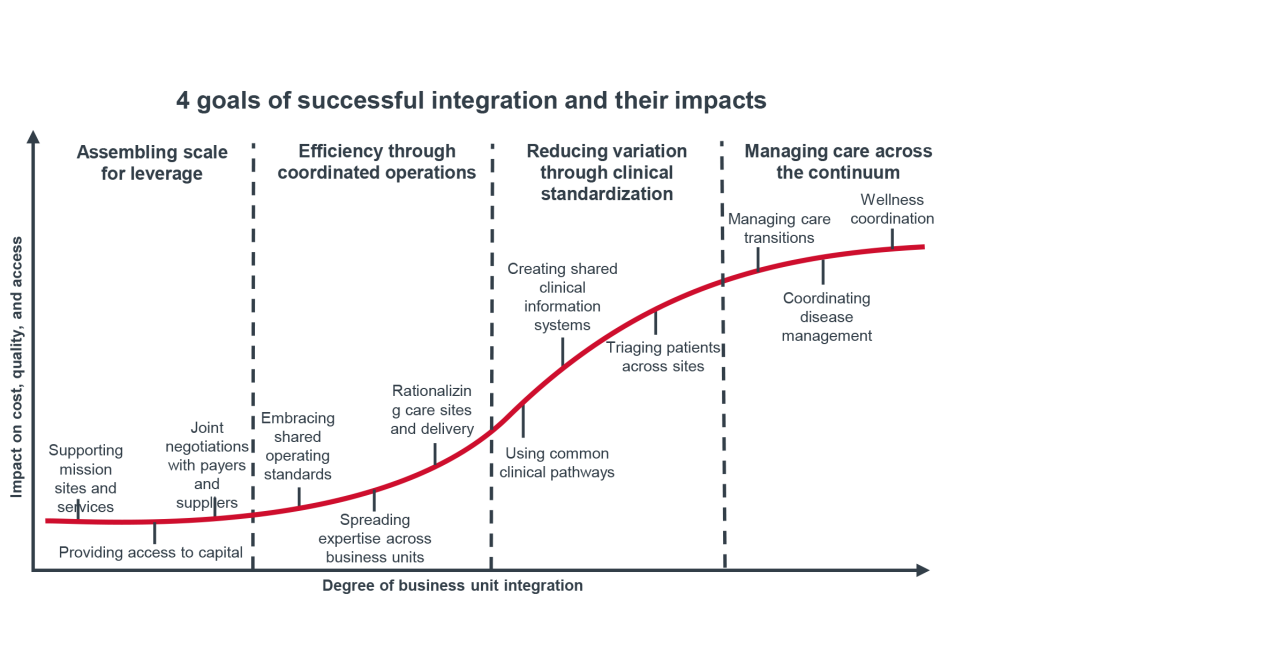
The most successful integrations focus on four goals:
- Assembling scale for leverage
- Generating efficiency through coordinated operations
- Reducing variation through shared standards
- Managing care across the continuum
Achieving those goals requires much more than just combining assets under a common brand. Underpinning all four goals are a commitment to building shared cultural principles across the merged organization and investment in workforce change management to ensure integration sticks. It also requires deliberate choices about governance, operating models, operational priorities, and organizational change.
Here are five mistakes that continue to derail post-merger integration efforts and what leaders should do instead.
Mistake #1: Letting technology define the integration strategy
Technology integration is often one of the most visible and resource-intensive components of a merger. EHR migrations, application rationalization efforts, and data conversion projects can quickly become the dominant focus of integration planning.
The problem is that technology should support the integration strategy, not determine it.
What to do instead
- Define the future-state operating model before major technology decisions are made.
- Clarify decision rights, governance structures, and workflow expectations early.
- Distinguish between Day One continuity efforts and longer-term transformation priorities.
- Treat technology as an enabler of integration rather than the integration strategy itself.
Organizations frequently establish integration timelines around major IT milestones while postponing more difficult decisions about governance, workflows, physician alignment, operating structures, and performance management. As a result, leaders may successfully implement a common technology platform while continuing to operate as multiple independent organizations.
The strongest post-merger performers take the opposite approach. They first determine how the future organization will operate, then they establish enterprise governance models, define decision rights, standardize key workflows, and determine where local variation is necessary. Only then do they configure technology to enable those decisions.
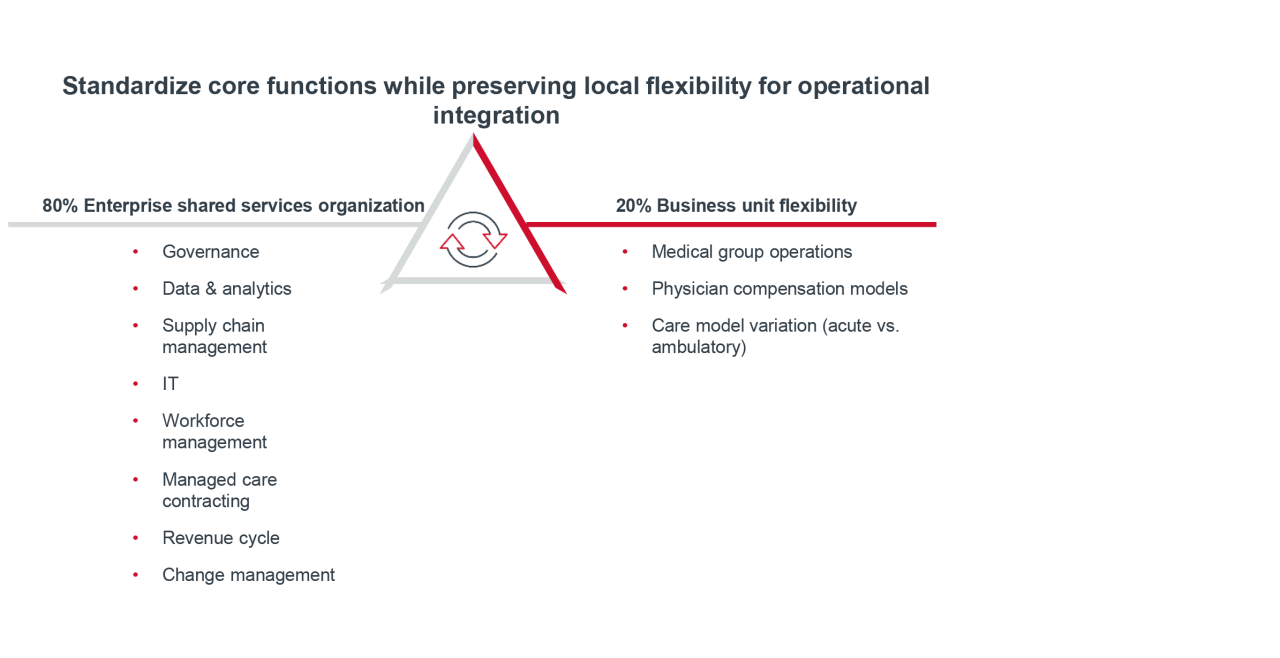
A large academic health system serving rural communities across a multistate region’s recent integration efforts illustrate this approach. Following a series of acquisitions and expansions across its network, the organization prioritized standardization in functions where enterprise scale could create measurable value, including HR, IT, supply chain, compliance, and other shared services. At the same time, leaders preserved local operational authority where flexibility remained important. Rather than assuming every function should be managed the same way. The health system created a model that balances enterprise consistency with local responsiveness.
This distinction matters because technology alone cannot deliver the benefits most leaders seek from M&A. Shared platforms can support scale, but they cannot by themselves create coordinated operations, reduce variation, or improve care coordination across a growing network.
Various goals informing structural decisions
Goals suggesting less centralization
| Goals suggesting greater centralization
|
Mistake #2: Setting value creation targets and failing to operationalize them
Most integrations begin with a value creation thesis. Leaders identify opportunities to reduce costs, improve performance, grow service lines, expand access, boost purchasing leverage and strengthen negotiating power, or better coordinate care across the continuum.
Yet many organizations stop at the spreadsheet. Synergy targets are established, financial projections are developed, and dashboards are created, but accountability for realizing those benefits often is not hardwired. Initiatives lack owners, timelines drift, and operational teams struggle to connect strategic goals to day-to-day decisions.
Organizations should recognize that value capture is not primarily a finance exercise; instead, it is an operational execution challenge.
Finance teams can quantify the opportunity, but operations teams must translate that opportunity into updated workflows, new governance approaches, revised service delivery models, and different ways of allocating resources. Without that translation, organizations frequently celebrate theoretical value long before they realize actual value.
The consequences extend beyond missed savings. Leaders lose credibility when promised benefits fail to materialize. Teams become overwhelmed by competing priorities. And initiatives may be counted multiple times, rely on the same constrained resources, or assume organizational changes that never occur.
Successful organizations recognize that the deal thesis must become a management system.
What to do instead
- Establish a single value ledger with clear definitions and attribution rules.
- Include revenue growth, avoided costs, implementation investments, working capital implications, and operational dependencies within value tracking.
- Build a sequenced enterprise integration roadmap based on time-to-value, organizational capacity, and change burden.
- Assign initiative ownership to leaders who control the operational levers required to achieve results.
- Create a dedicated transformation management capability focused on value realization, not just integration tracking.
- Use recurring governance forums to make trade-off decisions rather than simply review dashboards.
In many organizations, the challenge ultimately becomes a sequencing problem: leaders attempt to pursue every value creation opportunity simultaneously rather than prioritizing the initiatives most critical to early integration success. Rather than focusing on how much value exists on paper, leaders should determine how much change their organization can absorb while maintaining patient access, workforce stability, and clinical performance.
Mistake #3: Treating operational integration as administrative work instead of a strategic priority
Many executives understandably focus on high-profile strategic ambitions after a merger, including market expansion, physician alignment, service line growth, pricing leverage, and network strategy. Meanwhile, operational integration often receives less executive attention until a problem emerges.
Some potential problems include revenue cycle disruptions, contracting inconsistencies, supply chain inefficiencies, duplicative vendors, denial increases, credentialing delays, and inconsistent patient access processes.
By the time these challenges become visible, they are often affecting financial performance, clinical operations, physician satisfaction, and patient experience.
One of the most common integration mistakes is assuming these challenges will resolve themselves over time. In reality, organizations must actively integrate the reporting structures, decision-making processes, operational workflows, and performance management systems that connect formerly independent organizations to address these issues effectively.
From this perspective, operational integration becomes more than just cost reduction; it becomes the foundation that enables future enterprise performance. It enables organizations to not only achieve today’s level of performance at a lower cost tomorrow but also to leverage scale to drive performance improvement and increased value delivery.
What to do instead
- Establish dedicated integration workstreams for supply chain, revenue cycle, and payer contracting that focus not only on cost reduction but also performance optimization and increased service levels.
- Identify a prioritized portfolio of high-impact improvement opportunities based on scale of impact and speed to value.
- Sequence operational changes to accelerate value realization while minimizing disruption.
- Use early operational wins to fund longer-term transformation initiatives.
- Leverage standardization efforts to support future data, analytics, and AI initiatives.
Operational integration is often where organizations first experience the tangible benefits of becoming a larger system. Leaders who treat it as a strategic priority tend to unlock value faster than organizations that view it as administrative cleanup.
Mistake #4: Expanding the enterprise without creating a connected care delivery system
Many health systems pursue mergers to strengthen market presence, improve pricing leverage, expand access, and broaden care delivery capabilities. Yet after the transaction closes, organizations are often slow to coordinate meaningfully across these capabilities and continue to operate as collections of individual clinical assets rather than a connected care delivery system.
This is particularly important when it comes to referral integrity, patient navigation, and care coordination. Without clear pathways connecting providers, facilities, and service lines across the enterprise, organizations may successfully expand their footprint without improving the patient journey or achieving many of the strategic benefits that motivated the merger in the first place. This approach leaves significant value on the table.
As care increasingly shifts into ambulatory settings, organizations need a clear plan for how a combined enterprise will manage ambulatory growth, physician alignment, specialty expansion, care coordination, site-of-care optimization, and patient flow.
The challenge becomes even more important as organizations pursue broader goals around population health, care navigation, network performance, and access management.
Integration should create opportunities to rethink the care delivery portfolio rather than simply preserving legacy structures.
The most successful organizations use mergers as an opportunity to ask larger questions:
- How should care be distributed across the network?
- Where can a systemness approach enable more timely access to care? How can ambulatory assets support enterprise growth objectives?
- How can the system improve continuity of care across settings?
- What investments are required to support future patient needs rather than historical operating models?
Organizations that fail to address these questions often achieve growth without achieving systemness.
What to do instead
- Develop a deliberate ambulatory and site-of-care strategy for the combined enterprise that promotes profitable growth and enhanced access to care.
- Align physician, medical group, and service line strategies with long-term network objectives.
- Design care models that improve continuity across inpatient, outpatient, and post-acute settings.
- Evaluate investments through an enterprise lens rather than a facility-specific lens.
- Use integration as an opportunity to strengthen care coordination rather than simply expand geographic reach.
Mistake #5: Treating change management as something that begins and ends with a communications plan
Most leaders understand that post-merger integration creates disruption. Communication plans remain a critical component of successful integration. The challenge is that communication alone rarely changes behavior, aligns incentives, or creates the cultural cohesion necessary to support enterprise transformation.
Long after a transaction closes, hospitals, physician groups, operational leaders, and frontline teams often retain longstanding ways of working, referral patterns, governance habits, and cultural identities. Without deliberate efforts to establish a shared culture, organizations may continue to operate as separate entities in practice even after integration activities are formally complete. When organizations fail to address these realities, performance often remains fragmented, economies of scale prove difficult to achieve, and many of the intended benefits of the merger fail to materialize.
This challenge affects both clinical and nonclinical functions. Staff continue using legacy processes, best practices fail to spread, variation persists, and providers and patients suffer inconsistent experiences across the enterprise.
Rarely is the issue a lack of awareness. Most organizations recognize the need for change champions, but the problem is that change management is frequently under-resourced and assigned as a secondary responsibility to leaders who are already in charge of operational performance. Successful organizations treat change management as a core integration capability.
What to do instead
- Build a formal enterprise change network that includes both clinical and operational leaders.
- Identify influential local physicians, managers, and frontline champions early.
- Create role-specific adoption plans with measurable indicators of progress.
- Communicate the rationale behind decisions, not just implementation timelines.
- Establish change leadership as dedicated work rather than expecting leaders to absorb it into their existing responsibilities.
Integration succeeds when people understand not only what is changing, but also why those changes are necessary to achieve the goals that motivated the merger in the first place.
Bringing it all together
Health systems do not pursue mergers simply to become larger, but rather to unlock capabilities that individual organizations struggle to achieve on their own: greater scale, stronger operational performance, more consistent clinical quality, and better care coordination across the continuum.
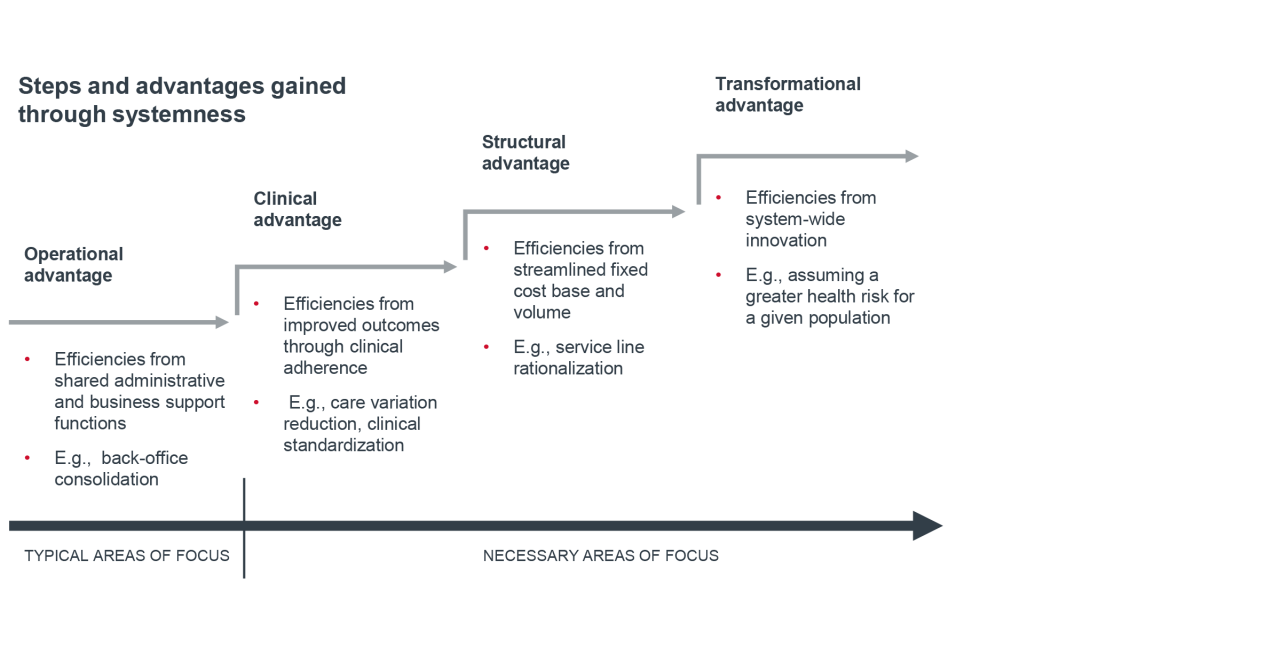
However, these benefits are not delivered by the transaction alone. They emerge as organizations progress from integration toward true systemness, using scale to create clinical, structural, and eventually transformational advantages across the enterprise.
The organizations that consistently outperform after M&A are the ones that recognize integration as an enterprise transformation effort, align technology and operations around a common operating model, build disciplined approaches to value realization, and embed the change management needed to make new initiatives stick.
Scale may create opportunity. Integration is what turns that opportunity into value.
Krista Bragg
Senior director, Optum Advisory


Posted on September 15, 2026

Don't miss out on the latest Advisory Board insights
Create your free account to access 1 resource, including the latest research and webinars.
Want access without creating an account?
You have 1 free members-only resource remaining this month.
1 free members-only resources remaining
1 free members-only resources remaining
You've reached your limit of free insights
Become a member to access all of Advisory Board's resources, events, and experts
Never miss out on the latest innovative health care content tailored to you.
Benefits include:
Unlimited access to research and resources
Member-only access to events and trainings
Expert-led consultation and facilitation
The latest content delivered to your inbox
You've reached your limit of free insights
Become a member to access all of Advisory Board's resources, events, and experts
Never miss out on the latest innovative health care content tailored to you.
Benefits include:
Unlimited access to research and resources
Member-only access to events and trainings
Expert-led consultation and facilitation
The latest content delivered to your inbox
This content is available through your Curated Research partnership with Advisory Board. Click on ‘view this resource’ to read the full piece
Email ask@advisory.com to learn more
Click on ‘Become a Member’ to learn about the benefits of a Full-Access partnership with Advisory Board
Never miss out on the latest innovative health care content tailored to you.
Benefits Include:
Unlimited access to research and resources
Member-only access to events and trainings
Expert-led consultation and facilitation
The latest content delivered to your inbox
This is for members only. Learn more.
Click on ‘Become a Member’ to learn about the benefits of a Full-Access partnership with Advisory Board
Never miss out on the latest innovative health care content tailored to you.
Benefits Include:
Unlimited access to research and resources
Member-only access to events and trainings
Expert-led consultation and facilitation
The latest content delivered to your inbox
