Auto logout in seconds.
Continue Logout

Access to cancer care remains inequitable due to systemic barriers and internal health system barriers. Health systems should consider which approaches will be most relevant to their local context. MedStar Health, in collaboration with its academic health system partner Georgetown University, is exploring two approaches to potentially help cancer patients overcome nonclinical obstacles and possibly improve appropriate access to specialty care.
Introduction and context
Why health equity strategies?
Health equity has been a concern for cancer care leaders, but tackling health equity in today's environment can be a challenging task from navigating funding constraints, to operational pressures, to solving for persistent disparities in access and outcomes. Inequities in cancer care are rarely driven by a single factor; rather, they emerge from a complex interplay of system design, local context, patient engagement, and resource availability.1 These realities underscore the need for open dialogue among health system leaders about what equity looks like in practice and how it can be advanced within diverse organizational environments.
Advisory Board and Pfizer hosted a roundtable discussion among cancer care providers to share health equity strategies. Providers highlighted that principles such as improving access, leveraging local data, strengthening care coordination, empowering patients, and collaborating across systems all play a role — but not every approach will be equally relevant or feasible for every organization. Health systems must determine which strategies align best with their patient populations, infrastructure, and local barriers to care, and how to adapt those principles in ways that are sustainable for their specific context.
How to use this emerging idea
To support health systems in finding the health equity approaches that work best for them, this piece presents two “emerging ideas” — distinct, real-world examples that illustrate how a health system is operationalizing health equity principles. These examples reflect work-in-progress that is being tested and refined as evidence is collected.
Rather than prescribing a universal approach, these examples are intended to help health system leaders understand what another organization has done, what challenges it sought to address, and how practical strategies can be applied or adapted elsewhere. Together, they are designed to spark discussion, reflection, and idea-sharing among peers committed to advancing equity in cancer care.
The idea
Health systems should consider which health equity strategies best fit their patient populations, infrastructure, and local context. For MedStar Health and their academic health system partner, Georgetown University, they identified two factors that were making care less equitable: patients’ non-clinical barriers to receiving care, and specialist referral pathways that may be contributing to less equitable care. As a result, they designed and are piloting interventions that may reduce inequities and improve outcomes.
Why now?
The American Cancer Society reports that people of color, those with lower income, and those living in rural areas have not seen the same advances in cancer prevention, early detection, and treatment.1 Social drivers — such as income, education, and insurance status — continue to shape who may benefit most from treatments.1
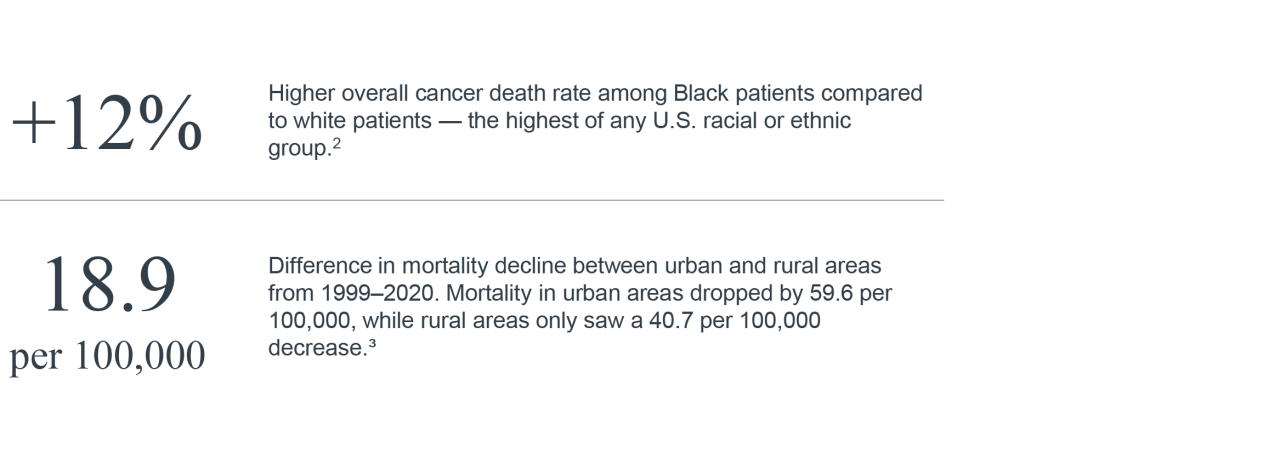
As novel therapies in precision medicine expand, these innovations may widen the gap in outcomes unless deliberate efforts are made to ensure equitable access across all populations.

* See endnote 4.

* See endnote 5.
Emerging idea 1: Removing non-clinical barriers
Cancer Legal Assistance & Wellbeing (LAW) project
The Cancer LAW project is an initiative between Georgetown University’s Health Justice Alliance and MedStar Georgetown Cancer Institute that removes civil legal barriers to oncology care, such as housing instability, employment discrimination, and benefits access. After a medical provider or patient support services team member spots a potential legal issue that the patient is facing, the patient is offered support. If the patient accepts, lawyers at the Cancer LAW project step in to assist patients in resolving relevant barriers to care.
Removing civil legal barriers to cancer care
The Cancer LAW project is a medical-legal partnership that helps patients resolve civil legal issues that may interfere with their continuum of care. Civil legal issues refer to unmet legal needs — such as those related to housing, employment, benefits, or insurance — that contribute to instability and can interfere with patients’ ability to adhere to medical care. These needs may be addressed through legal support.
Recognizing unmet civil legal needs among patients, the Cancer LAW project was added to support patient navigators and social workers by providing legal expertise to help patients address needs such as maintaining employment through treatment, sustaining housing stability, resolving poor housing conditions, accessing healthcare and government benefits, and providing advance healthcare planning. Resolving these legal barriers is one strategy that may help patients’ attend appointments and improve adherence to treatment plans.
Lawyers at the Cancer LAW project educate providers and the patient support services team to spot and refer legal issues during appointments. Patients may not mention the civil legal issues they are facing, because they are unaware that resources are available through the health system. On the flip side, medical and patient support services staff may not feel confident to ask patients about their barriers to care — especially if they do not feel they have any resources to offer the patient. Cancer LAW's no-cost legal services and close collaboration with patients' providers aim to address these challenges.
Once referred, interested patients meet directly with Cancer LAW lawyers to assess additional legal needs and help address identified issues. A close collaboration between clinical and legal staff — with legal staff co-located on-site — is designed to lead to seamless referrals and an easier patient experience.
The program was initially funded as a three-year pilot. The three-year pilot provided enough time to implement, gather data, and demonstrate the success of the program. Success has since drawn ongoing institutional funding and external support from sources like the Ralph Lauren Center for Cancer Prevention at Georgetown Lombardi Comprehensive Cancer Center, the DC Bar Foundation, Equal Justice Works Fellowships, and other donors. As a part of Georgetown University, Cancer LAW is able to increase its impact through student and university resources dedicated to its education, service, and research missions.
Results
88
Patients served in Q2 (April-June) 2025 by Cancer LAW
75%
Of Cancer LAW project patients reported that legal services helped them adhere to their treatment regimen*
*See endnote 6.
"The complexity of healthcare in today’s world requires extended care team members to work together in a coordinated, collaborative approach to meet the patient’s goals. Patients are already accustomed to having a team of specialists — adding a lawyer to the mix is one more tool to help patients achieve their goals."
Allison Dowling, JD, MLP Director of Cancer LAW Project
MedStar Washington Hospital Center’s Cancer Institute
Emerging idea 2: Connecting to specialist care
MedStar Health’s connection to specialty care
MedStar Health is piloting a virtual consultation service by staffing an on-call specialist in some specialties. This allows generalists to call a specialist for real-time consultations when faced with issues outside the generalist scope. MedStar Health is also exploring a digital health partnership with 1104Health, a platform for shared care where patients and their generalist can access subspecialists and trials.
Innovative solutions to connect patients to specialty care
Access to specialist care requires more than removing initial barriers — it also means ensuring that all patients within a health system receive timely and appropriate specialist input.
Generalists can manage many aspects of care but often encounter cases that warrant specialist support. For example, a specialist may be able to assist a generalist in interpreting an unusual test result or managing new treatment protocols in line with the best available evidence. Equity challenges — such as insurance coverage, geography, and health literacy — can impact whether that specialist connection happens.
To help close the gaps, MedStar Health is piloting two new approaches with the aim of more equitable access. First, they are running a pilot where a specialist is on-call, the results of which may be replicated within other therapeutic areas. Second, they are exploring a partnership with digital health company,1104Health, which would help generalists connect with subspecialists and clinical trials more easily.
Across both approaches, the key elements to specialist access that MedStar Health is prioritizing are:
- Protected time for specialists to help create equitable access. Where specialist input is needed for patient care, it must be a planned part of their role rather than something that specialists do in the edges of their time. In the on-call specialist pilot, the hospital system is financially supporting the pilot as an investment in quality care, since the consult system is not reimbursable by insurance. In the digital health partnership they are exploring, the digital health company provides a physician-facing collaboration platform and network that enables oncologists to co-manage patients, connect with disease experts and clinical investigators, and identify relevant clinical trials. In this model, the specialist time is paid for by the digital health company as part of its delivery model.
- A formal mechanism for getting specialist input that all generalists in the system can access. In the status quo, many doctors rely on their informal networks to be able to consult with a specialist. This may create inequities as only the patients of well-connected providers can access the best care. A formal mechanism — either a designated on-call system or a digital collaboration tool — helps ensure that all patients are being cared for with the same access to specialist expertise.
Market segment considerations
Academic medical centers
Academic medical centers can offer specialty expertise and advance on-site treatments. Yet ensuring patients reach the right specialist at the right time can be complex. These centers should consider evaluating referral pathways and coordination for complex cases as ways to prevent delays in care.
With broader resources — such as social work, legal aid, financial counseling, and patient navigation programs — academic medical centers are well positioned to address multiple patient needs. However, their diverse and often geographically dispersed populations make transportation and continuity of care critical equity concerns.
Community medical centers
Community medical centers may have closer ties to their community and deeper understanding of local needs. However, community medical centers may have fewer resources, so they should consider prioritizing high-impact, feasible interventions and look for partnerships to expand support services.
Because not all specialty care can be completed within a community medical center setting, community medical centers should consider creating a strategy to identify patients who need specialty care and make timely referrals to ensure specialist access where appropriate.
Should you pursue this idea?
The first step is understanding your health system’s equity challenges to identify the best opportunities for action. If your data indicates that there may be inequitable outcomes among patient populations at your health system, consider your local context and resources to identify where your health system has the greatest opportunity for action.
For MedStar Health, piloting both the Cancer LAW project and exploring approaches to improving specialist access has so far yielded promising results. MedStar Health has two hospitals in DC, one of which has a patient population who are more likely to be black, have 3 or more comorbidities, and who do not have private insurance. Based on national equity datasets, we would expect these demographic differences to result in disparate outcomes between the two hospitals — unless equity-focused interventions are in place. However, potentially because of MedStar Health’s equity work, current analyses show no significant difference across the two hospitals for colorectal cancer treatment by race/ethnicity, or by insurance status. Care delivery metrics in the analysis included molecular tumor testing, median time to treatment initiation, and short-term survival.7 While the analysis did not include a comparison to data before the equity-interventions were in place, this suggests that the approaches MedStar Health is pursuing may be effective in creating greater equity in cancer care. Study is underway to further investigate this hypothesis.
1 Islami F, et al. American Cancer Society's report on the status of cancer disparities in the United States, 2023. CA Cancer J Clin. March 2022.
2 Greenberg PD, et al. AACR Cancer Progress Report 2023. September 10, 2023.
3 Sokale IO et al. Disparities in cancer mortality patterns: A comprehensive examination of U.S. rural and urban adults, 1999-2020. Cancer Med. September 2023.
4 Tian, J., et al. Association of insurance status among cancer patients and survival outcomes: a systematic review and meta-analysis. Int J Equity Health. October 10, 2025.
5 Hage et al.Trends and Disparities in Next-Generation Sequencing in Metastatic Prostate and Urothelial Cancers. JAMA Netw Open. July 1, 2024.
6 Dowling AB, et. al. Legal issues and outcomes of a medical-legal partnership for cancer patients J Health Care Poor Underserved. 2025.
7 Marshall J et. al. Colorectal cancer care disparities in an urban diverse population: A tale of two hospitals in the nation’s capital. J Clin Oncol. 2025.
At Pfizer, we’re in relentless pursuit of breakthroughs that change patients’ lives. We innovate every day to make the world a healthier place. Our unique resources allow us to do more for people. Using our global presence and scale, we’re able to make a difference in local communities and the world around us. Pfizer supports the global healthcare community’s independent quality improvement initiatives to improve patient outcomes in areas of unmet medical need that are aligned with Pfizer’s medical and/or scientific strategies. For more information, please visit www.pfizer.com.
This report is sponsored by Pfizer, an Advisory Board member organization. Representatives of Pfizer helped select the topics and issues addressed. Advisory Board experts wrote the report, maintained final editorial approval, and conducted the underlying research independently and objectively. Advisory Board does not endorse any company, organization, product, or brand mentioned herein.
To learn more, view our editorial guidelines.
This report is sponsored by Pfizer. Advisory Board experts conducted the underlying research independently and objectively.


Don't miss out on the latest Advisory Board insights
Create your free account to access 1 resource, including the latest research and webinars.
Want access without creating an account?
You have 1 free members-only resource remaining this month.
1 free members-only resources remaining
1 free members-only resources remaining
You've reached your limit of free insights
Become a member to access all of Advisory Board's resources, events, and experts
Never miss out on the latest innovative health care content tailored to you.
Benefits include:
Unlimited access to research and resources
Member-only access to events and trainings
Expert-led consultation and facilitation
The latest content delivered to your inbox
You've reached your limit of free insights
Become a member to access all of Advisory Board's resources, events, and experts
Never miss out on the latest innovative health care content tailored to you.
Benefits include:
Unlimited access to research and resources
Member-only access to events and trainings
Expert-led consultation and facilitation
The latest content delivered to your inbox
This content is available through your Curated Research partnership with Advisory Board. Click on ‘view this resource’ to read the full piece
Email ask@advisory.com to learn more
Click on ‘Become a Member’ to learn about the benefits of a Full-Access partnership with Advisory Board
Never miss out on the latest innovative health care content tailored to you.
Benefits Include:
Unlimited access to research and resources
Member-only access to events and trainings
Expert-led consultation and facilitation
The latest content delivered to your inbox
This is for members only. Learn more.
Click on ‘Become a Member’ to learn about the benefits of a Full-Access partnership with Advisory Board
Never miss out on the latest innovative health care content tailored to you.
Benefits Include:
Unlimited access to research and resources
Member-only access to events and trainings
Expert-led consultation and facilitation
The latest content delivered to your inbox
