Auto logout in seconds.
Continue Logout
Covid-19 illuminated the fact that the current way we are asking our health care leaders to operate is not sustainable. While they have demonstrated tremendous resilience in response to the pandemic, many are experiencing burnout or leaving health care altogether. Moreover, leaders must continue to operate in an increasingly uncertain and volatile environment well beyond the end of the pandemic. This reality requires adaptive leaders who practice and model self-awareness and vulnerability, prioritize taking time away to restore themselves, and take risks to lead their teams through uncertainty.
Read on for three strategies executives should take to foster an environment that supports and reinforces these leadership behaviors.
Covid-19 placed an extraordinary level of stress on the health care workforce. Since the beginning of the pandemic, organizations were rightly concerned about the well-being of their staff amid unprecedented trauma.

Managers and directors bore an additional burden, charged with supporting their team’s resilience as well as their own. For example, leaders were expected to stay calm under pressure, strive for and inspire high performance, and prioritize their team at all times. These leadership behaviors help leaders protect their team but ultimately put them at risk for burnout.
As the pandemic wore on and leaders became increasingly overwhelmed, we saw a renewed focus on leadership resilience and how to cultivate it. Many organizations looked to additional training to bolster leaders’ personal resilience, such as workshops, leadership retreats, mindfulness training, and individual coaching sessions.
Individual interventions, such as training and coaching sessions, can be effective in cultivating resilient leaders. However, these interventions primarily treat the symptom of burnout. That is, they help leaders bounce back from stressful situations without addressing the underlying systems that contribute to burnout. This places the onus on the individual leader to become more resilient in the face of adversity. Instead, these individual interventions must be paired with an organizational approach that addresses the environment that leaders are operating within.
The upward trend in burnout certainly didn’t start with Covid-19. Rather, the pandemic amplified the conditions of a system that was already untenable and unsustainable for leaders. Thus, the ambition at hand is greater than helping leaders recover from the stress and trauma of Covid-19. Now is the time for executive teams to critically examine the aspects of our current culture that continue to undermine leaders’ resilience and ability to adapt. Through research interviews with health care leaders from around the world, we identified three elements of organizational culture that exacerbated leader burnout during the pandemic. These elements are summarized in the table below.

The ultimate pitfall with the way we look at well-being is that we only consider the need to boost resilience and not the need to fix the system. What we end up signaling to staff is that we’re trying to boost your resilience so that we can continue to treat you badly.
HR Director
The reality is that leaders will need to continue operating in an increasingly uncertain and volatile environment well beyond the end of the pandemic. This will require adaptive leaders who practice and model self-awareness and vulnerability, prioritize taking time away to restore themselves, and take risks to lead their teams through uncertainty. This report details three organizational strategies to cultivate an environment that supports and reinforces these leadership behaviors.
If organizations fail to address these environmental factors, we risk further disengaging or burning out our leaders, and/or losing them to other organizations and industries. This will undoubtedly have ripple effects across the entire workforce, as we can’t expect disengaged or burned out leaders to effectively support their teams.
To cultivate an environment that supports and reinforces these aspirational leadership behaviors, executives should pursue three strategies listed below. Within each strategy, we offer examples of organizations that are making progress in these areas.
Organizations often put staff resilience, well-being, and engagement before that of leaders, both in and outside of moments of crisis. For example, most engagement and retention action plans focus on support for frontline staff, leaving leaders out. Many leaders believe that they must put on a “brave” face in front of their teams and colleagues, as showing vulnerability is sign of weakness that undermines their very identity as a leader. However, suppressing emotions is not good for a person’s health, and organizations can’t expect disengaged or burned out leaders to effectively engage their teams.
A powerful way to improve emotional well-being is for a person to develop self-awareness by naming the emotions they are experiencing and asking for help when needed. These behaviors are core tenets of emotional intelligence, which offers many benefits to individuals and teams.
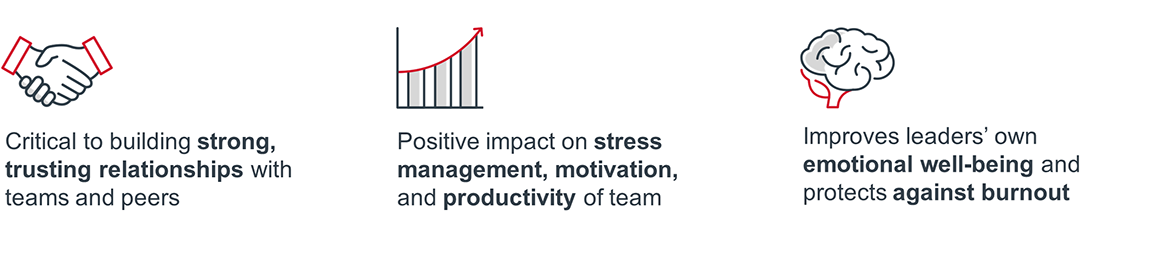
To cultivate resilient, adaptive leaders, organizations must normalize and encourage leaders to put on their own oxygen mask first. This shift runs counterintuitive to some deeply held beliefs about what leadership entails; thus, it’s unrealistic to rely on leaders to alter their own behavior. Rather, organizations must take steps to signal the criticality of emotional well-being, shifting it from a private, personal endeavor to one that is integrated into the day-to-day work and interactions between leaders. Below are some starting considerations from organizations that are doing this well.
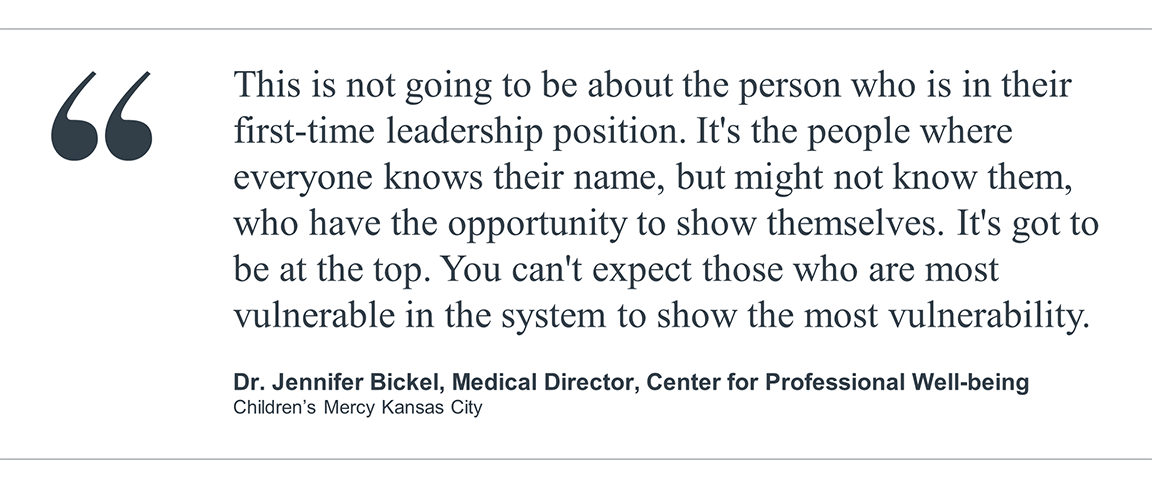
- This work begins with executive role modeling. Executives have an outsized impact when it comes to normalizing behaviors that contribute to mental and emotional well-being. For example, Children’s Mercy Kansas City features quotes from senior leaders on their internal webpage describing what they are doing to care for their personal well-being. This visibility gives leaders and staff permission to take steps to prioritize their own well-being.
- Hold space for leaders to connect with their peers. Leadership meetings often focus on operational challenges and updates, leaving little to no space for leaders to discuss the adaptive challenges they are navigating and the impact it has on their well-being. To address this gap, Parkview Health shifted the focus of their weekly nurse leadership meeting during Covid-19 to give leaders a space to process their emotions with a trusted group of peers. Instead of focusing on operational updates, they repurposed the hour to give leaders an opportunity to connect with one another on their current stressors, both work and non-work related.
- Assess emotional intelligence as a core leadership competency. This promotes a focus on developing one’s emotional intelligence and signals the importance of this competency to a leader’s ability to care for themselves and their teams. For example, WellSpan Health assesses leader’s emotional intelligence during hiring, onboarding, and promotion decisions to ensure they have leaders who are equipped to lead their teams. They also encourage leaders to discuss the results of these assessments during team building meetings and individual check-ins.
Rest and recovery are powerful ways to deal with stress. Even a 10-15-minute break carries restorative benefits. However, today’s health care environment offers little space for leaders to fully disconnect and recharge. Moreover, many of the leadership roles we’ve designed require leaders to operate at maximum capacity even under non-crisis times.
If we expect leaders to lead with creativity and compassion, organizations must intentionally carve out time for them to step away from day-to-day operations and regain perspective. This work must begin with an executive commitment to free up leaders’ capacity so they have time and space for strategic thinking and recovery. For best practices on rescoping the leader role to increase capacity, see practices 1-4 in our report Drive Organizational Change—Without Overloading Managers.
This strategy requires executives to take a hard look at leader workload and capacity, which may have cost implications for the organization and be next to impossible during crisis times. To begin, executives should reflect on:
- What did we take off leaders’ plates amid Covid-19 that we can leave off?
- What can we automate or make more efficient to allow leaders to focus more of their time on strategic thinking (as opposed to day-to-day operations)?
- How can we be more judicious in terms of what we are asking of our leaders each week (such as holding fewer meetings or shortening them)?
Progressive organizations protect time for leaders away from day-to-day operations, both during and outside of the workday. Note that the success of both strategies depend on the level of executive buy-in and role modeling.
- Dedicated space during the workday for strategic thinking. If we want leaders to have time for non-operational responsibilities, then executives must schedule and champion protected time during regular working hours for leaders to dedicate to strategic thinking. This can be as simple as giving leaders permission to decline meetings on their calendar that aren’t mission critical, to implementing dedicated blocks of time for leaders to step away from their operational work. For example, Texas Health Presbyterian Hospital Dallas implemented monthly “reflection days” for nursing leaders to take dedicated time away from work to devote to leadership activities, such as strategic planning, peer networking, and professional development. During these reflection days, units are covered by supervisors, peer nurse managers, or directors to ensure leaders’ time is protected.
- Protected time away from work to recharge. Given the 24/7 demands of health care, this ambition requires advanced planning—looking ahead on a quarterly basis, finding the time to take away, and appointing a second in command (or multiple) who are familiar with the leader’s responsibilities. Alternative work arrangements, such as flexible scheduling and remote work, offer additional ways to give leaders time to recharge away from work.
Covid-19 presented natural opportunities for creativity and innovation. In response to dire resource constraints, leaders rallied their teams around a shared purpose to create innovative ways of delivering care. Now is the time to take stock of this shift in organizational attitudes toward risk and uncertainty, and to assess what elements we can intentionally carry forward beyond crisis times. This will become increasingly important, given that today’s health care challenges demand leaders who can lead through tractable problems while simultaneously navigating intractable problems involving risk and uncertainty.
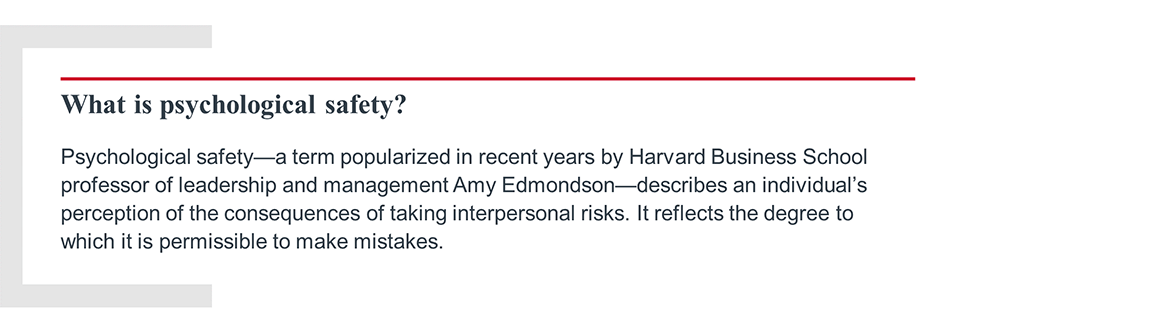
To help leaders navigate these challenges, organizations must foster a psychologically safe work environment—an environment characterized by a shared belief that the team is safe for interpersonal risk taking. In a psychologically safe environment, leaders feel comfortable voicing their opinions and taking risks. This enables leaders to truly lead—to make decisions, prioritize resources, and take calculated risk in service to system goals.
Progressive organizations are taking steps to foster a psychologically safe environment that encourages leaders to truly lead instead of waiting on commands from above.
- Orient toward purpose. Executives must clearly articulate the why behind what they ask of leaders. This enables leaders to make decisions independently, assess what’s working and what’s not working, and recalibrate accordingly.
- Create opportunities for innovation. Executives must communicate when they need leaders to follow the prescribed way of doing things versus when there is space for innovating. When the latter is true, consider shifting how we convene leaders to encourage open conversation and joint problem solving as opposed to top-down updates. For best practices on involving leaders in the decision-making process, see Practice 5 in our report, "Drive Organizational Change—Without Overloading Managers." In particular, create opportunities to actively encourage innovation among emerging leaders. To learn how one organization encouraged innovation among emerging leaders, see our case study on Western Health's 'Shark Tank'.
- Discuss failure openly and regularly. Reserve time for leaders to reflect on lessons learned and normalize talking about failures. For example, make it routine to conduct a post-mortem reflection as a leadership team following the launch of new project or process. In addition, hold executives accountable to sharing stories of “failing forward” with the organization at large during Town Halls or leadership meetings. AdventHealth even built case studies of leadership and organizational failures to teach in their leadership development program.
- Update performance management systems to incentivize risk-taking. Assess whether your current performance criteria rewards experimentation or whether it encourages leaders to play it safe. To further improve transparency and incentivize innovation, update annual goal systems to focus on quarterly or even monthly progress.
Changing leadership norms and behaviors will take more than just tactics and strategies. These strategies must be paired with ongoing conversations between the entire executive team that address the environment that leaders are operating within. To get the conversation started, we’ve provided several discussion prompts below to bring back to your executive team.
The good news is that these aspirational leadership norms and behaviors most likely already exist in areas of your organization. Start by reflecting on the aspirational leadership norms and behaviors presented in the table above.
- Where have you seen these aspirational norms and behaviors in practice?
- What impact did it have?
Then, reflect on how your organization can start moving toward these aspirational leadership norms and behaviors. Consider:
- If these aspirational behaviors were to become the norm, what then would be possible in our organization?
- What is hardest about moving toward these aspirations?
- What is the next right thing for you to do to help your organization move toward these aspirations?

Don't miss out on the latest Advisory Board insights
Create your free account to access 1 resource, including the latest research and webinars.
Want access without creating an account?
You have 1 free members-only resource remaining this month.
1 free members-only resources remaining
1 free members-only resources remaining
You've reached your limit of free insights
Become a member to access all of Advisory Board's resources, events, and experts
Never miss out on the latest innovative health care content tailored to you.
Benefits include:
Unlimited access to research and resources
Member-only access to events and trainings
Expert-led consultation and facilitation
The latest content delivered to your inbox
You've reached your limit of free insights
Become a member to access all of Advisory Board's resources, events, and experts
Never miss out on the latest innovative health care content tailored to you.
Benefits include:
Unlimited access to research and resources
Member-only access to events and trainings
Expert-led consultation and facilitation
The latest content delivered to your inbox
This content is available through your Curated Research partnership with Advisory Board. Click on ‘view this resource’ to read the full piece
Email ask@advisory.com to learn more
Click on ‘Become a Member’ to learn about the benefits of a Full-Access partnership with Advisory Board
Never miss out on the latest innovative health care content tailored to you.
Benefits Include:
Unlimited access to research and resources
Member-only access to events and trainings
Expert-led consultation and facilitation
The latest content delivered to your inbox
This is for members only. Learn more.
Click on ‘Become a Member’ to learn about the benefits of a Full-Access partnership with Advisory Board
Never miss out on the latest innovative health care content tailored to you.
Benefits Include:
Unlimited access to research and resources
Member-only access to events and trainings
Expert-led consultation and facilitation
The latest content delivered to your inbox